Table of Contents
"Personalized" Should Mean More Than a Name on a Mug
Most personalized gifts swap one text field. Here's what it looks like when the artwork, the song, the video, and the electronics are all made for one person.
Somebody who loves you once handed you a box with a “custom” gift inside. Maybe it was a mug with your name laser-etched in a typeface that had clearly never met the rest of the design. Maybe it was a cutting board, or a tumbler, or a canvas print with a text box floating slightly off-center over the artwork. You said thank you, and you meant it, because the person matters more than the object. But some quiet part of you clocked the truth: this is template #4,081, and your name is one of several thousand strings that have passed through that text field this year.
Nobody in that story did anything wrong. The giver genuinely tried. The company genuinely printed the name. The problem is the word doing all the heavy lifting on the product page. Somewhere along the way, the gift industry decided “personalized” means “we left one field editable.” We think it should mean something closer to “we made this for one person, and we can prove it.”
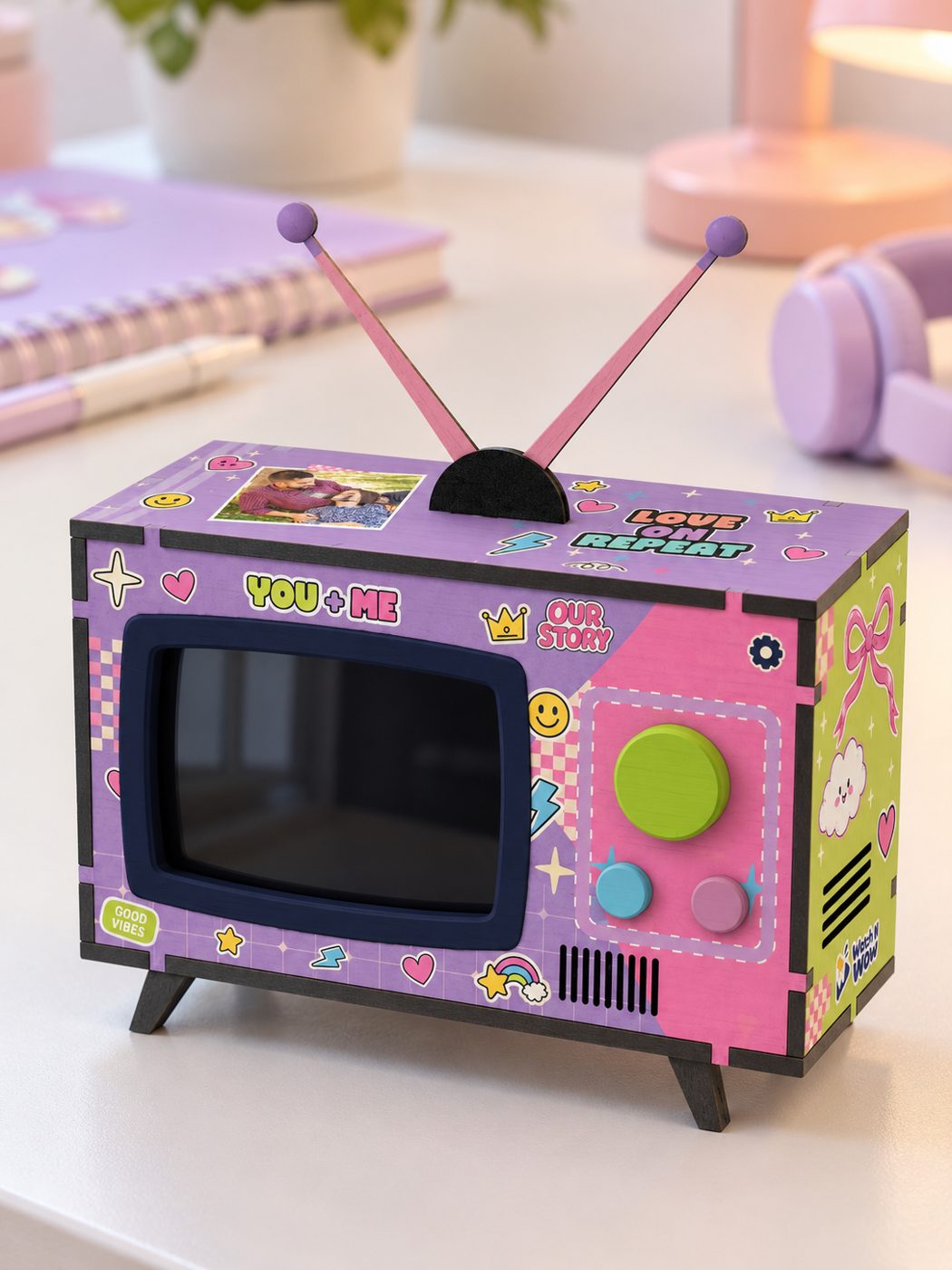
We’re Watch N Wow, a small Texas company that builds the Mini Memory TV, a little handcrafted retro television with a real screen inside. It’s five inches wide, 2.9 inches tall (5.8 if you count the antenna and legs), and 1.9 inches deep, and every single one leaves our bench different from every other one we’ve made. That last part is the point of this article. We want to walk through what personalization usually means, why people can feel the difference, and what it looks like when you commit to it at every stage of the build instead of just one.
The Name-on-a-Mug Standard
Here’s how most “personalized” gifts actually get made. A factory produces the object by the thousands: identical mugs, identical frames, identical blankets. The objects sit in a warehouse, finished in every way except one. When an order comes in, a machine applies your text string (a name, a date, maybe “World’s Best Dad”) to the blank spot reserved for it, and the object ships.
That’s it. That’s the whole personalization.
Notice what never happened. Nothing about the object’s shape, artwork, or function changed based on who it was for. The font wasn’t chosen to match the design, because the text isn’t part of the design; it’s a layer applied on top, which is why it so often looks like a sticker. No human involved in making it knows a single thing about the recipient. And the object existed, complete, before anyone knew your name. The company just finished it late on purpose.
To be fair to the mug people, a mug with your name on it is a perfectly nice thing. Our quarrel isn’t with mugs. It’s with the vocabulary. When the same word covers “we swapped one text string” and “we built this whole thing around your specific story,” the word stops carrying any information at all. So here’s a cleaner test. If a company could manufacture the gift completely before knowing anything about the person receiving it, what you’re buying is a late-stage customization. Personalization, the real kind, has to start earlier than that.
People Can Feel the Difference, and the Numbers Back It Up
You might suspect this is just us being precious about craft. The research says otherwise.
Back in 2018, Epsilon surveyed consumers and found that 80% said they’re more likely to do business with a company that offers personalized experiences.1 Three years later, McKinsey & Company’s “Next in Personalization” report found that 71% of consumers now expect companies to deliver personalized interactions, and 76% get frustrated when that doesn’t happen.2
Read those two findings together and you can watch personalization move from a delight to a baseline. In 2018 it made people like a company more; by 2021, its absence actively annoyed them. And that’s just for shopping. If a streaming app that doesn’t know your tastes feels lazy, think about what that same instinct does to a gift, an object whose entire premise is “I thought about you, specifically.”
When an app remembering your shoe size is the baseline, a gift that ignores everything about its recipient has a much higher bar to clear than it used to.
Generic didn’t get worse. Expectations got better. The name-on-a-mug standard was set in an era when printing a name at all felt like magic. It doesn’t anymore.
What Personalization Looks Like as a Pipeline
So what does the deeper version look like in practice? We can only speak for our own workshop, so we’ll use the Mini Memory TV as the worked example and go stage by stage. Each stage is a place where most products stop, and where we decided not to.
The story: their moments, your arrangement
Everything starts with the video that will play on the TV’s screen. You bring the raw material: their photos, their clips, the blurry birthday footage, the good vacation shots. You arrange them yourself, in the order you want the story told, and you control the timing moment by moment, so the photo that deserves four seconds gets four seconds and the joke clip gets exactly the beat it needs. No stock footage, no filler. The film is theirs before the object even enters the picture.
The words: your message, in the design’s own type
The TV’s cabinet artwork comes in 17 designs, and this is where we get particular. Each design has its own matching typefaces, and the text areas on the artwork use them. Your message doesn’t float over the design in Generic Sans; it’s set in the type that design was built with, in the spot the design reserved for it. The artwork isn’t a front-panel sticker, either. It carries across the front, the back, both sides, and the top, so the TV looks finished from every angle it’ll ever be seen on a shelf.
And you don’t have to take that on faith. As you type, a live preview shows your words exactly where they’ll print, and you can spin the whole TV around in a rotatable 3D preview to check the back and sides before you approve anything. What you see on the screen is what comes off the printer. If a line runs long for its slot, you find out while you’re typing it, not when you open the box.
The song: lyrics with their name in them
Every Mini Memory TV’s video can carry a custom song, composed from your answers about the person: their name, the shared details, the inside references only your family would catch. You pick the language, English or Spanish, and a style that actually fits them rather than whatever backing track was cheapest. Then comes the part we’re proudest of: the lyrics are editable, line by line. If the second verse almost lands but you’d never in a million years call your grandmother “my darling,” you change the line. It’s your song. We just help you write it.
The electronics: loaded and tested for one person
This is the stage that surprises people the most. The screen inside each TV is real, and the electronics in each unit are individually loaded with that one customer’s finished video before the TV ships. Then we power it on and watch it play, on that unit, start to finish. Not a sample reel. Not a test pattern. Their video, on their screen.
There is no shelf of finished TVs waiting for a name. Every unit that leaves here already contains the one video it was built to play.
We can’t personalize any later than that. The last thing that happens to a Mini Memory TV before it ships is that it does its job once, for us, so we know it’ll do its job for them.
The afterlife: the gift keeps working after the party
A gift’s worst enemy is the day after the party. So the finished video isn’t locked inside the TV. It’s downloadable, and it comes with a QR share page, which means the guest of honor can send the film to the cousins who couldn’t make it, and the aunt who shot the original clips can watch what they became. The physical TV sits on the shelf; the film travels. Both halves keep working long after the wrapping paper’s gone.
Why the Deep Version Actually Lands
There’s real psychology behind why this pipeline matters, and it’s worth being honest about, because it corrects a mistake almost every gift-giver makes. Us included.
Yang and Urminsky, in a 2018 paper in Psychological Science, found that givers tend to over-optimize for the moment of exchange. We chase the big reaction, the gasp when the paper comes off. Recipients, it turns out, care more about how much value the gift delivers over time.3 The flashy gift wins the unwrapping and then loses the year. A deeply personal object is the rare gift that doesn’t force that tradeoff: a tiny TV playing your kid’s face on a real screen gets the gasp, and the same object is still playing that story on the shelf in March.
Then there’s the question of why the object should exist at all, when you could just text someone a video. Atasoy and Morewedge, writing in the Journal of Consumer Research in 2018, found that people value physical goods more than identical digital ones, because we develop psychological ownership over things we can see, touch, and keep.4 The same film means more inside an object with weight, corners, and a permanent spot in the living room than it does as one more file in a cloud folder. That finding is more or less our founding premise. We just hadn’t read the paper yet when we built the first one.
A Test You Can Use on Anybody, Including Us
You don’t need to buy a tiny television to use any of this. The next time a product calls itself personalized, ask the mug question: could they have made this entire thing before they knew my person existed? If the answer is yes, you’re paying for an engraving pass. Sometimes that’s fine! Not every Tuesday calls for a bespoke object. But when the occasion actually matters, look for the gifts where your person’s story had to be present at every stage: in the film, in the words, in the music, in the hardware itself.
We hold ourselves to the same test. A Mini Memory TV can’t exist without its person. The video is theirs, the messages are yours, the song has their name in it, and the electronics were loaded and tested with their story before the box was sealed. It starts at $80 with shipping included, and we’ve worked hard to keep it there, because “made for one person” shouldn’t be a luxury category.
If someone in your life has a story worth five inches of screen, come start a design at watchnwow.com. Pick one of the 17 designs, type a message and watch it land in exactly the right spot, spin the 3D preview around, argue lovingly with the second verse of the song. We’ll build the rest around your person, and we’ll watch their video play once, on their TV, before we send it home.
Sources & research
-
Epsilon (2018). Consumer survey on personalization (industry report). 80% of consumers said they’re more likely to do business with a company that offers personalized experiences. ↩
-
McKinsey & Company (2021). “Next in Personalization” (industry report). 71% of consumers expect companies to deliver personalized interactions; 76% get frustrated when that doesn’t happen. ↩
-
Yang, A. X., & Urminsky, O. (2018). “The Smile-Seeking Hypothesis: How Immediate Affective Reactions Motivate and Reward Gift Giving.” Psychological Science. ↩
-
Atasoy, O., & Morewedge, C. K. (2018). “Digital Goods Are Valued Less Than Physical Goods.” Journal of Consumer Research. ↩