Table of Contents
How to Write a Recognition Message for a Multilingual Team
A multilingual employee appreciation message that lands: ask before translating, keep it specific, get a native-speaker review, give each language equal space.
The thank-you card for the warehouse team went out in English and Spanish. The English said, “You knocked it out of the park this quarter.” The Spanish, pasted from a translation app, said something about hitting a park. Two people laughed. One person, who had worked double shifts for a month, said nothing and left the card on the break-room table.
A multilingual employee appreciation message isn’t harder to write than a monolingual one. It just has more places to go wrong. This guide covers how to choose languages without assuming, how to write a message that survives translation, why a native-speaker review matters more than the tool you use, and how to give every language equal weight.
Key Takeaways
- Ask which language each person prefers for written recognition. Don’t infer it from a name, accent or background.
- Write the source message first in plain, specific sentences: what the person did and what changed. Idioms like “knocked it out of the park” rarely survive translation.
- Machine translation quality varies a lot by language. In one study of emergency-room instructions, Google Translate kept the meaning 94% of the time for Spanish but only 55% for Armenian (Taira et al., 2021).
- Have a fluent native speaker review every translated message before it goes out, and say thank you to them for it.
- Give each language equal size, order and placement. Research on corporate language policies shows non-native speakers can feel a loss of status even when they’re fluent (Neeley, 2013).
Why a translated thank-you can land worse than none
In the US, the Census Bureau’s 2018–2022 American Community Survey estimates found that 78.3% of people age 5 and older spoke only English at home. That leaves roughly one in five speaking another language at home, and among them Spanish was by far the most common, at 61.1%. In many workplaces, especially in logistics, healthcare, construction, hospitality and manufacturing, the share is higher.
Managers who want to recognize a mixed-language team usually run into the same questions. Should the message be in English only, so nobody feels singled out? Should it be translated for everyone? Who checks the translation? What about the person who speaks Tagalog when everyone else speaks Spanish or English?
The risk isn’t only a funny mistranslation. A recognition message is supposed to say “we see you.” When one language gets the careful version and another gets a rushed machine draft, the message says something else: we saw some of you more clearly. Gallup’s research on authentic recognition, based on more than 10,000 US workers, found that Hispanic men and women were among the groups reporting the lowest endorsement of recognition authenticity and the highest skepticism, and suggested improving authenticity may matter even more for them. Getting language right is one concrete way to do that.
What the research says about language, status and translation
Non-native speakers can feel a loss of status, regardless of fluency
Tsedal Neeley’s 2013 study in Organization Science followed a French high-tech company that adopted English as its common corporate language. Non-native English speakers experienced a loss of status regardless of their actual fluency, and those who rated their own fluency as medium were the most anxious. The study was qualitative and at a single company, so it can’t tell us how common the effect is. It does show something managers should hear: language at work isn’t neutral, and how you handle it signals who belongs at the center.
Machine translation is uneven across languages
Breena Taira and colleagues tested Google Translate on 20 common emergency-department discharge instructions, published in the Journal of General Internal Medicine in 2021. Native speakers rated the output. Overall, 82.5% of translations kept their meaning. But the range was wide: Spanish 94%, Tagalog 90%, Korean 82.5%, Chinese 81.7%, Farsi 67.5% and Armenian 55%. The authors concluded the tool was inconsistent between languages and should not be relied on alone for patient instructions.
A thank-you note isn’t a medical instruction, and translation tools keep changing. The lesson still holds: a tool that does well in one language may do poorly in another, and you can’t tell which from the output alone. A human who reads the language can.
People underestimate how much a sincere thank-you is worth
Amit Kumar and Nicholas Epley’s 2018 experiments in Psychological Science found that people who wrote gratitude letters underestimated how surprised and positive recipients would feel, and overestimated how awkward recipients would find it. That gap gets wider when you’re worried about language: managers sometimes skip the message entirely because they fear getting it wrong. The research suggests a sincere, specific message, even a simple one, is worth more than the writer expects.
Ways to handle language, compared
Here are the common approaches to recognition on a multilingual team and when each works.
| Approach | Works when | Risk | Effort |
|---|---|---|---|
| English only | Everyone prefers English for work messages | People who read English with effort get less from it | Low |
| Machine translation, no review | Never for recognition | Errors and wrong tone vary by language; can read as careless | Low |
| Machine draft + native-speaker review | You have a fluent reviewer for each language | Reviewer time; must thank and credit them | Medium |
| Written by a bilingual colleague or manager | A trusted bilingual person knows the recipient | Can overload the same bilingual staff every time | Medium |
| Professional translation | Formal awards, printed plaques, company-wide messages | Cost and lead time | Higher |
| Each person’s preferred language, individually | Personal notes and one-to-one recognition | Requires asking preferences in advance | Medium |
The pattern: the cheapest option (machine translation with no review) is also the one most likely to undercut the message. The best option for personal recognition is usually the last row: write to each person in the language they asked for, with a fluent check.
How to write it, step by step
Step 1: Ask about language preference; don’t assume
Add one question to your recognition preferences: “Is there a language you’d prefer for written recognition?” Leave it open text. Some people want their home language; some prefer English at work; some want both. Don’t infer from a surname. Our recognition preference survey includes this question. Common mistake: translating for someone who would have preferred English and now feels singled out.
Step 2: Write a plain, specific source message
Write the original in short sentences that name the action and the impact: “You trained four new pickers in two weeks. Our error rate on that line dropped, and the new team members told me they felt welcome.” Avoid idioms (“crushed it,” “went the extra mile”), sports metaphors and puns. Common mistake: writing a clever English line that has no equivalent in other languages.
Step 3: Choose the right level of formality
Many languages mark formality in ways English doesn’t. Spanish has tú and usted; Korean and Japanese have several levels; Tagalog has po and opo. A message from a senior leader to a long-tenured colleague may need a different register than one between peers. Ask your reviewer which fits. Common mistake: using a casual form with an older colleague who would expect a respectful one, or a stiff form that sounds cold.
Step 4: Translate, then get a native-speaker review
Use whatever draft method you like, then have a fluent native speaker read the result for meaning and tone, not only grammar. Ask them: “Does this sound like a real person saying thank you?” If you rely on bilingual colleagues, rotate the request, keep it short, and recognize their help, because translation is work. Common mistake: asking the one bilingual employee to translate everything, every time, unpaid and uncredited.
Step 5: Spell names exactly right
Accents, tildes and the order of family names matter. “Peña” is not “Pena,” and “Nguyễn Văn An” may prefer a particular order or a shortened form. Copy the spelling the person uses in their own signature. Common mistake: dropping accents because the keyboard makes it harder.
Step 6: Give each language equal space
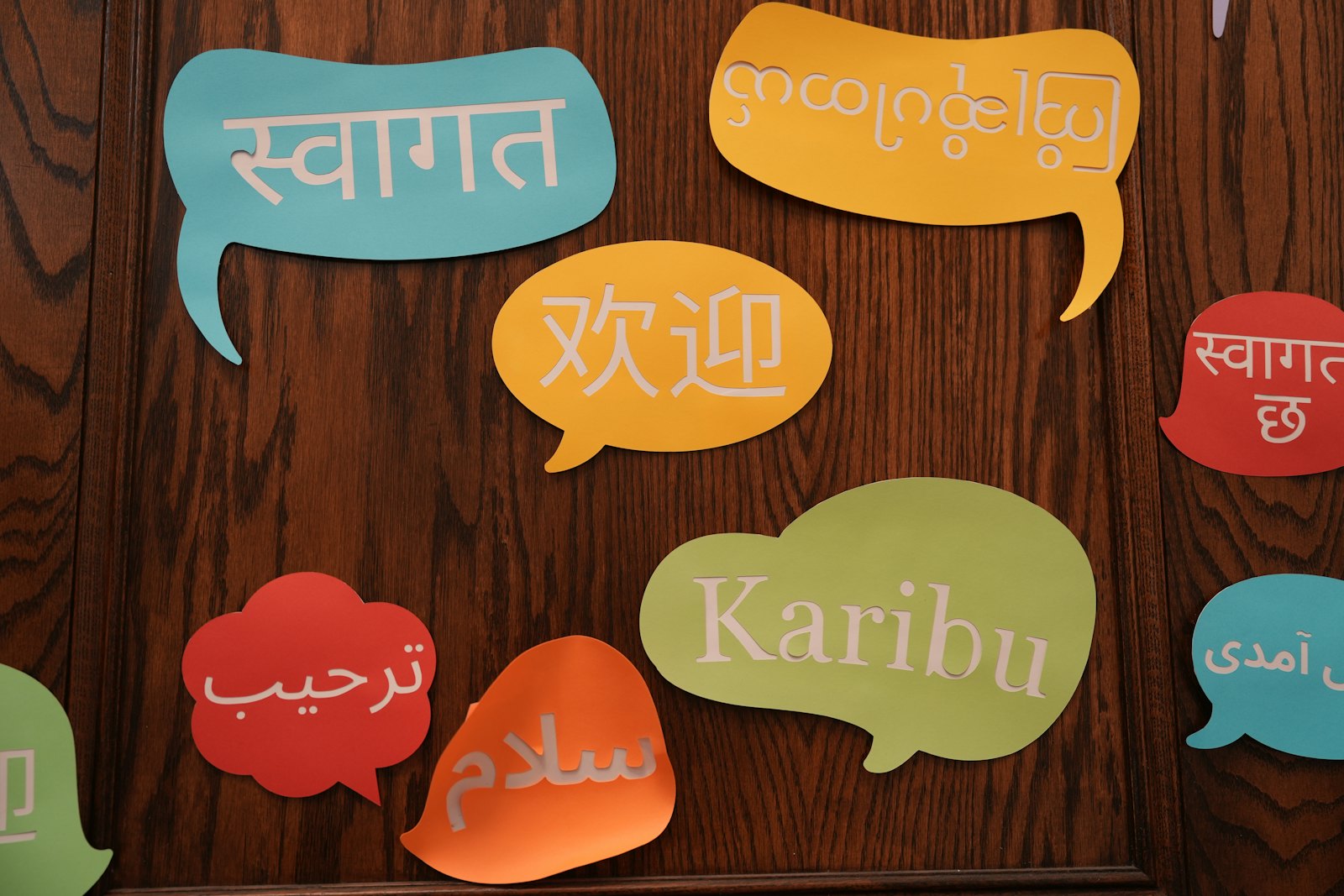
On a card, slide or printed keepsake, show each language at the same size, with the same care in layout. If space is tight, consider separate versions rather than shrinking one language. When reading aloud at an event, let a fluent speaker read the non-English version rather than having a non-speaker struggle through it. Common mistake: a large English headline with the translation in small italics underneath.
Step 7: Read it aloud before sending
Read each version aloud, or have the reviewer do it. Awkward phrasing shows up immediately when spoken. Common mistake: sending something nobody fluent has heard or read in full.
How to make it personal
If you have 10 minutes
Write the two-sentence source message for one person: what they did and what changed. Remove any idiom. That’s your base for every language.
If you have a weekend
Ask your team the language-preference question, find a reviewer for each language you’ll need, and thank each reviewer specifically. Draft your next round of recognition notes with them.
If you want it to last years
For anything printed or kept, such as a card, a plaque or a keepsake with photos, budget time for a careful review. A mistake in a chat message disappears; a mistake on something someone keeps on a shelf stays there. If photos are involved, use our guide to asking employees for photos without pressure, and remember that the thought behind a gift only registers when it shows: correct names and natural language are part of what shows.
The question to ask yourself: “If I received this message in my second language, would it sound like someone who knows me wrote it?”
Frequently asked questions
Should employee recognition be translated into employees’ native languages?
Only if they want it. Ask each person which language they prefer for written recognition. Some will want their home language, some prefer English at work, and some want both. Translating without asking can make someone feel singled out.
Is it okay to use Google Translate for a thank-you message to employees?
As a first draft, perhaps, but not on its own. A 2021 study found Google Translate kept meaning 94% of the time for Spanish but only 55% for Armenian on medical instructions. Quality varies by language, and you can’t judge it without reading the language. Have a fluent native speaker review it.
How do I say thank you to a team that speaks different languages?
Keep the core message short and specific, then present it in each language the team prefers, with equal size and placement. At an in-person event, have fluent speakers read each version. One sincere, accurate message beats a long one with errors.
What words should I avoid in a multilingual appreciation message?
Avoid idioms, sports metaphors, slang and puns, such as “knocked it out of the park,” “crushed it” or “went the extra mile.” They often translate literally or not at all. Describe the specific action and its impact instead.
Is it fair to ask bilingual employees to translate recognition messages?
Occasionally, and only if they’re willing, with credit and thanks. Translation is real work. Rotate requests, keep them short, consider professional translation for formal or printed items, and recognize the reviewer’s contribution.
About the author
Ricky Flores is the founder of Watch N Wow and an electrical engineer with 15+ years of experience building consumer technology at Apple, Samsung, and Texas Instruments. In Dallas, Texas, he builds the Mini Memory TV by hand: a small retro TV that plays a video, a message and an original song made from your photos and your story. Read more at watchnwow.com.
Sources
- U.S. Census Bureau (2023). “2018–2022 American Community Survey 5-Year Estimates: language spoken at home.” Press release CB23-208. https://www.census.gov/newsroom/press-releases/2023/language-at-home-acs-5-year.html
- Taira, B. R., Kreger, V., Orue, A., & Diamond, L. C. (2021). “A Pragmatic Assessment of Google Translate for Emergency Department Instructions.” Journal of General Internal Medicine, 36(11), 3361–3365. https://pubmed.ncbi.nlm.nih.gov/33674922/
- Neeley, T. B. (2013). “Language Matters: Status Loss and Achieved Status Distinctions in Global Organizations.” Organization Science, 24(2), 476–497. https://doi.org/10.1287/orsc.1120.0739
- Kumar, A., & Epley, N. (2018). “Undervaluing Gratitude: Expressers Misunderstand the Consequences of Showing Appreciation.” Psychological Science, 29(9), 1423–1435. https://doi.org/10.1177/0956797618772506
- Maese, E., & Lloyd, C. (2023). “Is Your Employee Recognition Really Authentic?” Gallup. https://www.gallup.com/workplace/508208/employee-recognition-really-authentic.aspx