Table of Contents
Why a Song With Your Name in It Hits Different
Neuroscience keeps finding that music reaches memory like nothing else can. Here's what happens when the song was written about you.
You’re in line at the H-E-B, half-listening to the overhead speakers, when the opening notes of a song you haven’t thought about in twenty years come on. And just like that you’re sixteen again, riding shotgun in your dad’s truck with the windows down, somewhere between Waco and nowhere in particular. You can smell the vinyl seats. You can hear him tapping the steering wheel a half-beat behind the drummer, the way he always did.
Nobody asked your brain to do that. It just did.
We think about that little ambush all the time, because it’s basically our whole business. Watch N Wow makes a small handcrafted television, the Mini Memory TV, that plays a film of someone’s life set to a song written about them, with their actual name in the lyrics. And the reason we bother with the song part, the reason we don’t just drop a stock track under the photos and call it a day, comes down to what music does inside a human head. Scientists have been mapping it for years now, and the findings keep pointing the same direction. The short version: music doesn’t just decorate a memory. It opens it.
Your Brain Keeps a Jukebox
In 2009, a researcher named Petr Janata published a study in the journal Cerebral Cortex that put a name on the thing that happened to you at the H-E-B. He played excerpts of popular songs to people lying in a brain scanner and watched what lit up. When a song was familiar, and especially when it pulled up a personal memory, a region called the medial prefrontal cortex went to work. That’s an area right behind your forehead that helps stitch together your sense of who you are, and it turns out to be the meeting point where music and autobiographical memory shake hands.1
Janata called these experiences music-evoked autobiographical memories, and what struck him was how vivid they were. Not “oh yeah, I liked that song.” Full scenes. People, weather, the exact feeling of a specific summer. A familiar song turns out to be one of the strongest retrieval cues we know of for personal memories, because the melody carries the emotion of the moment along with the facts of it. A photo shows you what happened. A song puts you back inside it.
Anyone who’s ever DJ’d a quinceañera already knew this, honestly. Watch the grandmothers’ faces when the right cumbia comes on and tías who haven’t danced in a decade come out of their chairs. That’s the medial prefrontal cortex, dressed up for a party.
The Songs That Refuse to Leave
Here’s the part of the research that gets us every time.
In 2015, Jacobsen and colleagues published a study in the journal Brain asking why people with advanced Alzheimer’s disease, people who may no longer recognize their own children, will still light up when they hear a song they’ve known for decades. Sometimes they sing along, every word intact. Every caregiver has a story like this. The researchers found a likely explanation in the anatomy itself: the brain regions that encode long-known musical memory are among the areas relatively spared by Alzheimer’s pathology.2 The disease tears through so much of the mind, but those particular rooms, the ones where the old songs live, tend to be among the last it reaches.
Read that again, slowly. Of everything a mind holds onto, the music is what holds on back.
Long after names and faces blur, the brain keeps the songs. That’s not sentiment. That’s anatomy.
We’re not going to pretend a gift can fix memory loss, and we’d never sell one that way. But a song with her grandchildren’s names woven into it, in a style she’s loved her whole life, is exactly the kind of key this research describes. A song is a door that stays unlocked longer than almost anything else.
A Voice Saying Your Name Is Its Own Medicine
So familiar music reaches deep. But there’s a second ingredient in a personalized song, and it has its own research trail: the sound of care arriving through a voice.
In 2010, Leslie Seltzer, Toni Ziegler, and Seth Pollak ran a study, published in Proceedings of the Royal Society B, with girls who had just finished a stressful task. Some got to hear their mothers’ voices on the phone. Others received only text messages with comforting words. The girls who heard their mother’s actual voice showed lower stress hormones and a rise in oxytocin, the hormone tied to bonding and trust. The text group, reading essentially the same words, didn’t get the same lift, a finding the team confirmed in a follow-up published in 2012.3 The comfort wasn’t in the words. It was in the sound.
Now, a custom song isn’t your mother on the phone, and we won’t pretend otherwise. But the principle travels: hearing beats reading. There’s a reason a birthday card that says “Happy birthday, Marisol” gets a smile, but a room full of people singing “Marisol” in the middle of a chorus makes Marisol cover her face and cry. Your own name, sung out loud, aimed straight at you, inside a melody, lands somewhere a caption can’t go.
That’s the whole bet behind the way we build these songs. Not a pretty track that could belong to anyone with a pulse. Lyrics with the recipient’s real name in them, their real details, sung where they can hear it.
Nostalgia Got a Bad Rap It Didn’t Deserve
For a long time nostalgia had a reputation as a weakness. Something to snap out of. Sighing over old photos was treated like a habit for people stuck in reverse.
The research says the opposite. Constantine Sedikides and Tim Wildschut have spent two decades, starting around 2006, studying what nostalgic reflection actually does to a person, and the pattern across their work is remarkably consistent. Nostalgia increases social connectedness, the felt closeness to the people in our lives. It strengthens self-continuity, the thread between who you were and who you are now. And it raises a person’s sense that their life has meaning.4 Music, as it happens, is one of the most reliable triggers of nostalgia there is.
So when someone watches a film of their own life while a song sings their story back to them, the warm ache in their chest isn’t self-indulgence. It’s closer to a nutrient. Connection, continuity, meaning. The good stuff, all at once.
Nostalgia isn’t living in the past. It’s the past showing up to remind you your life added up to something.
Okay, Let’s Talk About the Robot
Here’s the question we get, usually with one eyebrow up: “So… AI writes the song?”
Fair question. Here’s the honest answer.
AI plays the instruments and carries the tune. The memories, the names, the details that make people cry, those come from you. Here’s how it actually works. You answer a few questions: who this is for, the memories you want in it, the tone you’re after (tearjerker, funny, or a little of both), and the style. And we do mean the style. Pick anything from country ballads to cumbia, soft piano to mariachi to bachata, in English or in Spanish or some of each, because plenty of families live in both languages and their songs should too. Then the AI helps draft lyrics built from what you told us: her actual name, the street she grew up on, the nickname only her sisters are allowed to use, the road trip where the transmission gave out just past Laredo.
Then you read every line of it. Don’t like one? Change it yourself, or hit regenerate and get a fresh take. Do that as many times as you want. This songwriter never gets tired, never bills by the hour, never sighs and says “good enough.” You’re the one deciding what’s true and what stays. Think of it as directing a session musician with infinite patience. Hiring a human composer to write, arrange, and record an original song about your mom would cost more than most cars’ down payments, and even then, you’d still be the one supplying the only irreplaceable part: the story.
And the science above doesn’t actually care who played the guitar. Janata’s scanner didn’t distinguish between a track cut in Nashville and one generated on a server. What the brain responds to is familiarity, emotion, a voice, a name, a story it recognizes as its own. That part no machine can supply. That part comes entirely from you, and we’ve built the whole process to keep it that way.
The Moment the Little TV Turns On
All of this research lands in one specific thirty seconds we’ve come to love.
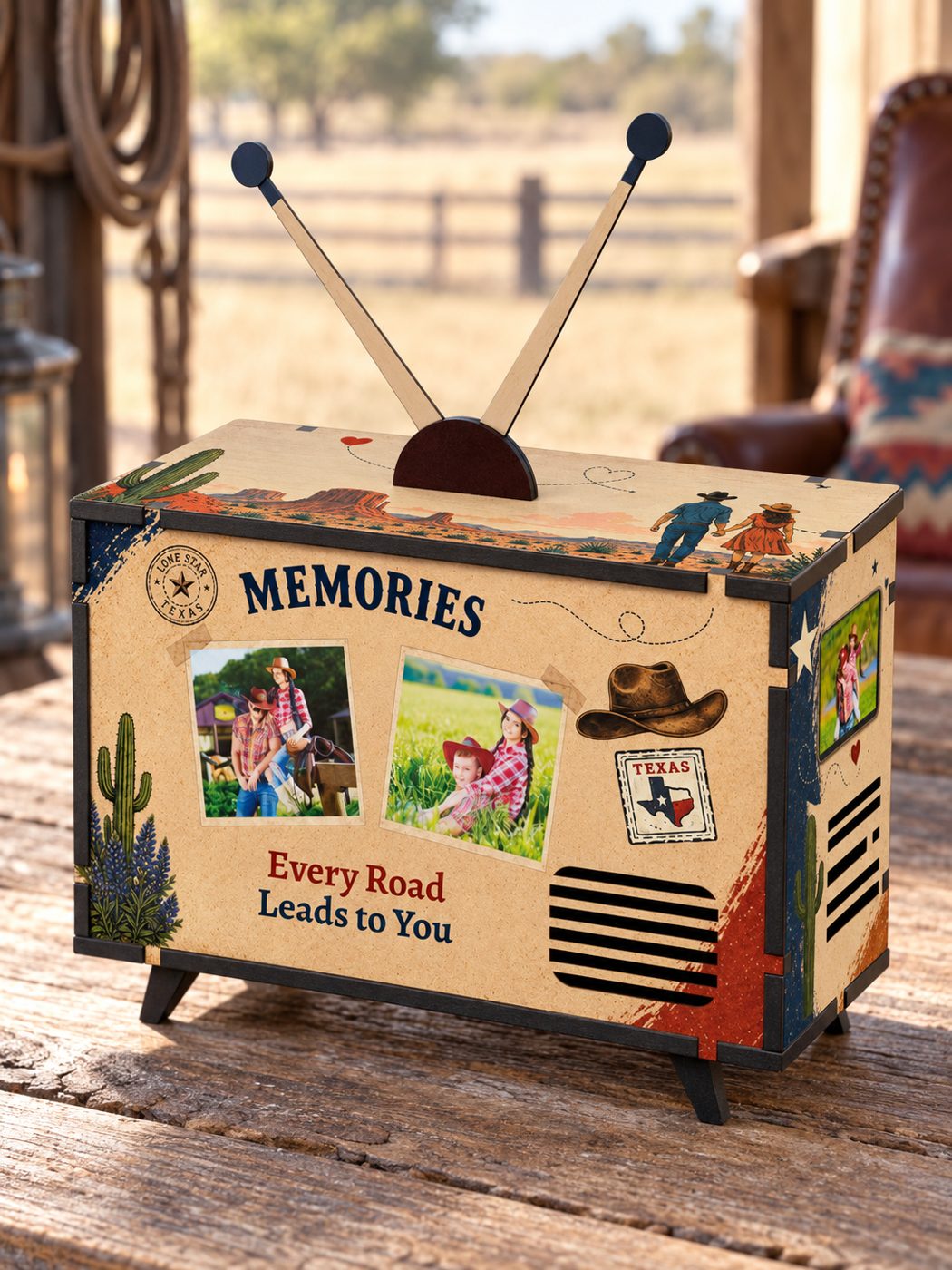
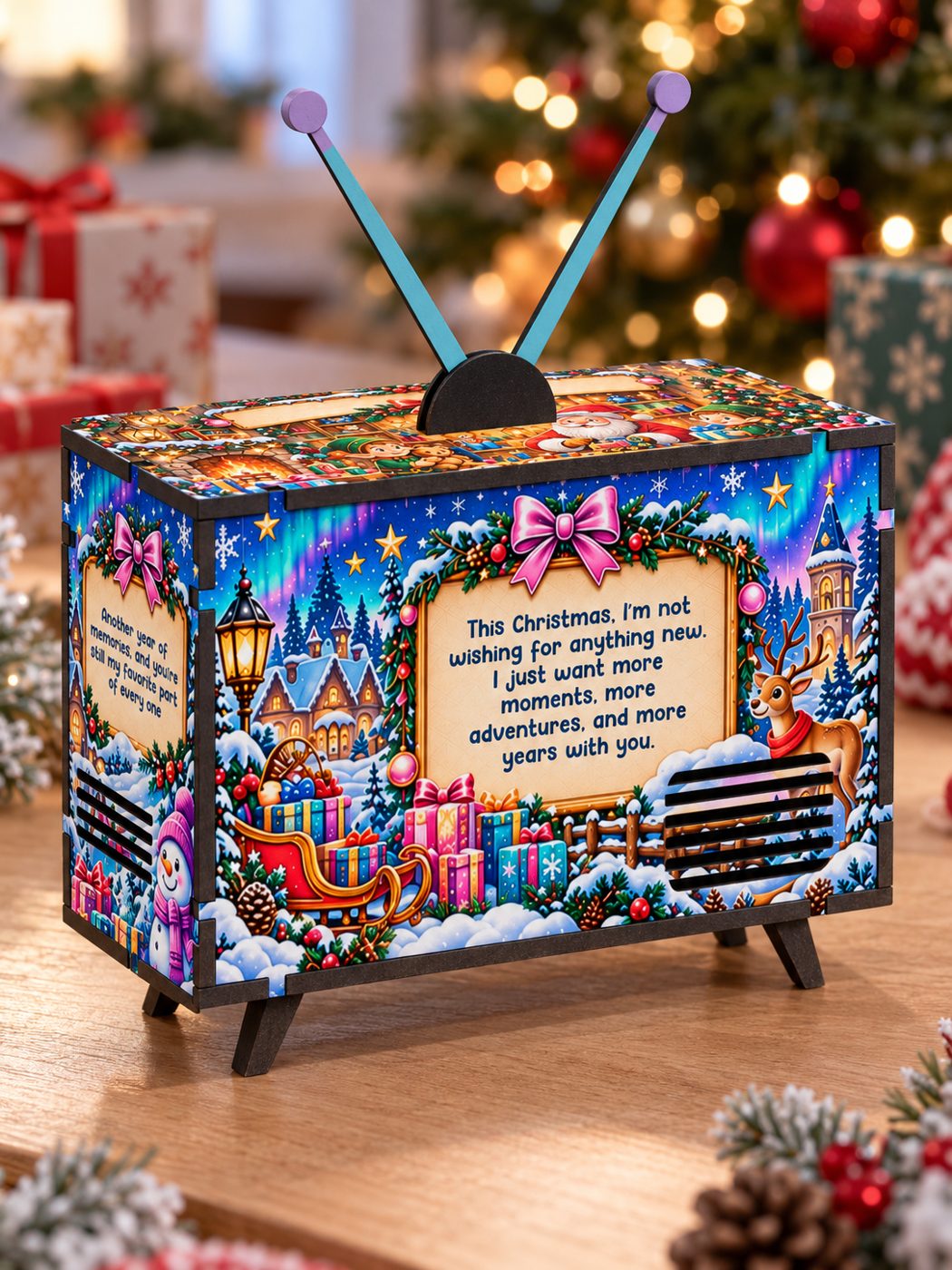
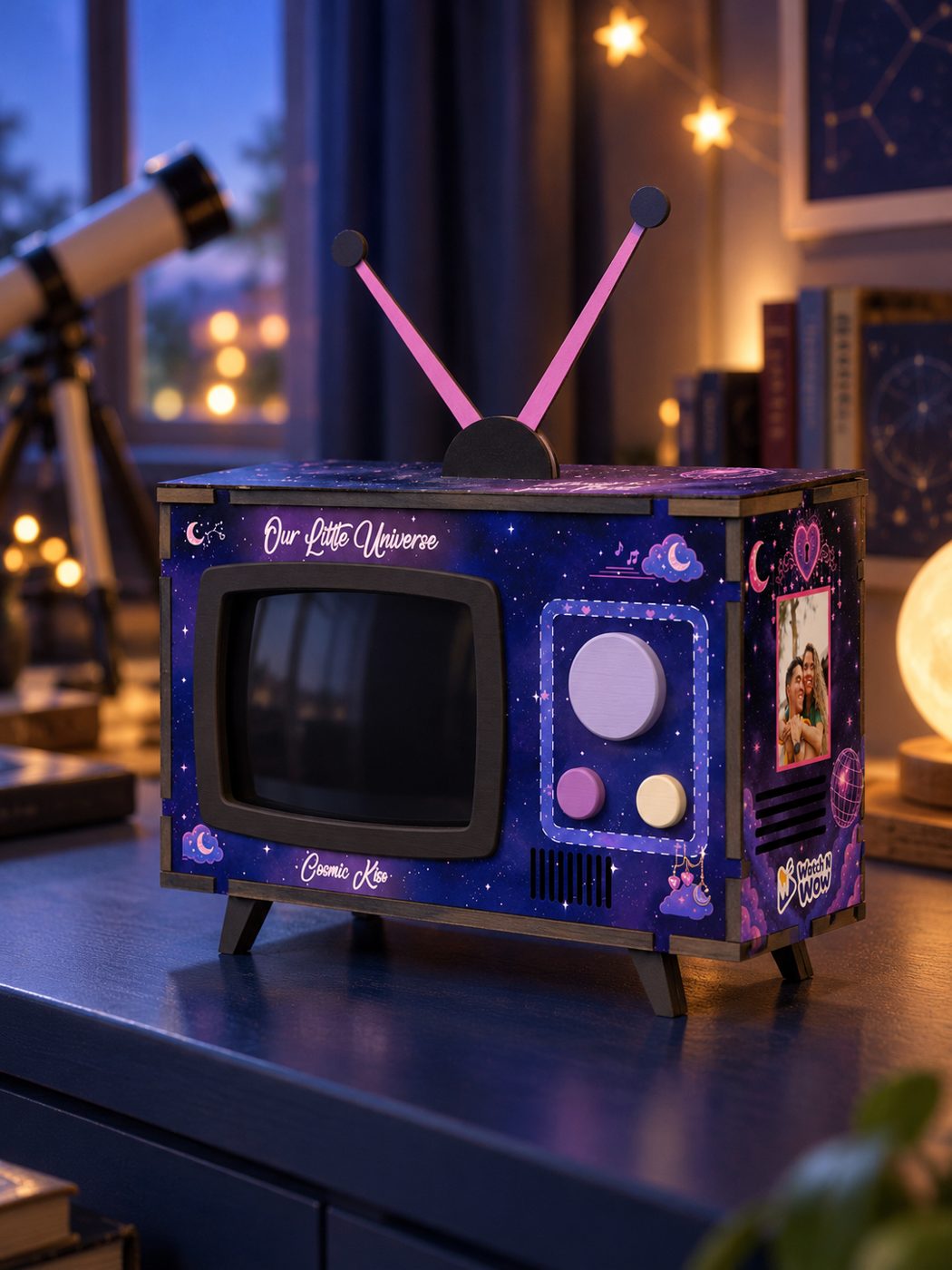
The Mini Memory TV is small. About five inches wide, three inches tall (closer to six once you count the antenna and the little legs), and two inches deep, handcrafted to look like the set that used to sit in your grandparents’ den. Inside the retro shell is a real working screen. Someone unwraps it, finds the knob, clicks it on. Then the pictures start: the wedding, the kids lined up on the porch by height, the shaky phone clip from some Christmas nobody can date exactly. And underneath it all, a song they have never heard in their life begins to play, and a voice sings their name.
Picture that moment landing. A grown man narrating the first minute out loud (“oh no, not the mustache years”) and then going completely silent at the chorus. An abuela putting her hand flat on her chest and humming harmony to a song that is four minutes old. It doesn’t play like technology. It plays like being known.
That’s the real difference between this and a slideshow with a stock track underneath. A stock song is somebody else’s memory cue. It’s busy lighting up strangers’ summers in a million other brains. A song written from your details points at exactly one life. There is one person on earth that chorus is about, and she’s the one holding the TV.
Every order ships from our shop in Texas starting at $80, and the TV isn’t all you get. The video is yours to download and keep forever, and it comes with a QR share page so the cousins two states over can watch it the same night and cry at a comfortable distance.
If someone you love has a story worth singing, we’d be honored to help you write it. Come tell us about them at watchnwow.com, answer a few questions, and hear what their life sounds like as a song.
Sources & research
-
Janata, P. (2009). “The Neural Architecture of Music-Evoked Autobiographical Memories.” Cerebral Cortex. ↩
-
Jacobsen, J.-H., Stelzer, J., Fritz, T. H., Chételat, G., La Joie, R., & Turner, R. (2015). “Why Musical Memory Can Be Preserved in Advanced Alzheimer’s Disease.” Brain. ↩
-
Seltzer, L. J., Ziegler, T. E., & Pollak, S. D. (2010). “Social Vocalizations Can Release Oxytocin in Humans.” Proceedings of the Royal Society B. Follow-up: Seltzer, L. J., Prososki, A. R., Ziegler, T. E., & Pollak, S. D. (2012). “Instant Messages vs. Speech: Hormones and Why We Still Need to Hear Each Other.” Evolution and Human Behavior. ↩
-
Sedikides, C., & Wildschut, T. (2006–present). Research program on nostalgia, social connectedness, self-continuity, and meaning in life, including Sedikides, Wildschut, Arndt, & Routledge (2008), Current Directions in Psychological Science. ↩