Table of Contents
A Trillion Photos a Year, and Nothing on the Wall
We've never captured more moments or looked at fewer of them. A practical case for turning your camera roll's best 60 seconds into something real.
Open your camera roll. Right now, go ahead. We’ll wait.
If your phone looks anything like ours, there are about 23,000 things in there. A screenshot of the Wi-Fi password for a rental you checked out of in 2023. A photo of where you parked at the airport. Fourteen nearly identical shots of one sunset, because the sky kept doing something slightly better every four seconds and you couldn’t not. A picture of a blender receipt, kept “just in case,” for a blender you no longer own.
And somewhere in the middle of all that, wedged between a screenshot of a group-chat argument and a photo of a rash you meant to ask a doctor about, there’s a nine-second video of your dad teaching your kid to whistle. His hands on her shoulders. The exact laugh he does when something finally works.
That clip is one of the best things you own. It’s filed next to a parking spot.
This is the strange deal we’ve all quietly signed. We’re the most photographed generation in human history, and most of us couldn’t put our hands on our ten favorite moments without twenty minutes of scrolling and a small existential crisis. The moments are all there. They’re just buried alive.
The junk drawer in your pocket
Industry analysts estimate people now take well over a trillion photos a year worldwide.1 A trillion. Nobody can count it precisely, but everyone who studies it agrees on two things: the number keeps climbing, and the fraction that ever gets printed, framed, or even deliberately looked at again keeps shrinking. In practice, most photos get seen exactly twice. Once when you take them. Once when your phone begs you to buy more storage.
It wasn’t always like this. Your grandparents shot one 24-exposure roll of film across an entire summer, and every single frame got studied, passed around the table, argued over, and glued into an album. Looking was the whole point. The album on the shelf wasn’t a backup of the memories. It was the destination.
We flipped that without noticing. Capture became free and infinite, so the destination quietly disappeared. Now the camera roll is a junk drawer: treasures and garbage in one undifferentiated pile, sorted by nothing but date. Your daughter’s actual first steps carry the same visual weight as a screenshot of a soup recipe you never made. The drawer doesn’t know the difference. And after enough years of this, we sort of stop knowing too, because we stop opening the drawer at all except to hunt for something practical.
None of this is a scolding, by the way. We do it too. One of us has six photos of the same houseplant from slightly different angles and cannot explain a single one of them.
Here’s the thing, though. The instinct to capture was never the mistake.
Actually, keep taking the photos
You’ve heard the sermon: put the phone away, be present, experience the moment through your own eyes for once. It sounds wise. It’s also, according to the best research we’ve seen, mostly wrong.
In 2016, researchers Kristin Diehl, Gal Zauberman, and Alixandra Barasch published a series of experiments in the Journal of Personality and Social Psychology, spanning real bus tours, museum visits, meals, and controlled lab studies. The result surprised a lot of people: taking photos generally increased how much participants enjoyed the experience.2 Not decreased. Increased. The camera works like a highlighter. When you’re deciding what’s worth photographing, you’re looking harder, noticing more, more engaged with the thing in front of you. (The effect faded when the camera got in the way of the experience itself, so nobody’s defending the person filming an entire concert in vertical video. But the ordinary snap? It helps.)
So photo guilt is mostly misplaced. You weren’t failing to live in the moment. You were paying attention to it. The researchers describe photo-taking as something that focuses attention on the experience, which means your fourteen sunsets were really fourteen small acts of noticing. Not a character flaw. A reflex worth keeping.
The failure comes after. We behave as if taking the picture is the whole job. Snap, feel that little spark of this matters, pocket the phone, and trust some future version of ourselves to do something with it. That future person never shows up. They’re busy. Taking more photos, mostly.
The problem was never that we take too many photos. It’s that we never see them again.
Buried isn’t the same as kept
A memory that takes effort to reach is a memory you’ll almost never visit. That’s not a character flaw; it’s just friction. To rewatch the whistle video you’d have to remember it exists, remember roughly when it happened, open the app, and scroll past four hundred receipts and sunsets to find it. Nobody does that on a random Tuesday.
Now compare that to the stuff at eye level. The photo strip on the fridge. The framed picture in the hallway you pass forty times a day. You never decide to look at those. You just do, constantly, in passing, and they quietly keep those people and those years present in the house. That’s the entire trick. Not better memories. Shorter distance.
There’s real psychology underneath this. In 2018, Ozgun Atasoy and Carey Morewedge published research in the Journal of Consumer Research showing that people consistently value physical goods more than identical digital ones.3 Same book, same movie, same photograph; the physical version feels more like ours. Their explanation is psychological ownership. We can hold it, place it, point at it, hand it to someone.
A file is a fact. A thing is a possession.
And the payoff for actually revisiting memories is well documented too. Constantine Sedikides and Tim Wildschut have spent two decades, from 2006 to now, studying nostalgia, and their findings run opposite to the old idea that looking backward is unhealthy. Revisiting meaningful memories reliably increases feelings of social connectedness, strengthens self-continuity (the sense that who you are now is connected to who you’ve been), and boosts a sense of meaning.4 Nostalgia isn’t wallowing. It’s maintenance.
Put those findings side by side and the diagnosis writes itself. Physical beats digital for feeling truly owned. Revisiting does us measurable good. And yet we store our entire lives in the one format engineered to be scrolled past.
The fix isn’t capturing less. It’s surfacing more: pulling the best moments out of the pile and giving them a form, and a spot in the house, where getting seen is the default instead of a project.
How to find the sixty seconds that matter
Whatever form you choose (a frame, a photo book, a tiny television, more on that in a minute), the hard part is the same: getting from 23,000 down to a handful. A few rules we swear by:
- Motion beats posing. The slightly blurry shot of your mom mid-laugh, hand on her chest, beats the one where everyone lined up and said cheese. Posed photos show what people looked like. Candids show what they were like.
- Hunt for voices. The most underrated files in any camera roll are the clips where someone can be heard. Grandpa saying a grandkid’s name. Your six-year-old narrating a Lego build like a nature documentary. Memory holds onto faces far longer than it holds onto voices, which is why a recovered voice hits like nothing else.
- One era per gift. A minute about the lake-house summer of 2019 lands harder than a minute sprinting from 2009 to now. Specificity is the whole flavor. Save the other eras; that’s next year’s gift.
- Keep one boring one. Dad at the sink doing dishes. The dog asleep in a laundry basket. The in-between moments are what a house actually felt like, and they’re the first thing everyone forgets.
- Then cut it in half. Twelve to fifteen photos and two or three short clips fill a minute comfortably. If everything’s precious, nothing is. Be ruthless now; you can always make another one later.
Order matters too. Open with an image that instantly names the era, the one that makes the person say “oh no” and cover their mouth. Build through the middle. End on the clip with a voice in it, because that’s the emotional exit, and whatever plays last is the part they’ll rewind. And trim harder than feels polite. A clip’s best two seconds beat its full forty; you’re keeping the whistle, not the ten seconds of pocket-fumbling before it.
And the song underneath? Make it sound like them. The style of their kitchen radio, their wedding, their terrible road-trip CD. Not whatever’s trending this month. A sound they already love does half your work for you.
What we built for this
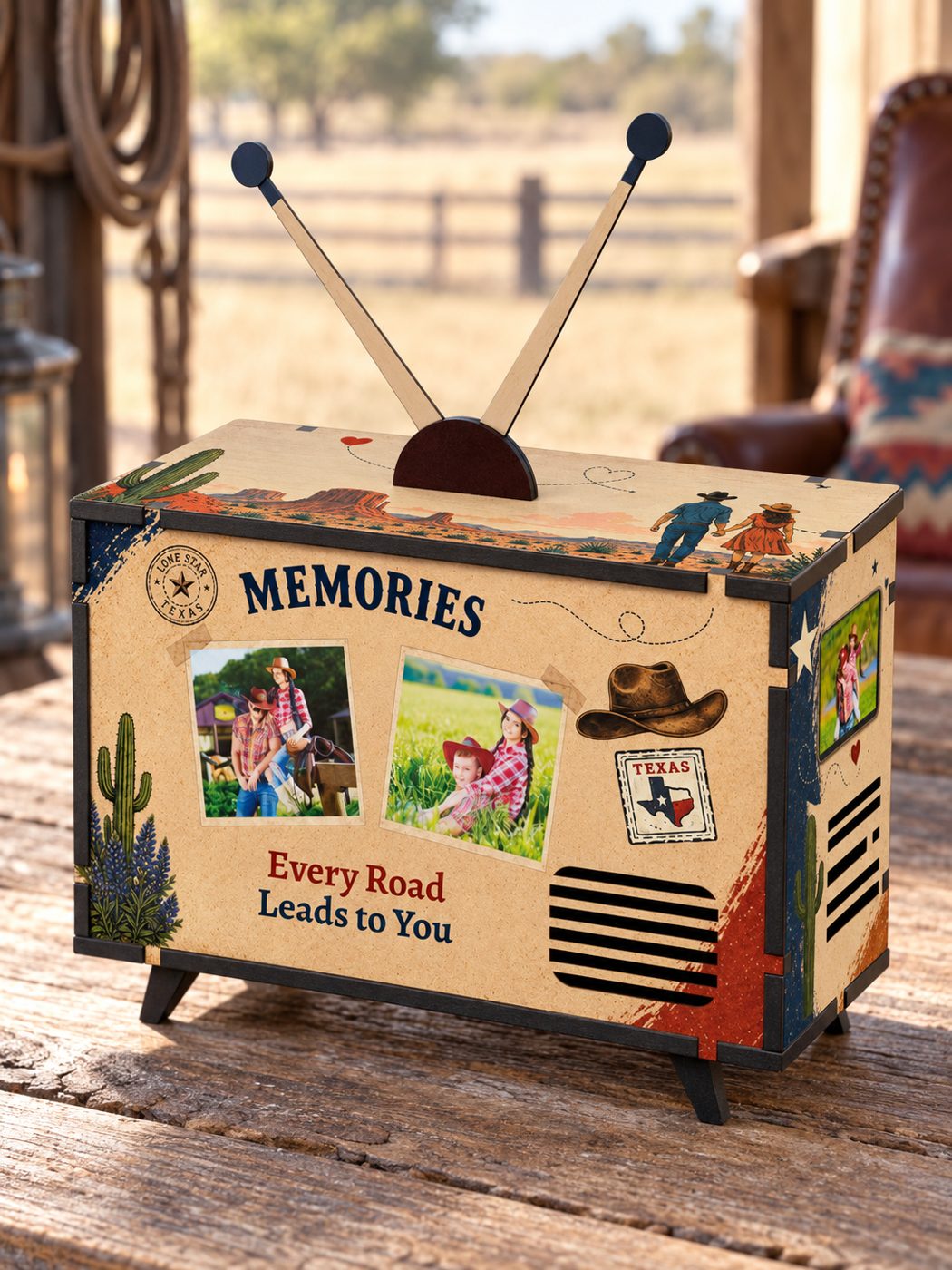
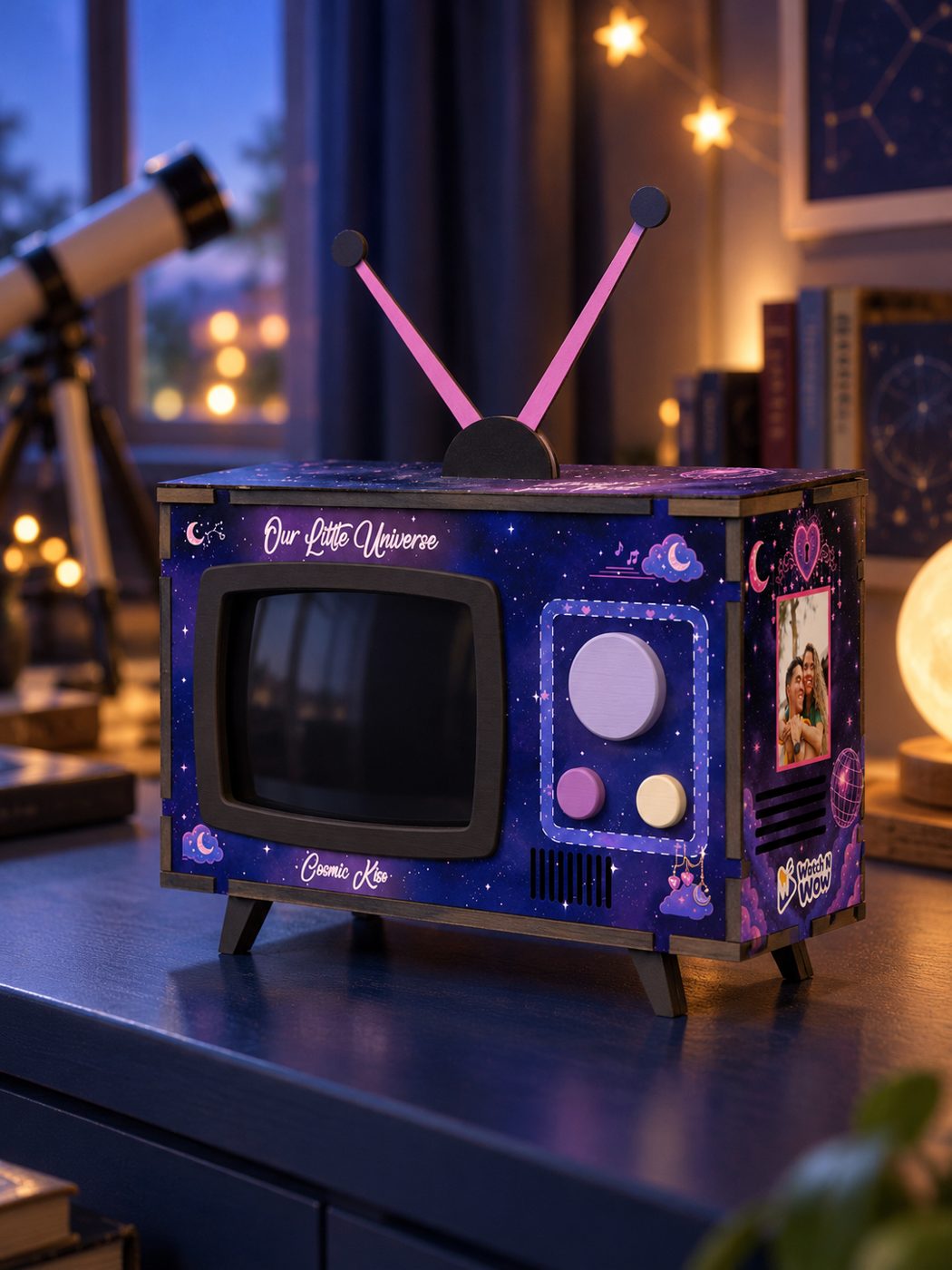
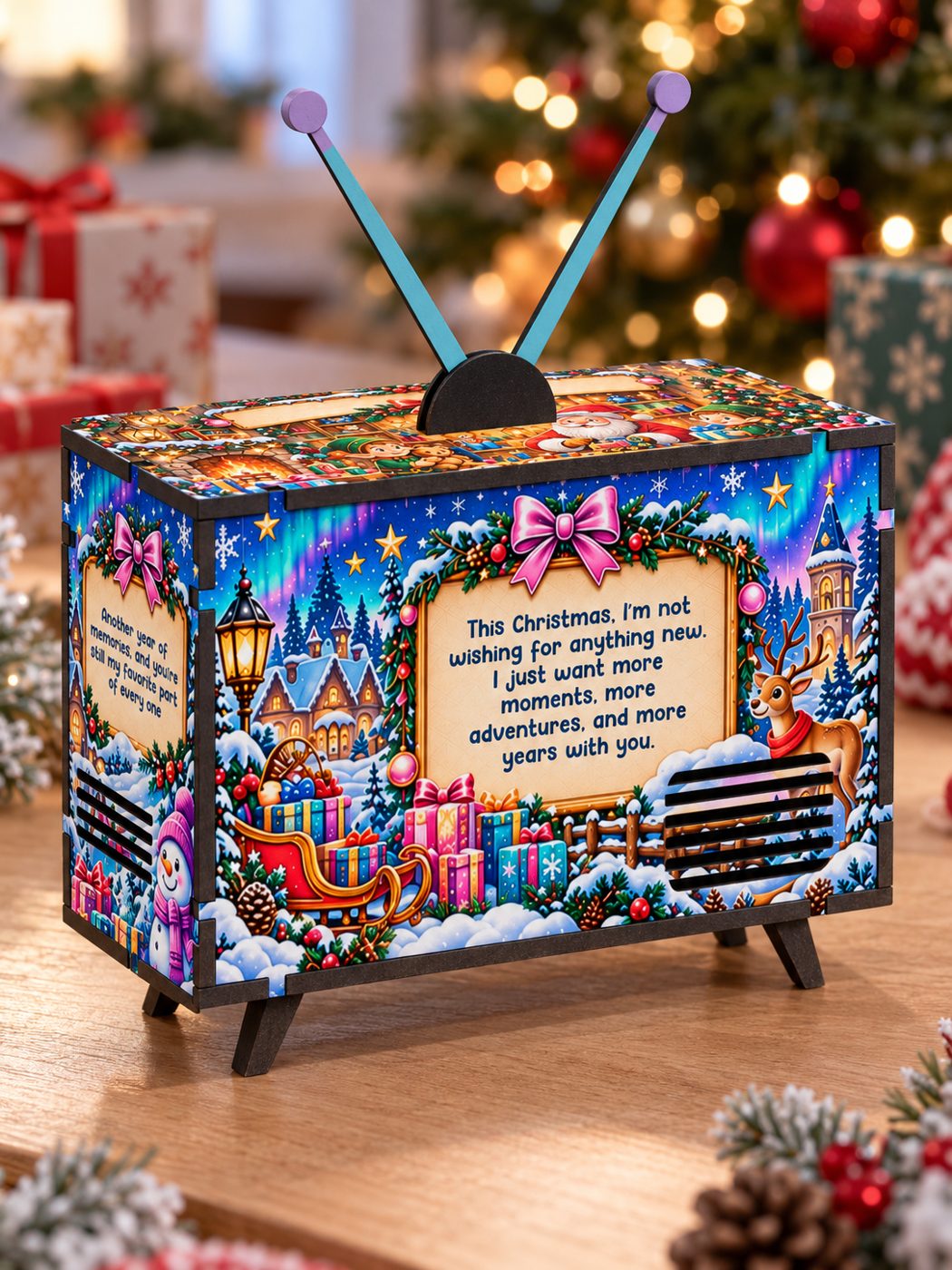
We’re Watch N Wow, a small team in Texas, and this exact problem is why our product exists. The Mini Memory TV is a little handcrafted retro television, five inches wide, 2.9 inches tall (5.8 once you count the antenna and its little legs), 1.9 inches deep, with a real screen inside. You upload your photos and clips, drag them into the order you want, set how long each moment stays on screen, trim the clips down to the good parts, and shape the custom song that plays underneath — you pick the style and the details, and the lyrics can even carry their name. What comes back is your minute, playing on a tiny TV that sits on a shelf and starts whenever someone wants it to. The whole thing is smaller than a loaf of bread. People underestimate it right up until it turns on.
The physical part is the point. It takes up shelf space. Guests ask about it. Somebody dusts it. It gets watched for the same reason fridge photos get seen: because it’s there, at eye level, asking nothing of anyone.
But we were never going to trap a memory inside an object, because objects stay in one house and families don’t. Every order includes a downloadable copy of the finished video, plus a private share page. The video itself ends with a QR code, and anyone who scans it can watch, download, or share the film from any phone. So grandma’s cousin, the one who couldn’t fly in for the party, scans the little screen over a video call and watches the whole thing from her own kitchen, an ocean away. The film never gets stranded in one chat thread, never depends on one person’s phone surviving, and never asks anyone to install anything.
Shelf copy for the daily glances. Cloud copy for everyone else. It starts at $80 and ships ready to gift.
Here’s some homework, no purchase required. Sometime this week, open the junk drawer on purpose. Search a name, a month, a place. Pull out ten things that make your chest do something and drop them in an album called The Good Ones, so at least they’re findable. That alone puts you ahead of nearly everyone. And if you decide those sixty seconds deserve a body, with a screen and an antenna and a spot on the shelf next to the people they belong to, we’d love to help you build it at watchnwow.com.
Sources & research
-
Annual photo-volume figures are industry analyst estimates. Treat “well over a trillion a year” as a well-supported order of magnitude, not a precise count. ↩
-
Diehl, K., Zauberman, G., & Barasch, A. (2016). “How Taking Photos Increases Enjoyment of Experiences.” Journal of Personality and Social Psychology. ↩
-
Atasoy, O., & Morewedge, C. K. (2018). “Digital Goods Are Valued Less Than Physical Goods.” Journal of Consumer Research. ↩
-
Wildschut, T., Sedikides, C., Arndt, J., & Routledge, C. (2006). “Nostalgia: Content, Triggers, Functions.” Journal of Personality and Social Psychology, along with the ongoing nostalgia research program led by Sedikides and Wildschut (2006 to present) on connectedness, self-continuity, and meaning. ↩