Table of Contents
First Father's Day Gift Ideas Built From Everyday Moments
A first Father's Day photo gift doesn't need a newborn shoot. How to capture the midnight bottles and ordinary routines, and turn them into a gift he'll replay.
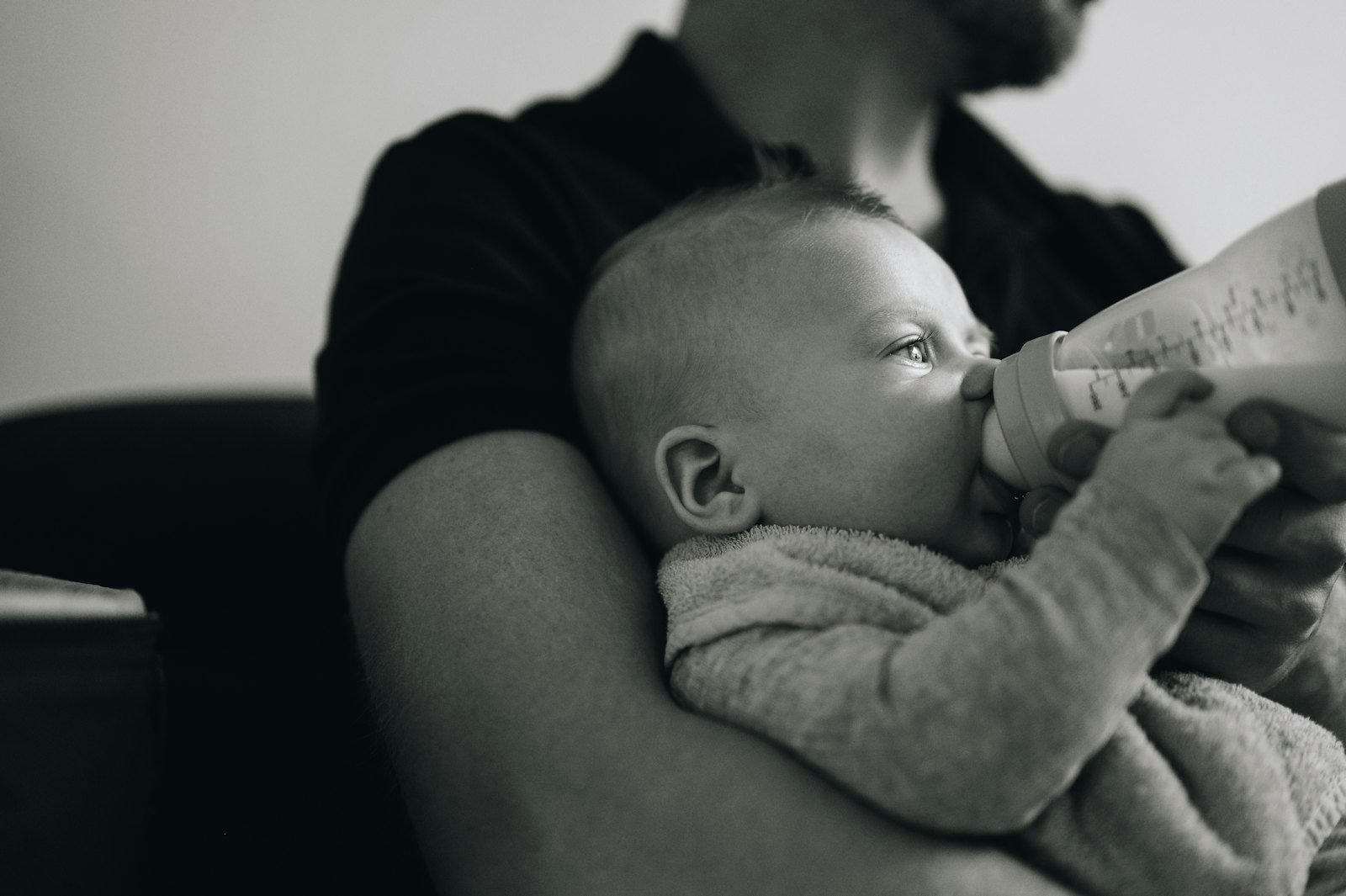
It’s 3:12 a.m. He’s on the couch with the baby in the crook of one arm and a bottle in the other hand, reading the side of the formula can because his phone is out of reach. Nobody is photographing this. Nobody thinks it’s a memory. It is.
A first Father’s Day photo gift works best when it’s built from moments like that one: the feeds, the baths, the stroller loops, the faces he makes during diaper changes. You don’t need a professional newborn session or a perfectly dressed baby. You need a few weeks of paying attention, a simple shot list, and a way to put the results somewhere he’ll see them again. This guide walks through all three.
Key Takeaways
- People underestimate how much they’ll enjoy rediscovering ordinary moments later, and the gap is largest for mundane experiences, not big events (Zhang et al., 2014).
- New fathers bond through play and physical contact; in one study, fathers’ oxytocin tracked stimulatory touch and play, not just cuddling (Gordon et al., 2010). Photograph those moments.
- A shot list of 10 routines, captured over three to six weeks, beats one staged photo shoot for this gift.
- Zoom in on details (his hand around her foot, the bottle tilted just so). Focused photos are remembered better than wide snapshots (Henkel, 2014).
- Keep the finished gift short and replayable: 12 to 20 images or clips, in order, with one line from you.
Why most first Father’s Day gifts miss the actual first year
Search “first Father’s Day gift” and you’ll find a wall of the same objects: mugs printed “Est. this year,” handprint kits, matching dad-and-baby shirts. None of them are bad. But most are about the title of father. They say “you are now a dad.” They don’t say anything about how he’s been a dad.
The questions new parents actually ask are more specific. “What can I give my husband for his first Father’s Day that isn’t cheesy?” “Is a photo gift too much when the baby is only two months old?” “We don’t have any good pictures of him with the baby, only of me.” That last one comes up constantly, and it’s the real problem. In most households one parent holds the phone more often, and that parent is underrepresented in the camera roll. If you’re the one taking the pictures, you probably have hundreds of the baby and a handful of him with the baby, most of them blurry.
There’s also a timing trap. Newborn shoots happen in the first two weeks, when everyone is exhausted and the baby looks like a small, startled potato. By Father’s Day, the baby might be four months old or ten, and the dad you’re celebrating has spent those months doing hundreds of small, repeated things. The midnight bottle. The swaddle he got better at than you. The song he sings that isn’t really a song. Those routines are the first year. A gift that captures them is about him, not about the greeting-card category.
What the research actually says about everyday moments
Ordinary moments become more interesting than we expect
A 2014 paper in Psychological Science by Ting Zhang, Tami Kim, Alison Wood Brooks, Francesca Gino and Michael Norton tested what happens when people document ordinary life and look at it later. In a time-capsule study, participants recorded recent experiences (the last social event they attended, a conversation, a song they were listening to) and predicted how interesting it would be to rediscover them months later. They consistently underestimated it. The gap was largest for mundane experiences rather than extraordinary ones. People assumed they’d remember the ordinary stuff anyway, so it didn’t seem worth recording. They were wrong. The authors link the error to “erroneous faith in their memory of everyday events.”
That finding is the backbone of this guide. The routines that feel too boring to photograph in month two are exactly the ones a family will be delighted to rediscover in year five. The study was done with adults in the US documenting their own lives, not parents specifically, so treat the application as a reasonable extension rather than a tested result.
Fathers bond through play, so photograph the play
Ilanit Gordon, Ruth Feldman and colleagues followed 160 first-time mothers and fathers across the first six months after birth and published the results in Biological Psychiatry in 2010. Oxytocin, the hormone most associated with bonding, rose over that period in both parents, with no difference in levels between mothers and fathers. What differed was the behavior it tracked. Mothers’ oxytocin was linked with affectionate parenting: gentle touch, positive affect, “motherese” speech. Fathers’ oxytocin was linked with stimulatory parenting: moving the baby around, tactile play, showing the baby objects.
This is a single study of cohabiting couples in Israel, and it describes averages, not rules about any particular dad. But it gives you a useful nudge. Don’t only photograph him holding a sleeping baby. Photograph the airplane rides, the tummy-time coaching, the toy he holds up and shakes. Those may be the moments where his bond is actually being built.
Zoom in, and you’ll both remember it better
Linda Henkel’s 2014 study in Psychological Science took participants on a museum tour and had them photograph some objects and simply look at others. Photographing whole objects led to worse memory for them, a “photo-taking-impairment effect.” But when participants zoomed in on a specific detail, the impairment disappeared. Focusing the camera focused attention.
For a gift, this means a detail shot (his thumb inside her fist, the burp cloth on his shoulder, the bottle at the angle he always holds it) does double duty. It gives the gift texture, and the act of framing it carefully helps you remember the moment too.
Most dads say they don’t get enough time
Pew Research Center’s 2019 fact sheet on American fathers reported that dads averaged about eight hours a week of child care in 2016, roughly triple the 1965 level, while mothers averaged about 14. In a 2017 Pew survey, 63% of fathers said they spend too little time with their children, compared with 35% of mothers. Many new dads go back to work quickly. A gift that shows the time he did spend, in specific scenes, answers that worry directly.
And the standard gifts are what everyone else buys
The National Retail Federation’s latest Father’s Day survey of 7,914 adults found the most common planned gifts were greeting cards (60%), clothing (58%), a special outing (55%) and gift cards (52%). Only 34% said creating a special memory was the most important thing in choosing a gift. There’s nothing wrong with a card and a shirt. But if you want the first one to feel different, the memory route is the least crowded.
Staged shoot vs everyday-moments gift: a comparison
Here’s how the common approaches compare for a first Father’s Day.
| Approach | What it does well | Where it falls short | Effort | Best if… |
|---|---|---|---|---|
| Professional newborn shoot | Beautiful, well-lit images | Captures week two, not the year; dad often posed | One session, higher cost | You already booked one |
| ”Est.” mug or shirt | Quick, cheerful, wearable | Generic; says “dad” not “this dad” | Minutes | You want something light alongside a bigger gift |
| Handprint or footprint kit | Physical, dated keepsake | Mostly about baby; can be messy at 2 a.m. | An hour | Baby is under 6 months |
| Everyday-moments photo gift | Shows how he parents; builds a record you’ll rediscover | Needs 3–6 weeks of quiet planning | 15 minutes a week + assembly | You want it to be about him |
| Recorded voice or video message | His child’s sounds, your words | Less visual unless paired with images | 30 minutes | Baby is babbling or laughing |
The everyday-moments approach costs the least money and the most attention. That trade is the point.
How to make a first Father’s Day photo gift from everyday moments
Step 1: Write a 10-routine shot list
Sit down for ten minutes and list the routines that are his. Not the ones you wish he did. The ones he actually does. A typical list looks like: night feed, morning hand-off, bath, the walk, burping, the car seat buckle, reading (or narrating sports to the baby), nap on his chest, the silly song, the first time he fixed something for the baby. Why: a list turns vague intention into ten small tasks. Common mistake: listing milestones (first smile, first roll) instead of routines. Milestones are lucky captures. Routines repeat, so you get several tries.
Step 2: Capture quietly over three to six weeks
Aim for two or three routines a week. Shoot in the light you have: a lamp for the night feed, a window for the bath. Take short clips as well as photos, five to ten seconds each; sound matters, especially his voice talking to the baby. Why: the rediscovery study found the value is in recording what’s actually happening, not a performance of it. Common mistake: announcing “I’m taking pictures for Father’s Day!” He’ll start posing and the routine disappears. If he notices, “I just want more pictures of you two” is true and enough.
Step 3: Get at least three detail shots
Hands, feet, the bottle, the burp cloth, his watch next to her tiny wrist. Use the zoom or step closer. Why: Henkel’s zoom finding; details also read well on small screens and in prints. Common mistake: only shooting wide, where both faces are small and the light is flat.
Step 4: Ask one other person for one photo
Grandparents and friends who visited often have the shots you don’t, usually of you and him with the baby. Send one specific request: “Do you have any photo of him holding the baby when you visited? Even a blurry one.” Why: specific asks get answers; vague asks (“send me photos!”) don’t. Common mistake: asking a group chat for “any photos,” which produces either silence or 200 images.
Step 5: Edit down hard
Pick 12 to 20 images and clips. Put them in the order of a day (night feed first, or morning hand-off first) rather than date order. That structure says “this is what your days look like,” which is the message. Common mistake: keeping three near-identical shots of the same moment because you can’t choose. Pick the one where his face is visible.
Step 6: Add one line in your words
Not a poem. One sentence that names something only you saw: “You hum the same four notes every night and she stops crying every time.” Why: the other studies in this blog’s archive on why the thought behind a gift often goes unnoticed point the same way; specificity is what makes effort visible. Common mistake: writing about fatherhood in general.
Step 7: Choose a format he’ll replay
A printed set, a short slideshow, a small album, or a looping video. What matters is that he’ll see it again without hunting for it. A folder in the cloud is easy to make and easy to forget; the research on physical versus digital gifts found people feel more ownership over physical versions. What not to do: post it publicly first. Let him see it alone, then decide together whether to share.
How to make it personal
If you have 10 minutes
Write down the three routines he does that you’d miss most if they stopped. Set a recurring phone reminder, “photo of them,” for the time one of them happens.
If you have a weekend
Capture two routines with photos and a short clip each. Text one grandparent asking for one specific photo. Write your one sentence.
If you want it to last years
Keep shooting the same routines every few months: the night feed becomes the bedtime story, the stroller becomes the scooter. A first-year set that continues into year two and three becomes the record your child will look at too. Print a copy and back up the files in two places.
The question to ask yourself: “Is this a picture of a dad, or a picture of him being a dad the way only he does it?”
Frequently asked questions
What do you get a new dad for his first Father’s Day?
Something about how he’s parenting, not just the title. A short set of photos and clips of his actual routines (feeds, baths, walks) with one line in your words works well because it shows he’s been seen. Pair it with something practical or an outing if you like; the memory piece is what makes it his first.
Is a photo gift cheesy for a first Father’s Day?
Only if it’s generic. Staged poses and printed slogans can feel like a template. Candid photos of real routines, chosen carefully and kept to 12 to 20 images, feel personal rather than cheesy. If he dislikes sentimentality, keep the words short and let the pictures carry it.
Who gives the first Father’s Day gift if the baby can’t?
Usually the partner, sometimes with grandparents’ help. Many families sign it “from the baby,” which is sweet, but a line in the partner’s own voice is often what the dad remembers. You can do both: a card “from” the baby and one sentence from you.
What if I don’t have any good photos of him with the baby?
Start now with a shot list and three to six weeks of quiet capture. Ask visitors for one specific photo each. Detail shots (hands, feet, the bottle) work even when lighting or angles are bad, because faces aren’t the point.
When should I start planning a first Father’s Day gift?
Six weeks ahead gives you enough time to capture several routines without rushing. If you only have a week, pick three routines and capture them over two or three days; a small set of real moments beats a big set of staged ones.
If you’d rather have those photos and clips turned into a short video with a message and an original song, loaded onto a small retro TV that plays without Wi-Fi or an app, that’s what we make at Watch N Wow.
About the author
Ricky Flores is the founder of Watch N Wow and an electrical engineer with 15+ years of experience building consumer technology at Apple, Samsung, and Texas Instruments. In Dallas, Texas, he builds the Mini Memory TV by hand: a small retro TV that plays a video, a message and an original song made from your photos and your story. Read more at watchnwow.com.
Sources
- Zhang, T., Kim, T., Brooks, A. W., Gino, F., & Norton, M. I. (2014). “A ‘present’ for the future: The unexpected value of rediscovery.” Psychological Science, 25(10), 1851–1860. https://doi.org/10.1177/0956797614542274
- Gordon, I., Zagoory-Sharon, O., Leckman, J. F., & Feldman, R. (2010). “Oxytocin and the development of parenting in humans.” Biological Psychiatry, 68(4), 377–382. https://pubmed.ncbi.nlm.nih.gov/20359699/
- Henkel, L. A. (2014). “Point-and-shoot memories: The influence of taking photos on memory for a museum tour.” Psychological Science, 25(2), 396–402. https://doi.org/10.1177/0956797613504438
- Livingston, G., & Parker, K. (2019). “8 facts about American dads.” Pew Research Center. https://www.pewresearch.org/short-reads/2019/06/12/fathers-day-facts/
- National Retail Federation & Prosper Insights & Analytics (2026). “Father’s Day spending to hit record $27.9 billion.” https://nrf.com/media-center/press-releases/father-s-day-spending-to-hit-record-27-9-billion
- Atasoy, O., & Morewedge, C. K. (2018). “Digital goods are valued less than physical goods.” Journal of Consumer Research, 44(6), 1343–1357. https://doi.org/10.1093/jcr/ucx102