Table of Contents
The Gift That Doesn't Live in a Cloud
Research says we value physical things more than identical digital ones. Here's why a memory you can hold — and press play on — lands differently.
Somewhere on your phone, there’s a video of your mom laughing so hard she can’t finish her sentence. You know it exists. You shot it. But right now, at her birthday dinner, with the whole table leaning in, you’re scrolling through eleven thousand photos trying to find it while the moment quietly deflates. “Hang on. It’s in here somewhere.”
We’ve all done that scroll.
And we’ve all done the other thing, too: sent the precious video as a link. Into the group chat it goes, where it collects two hearts and a thumbs-up, then sinks beneath a plumber recommendation and somebody’s flight details. By Thursday it’s archaeology.
That’s the odd spot we’ve all landed in. We’re the most thoroughly documented people in human history, and almost none of that documentation is ever actually in front of us. Our memories aren’t lost. They’re filed. Stored behind a login, under everything newer, in a cloud nobody visits on purpose.
So here’s the question we think about constantly at Watch N Wow, because answering it well is basically our whole job: when you want to give someone a memory, what should that memory be made of? A shared album is free. A link costs nothing to send. Why would anyone spend real money on a small physical object that plays footage they could text for free?
It turns out researchers have been circling that exact question for years, and their answers line up with something you can probably already feel in your gut. Pixels on a borrowed screen and an object in someone’s hands are not the same gift. Not even close.
The Trillion-Photo Problem
Start with scale. Industry analysts estimate people now take well over a trillion photos a year. A trillion. And by those same estimates, only a small fraction of them are ever printed or revisited at all.
That’s not a character flaw. It’s just what abundance does. When film cost money and developing took a week, a photograph was an occasion. You planned for it. You waited on it. The good ones went into an album, and the album went on a shelf where hands could actually reach it. Now a photo is something your phone does while you’re paying for parking.
There’s nothing wrong with capturing everything. We do it too. The trouble is that a camera roll has no front door. It never stops you and says: this one. This one matters. Every image gets identical treatment, which in practice means almost none.
Digital sharing inherits the same flatness. A link is a small to-do item. Your person has to notice it, tap it, and watch it before the next notification muscles in, and then it settles into the sediment with everything else. Watch how people treat a shared-album invitation sometime. It’s homework with a heart button.
A memory that lives only in the cloud is a memory on layaway. Somebody has to go retrieve it, every single time. Mostly, nobody does.
Your Hands Know Something Your Cloud Doesn’t
Here’s where it gets interesting. In a 2018 study published in the Journal of Consumer Research, titled plainly “Digital Goods Are Valued Less Than Physical Goods,” researchers Ozgun Atasoy and Carey Morewedge ran a series of experiments using photos, books, and films. Same content, two formats. Again and again, people were willing to pay more for the physical version of an identical good.1
Why? The effect, they found, is driven by psychological ownership: the sense that a thing is really, truly yours. And that sense turns out to be much stronger for things we can touch. A file feels like access. An object feels like possession. You can hold it, place it, hand it to somebody else. Your body is involved, so your relationship to it is different.
Now think about what a gift fundamentally is: a transfer of ownership. This is yours now. When the gift is a link, that transfer barely registers. It’s permission, not possession. When it’s an object with weight, with a place in the house, the ownership is obvious the moment their fingers close around it.
A link asks to be clicked. An object asks to be kept.
We didn’t need a journal article to tell us people treasure what they can hold. But it’s useful to know the effect is measurable, repeatable, and not just sentiment or marketing. Your instinct that a printed photo “counts” more than the same photo in a text thread? That’s your brain doing exactly what the research says brains do.
Nostalgia Is Doing Real Work
There’s a second body of research we lean on, and it’s about what happens after the gift is given.
Since 2006, psychologists Constantine Sedikides and Tim Wildschut at the University of Southampton have led a long-running research program on nostalgia, with findings published in journals including the Journal of Personality and Social Psychology and Current Directions in Psychological Science. Their consistent result: engaging with nostalgic memories isn’t idle wallowing. It reliably increases feelings of social connectedness, strengthens self-continuity (the sense that you’re still the person who lived those moments), boosts meaning in life, and can buffer loneliness.2
Read that list again with a specific person in mind. A grandmother who lives alone now. A dad whose kids just scattered to three different cities. A friend starting over somewhere unfamiliar. For people in those seasons, a well-chosen memory isn’t decoration. It’s closer to a vitamin.
Here’s the catch, though. Nostalgia doesn’t fire on its own. It needs a trigger. And that’s the quiet problem with cloud-stored memories: out of sight is out of mind, almost by definition. The photos that could do all this psychological good are sitting in the dark, waiting for someone to remember to go looking for them.
An object on a shelf is a trigger that’s always armed. It catches the eye on an ordinary Tuesday. It gets picked up, dusted, shown to a neighbor who asks about it. Every glance is a small dose of exactly the thing the Southampton team has spent two decades measuring. That’s what a keepsake actually is, mechanically speaking: nostalgia, pre-installed, within arm’s reach.
A Thing That Behaves Like an Experience
In 2003, Leaf Van Boven and Thomas Gilovich published a much-cited paper in the Journal of Personality and Social Psychology asking a deceptively simple question: do experiences or material purchases make us happier? The experiences won.3 Follow-up work by Amit Kumar and Gilovich helped explain why: experiential purchases give us more anticipation beforehand and more retelling afterward.4 A trip starts paying off before you’ve packed a bag, and it keeps paying every time you tell the story at dinner.
The easy takeaway is “give experiences, not stuff.” But the finer print is more useful. The purchases that keep making us happy are the ones that generate stories. And some objects are story machines. A guitar. A cast-iron pan with decades of dinners baked into it. Your grandfather’s watch, which is technically just a watch until someone asks about it and suddenly you’re twenty minutes into how he wore it through two careers and never once set it to daylight saving time. The line between a material gift and an experiential one is blurrier than it looks.
A tiny television that plays your family’s story sits about as close to that line as an object can get. There’s anticipation while you build it: choosing the photos, watching the design come together, hearing the song for the first time. There’s the reveal, which we’d argue is the best single moment our product produces. And then there’s the retelling, which never really stops, because a small retro TV on a shelf is a conversation starter by design. Guests ask. Someone presses play. The story gets told again, and everyone in the room gets a little of that connectedness the nostalgia researchers keep documenting.
What Actually Shows Up in the Box
So let’s get concrete about what this thing is.
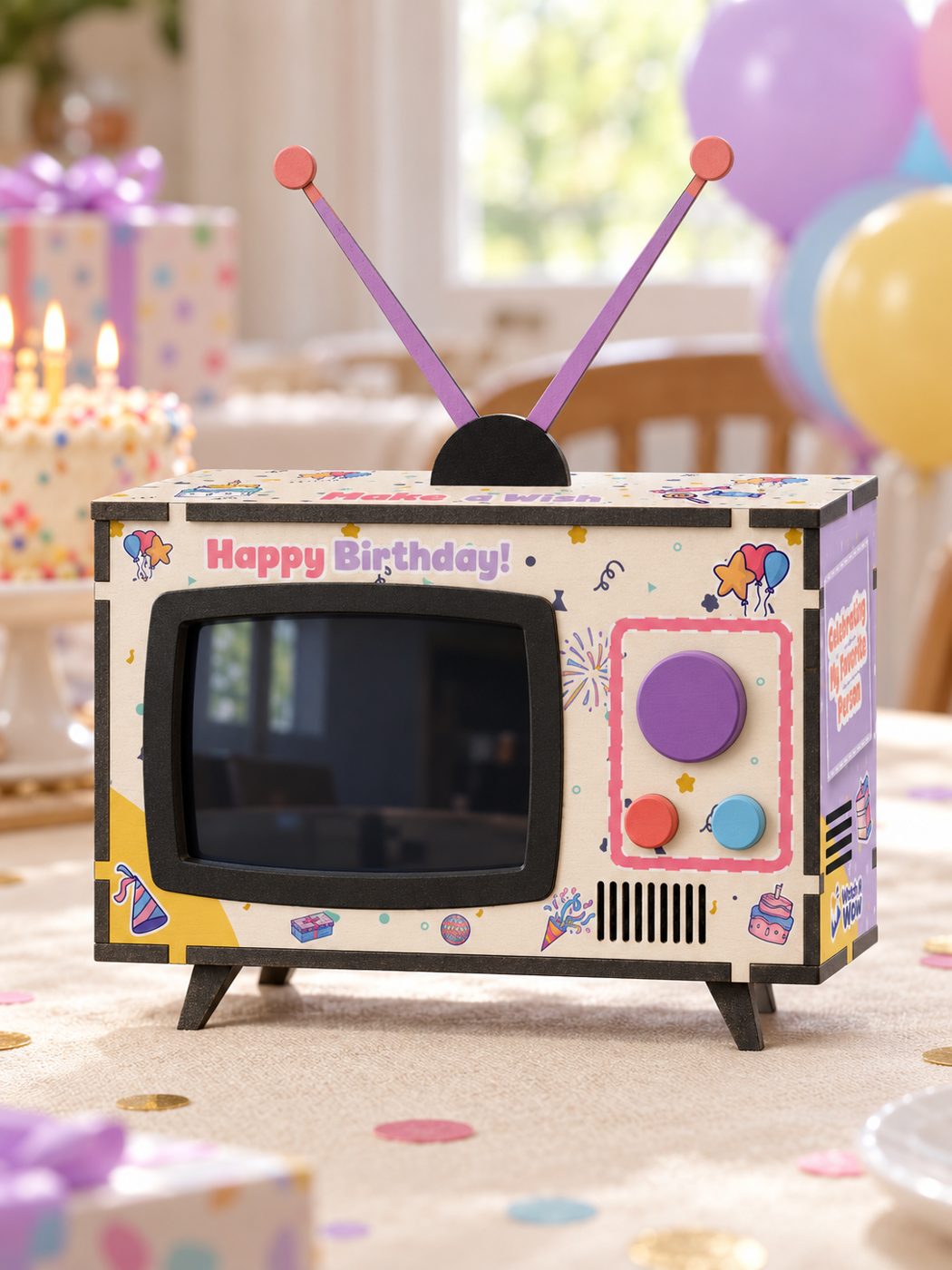
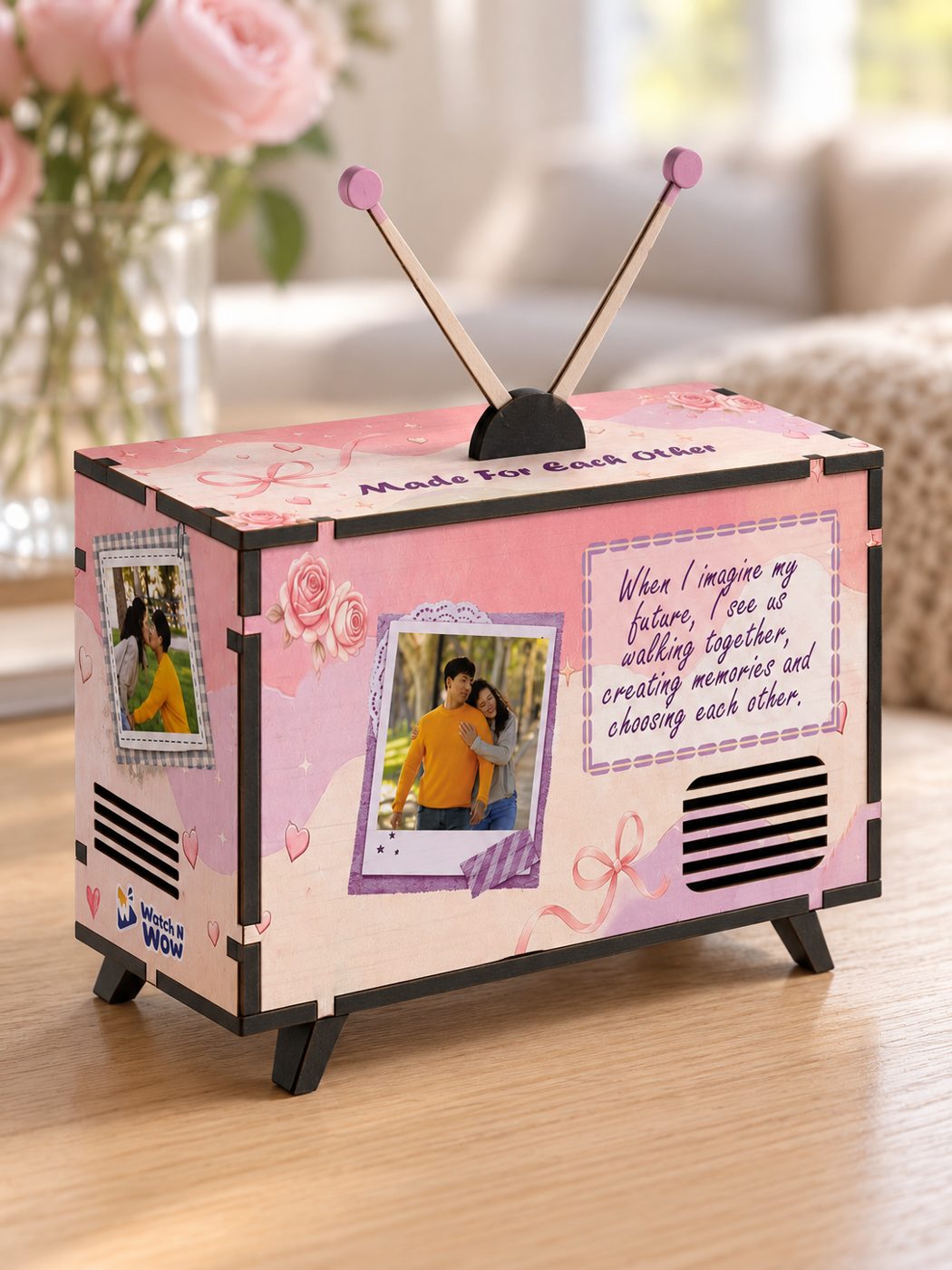
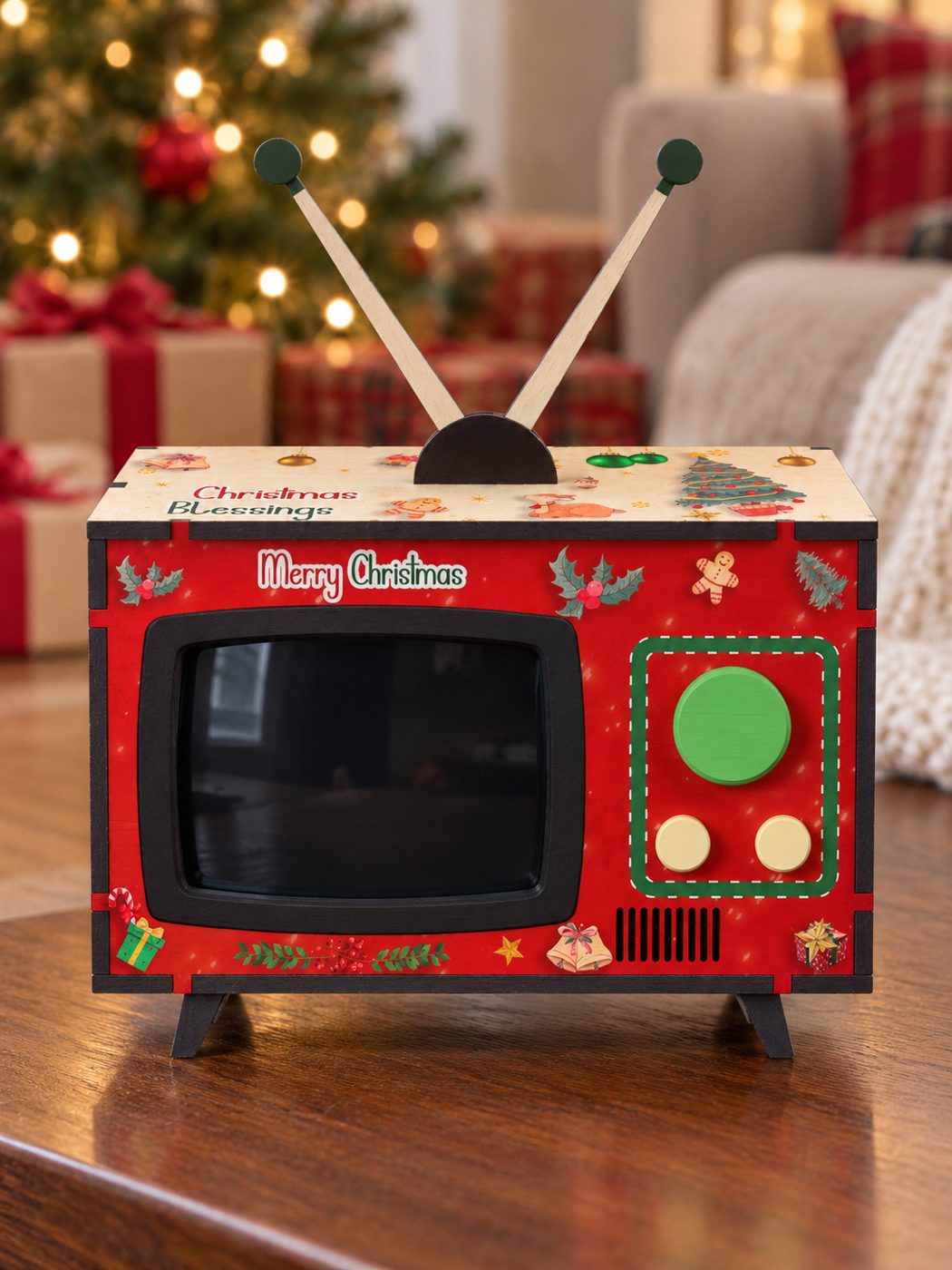
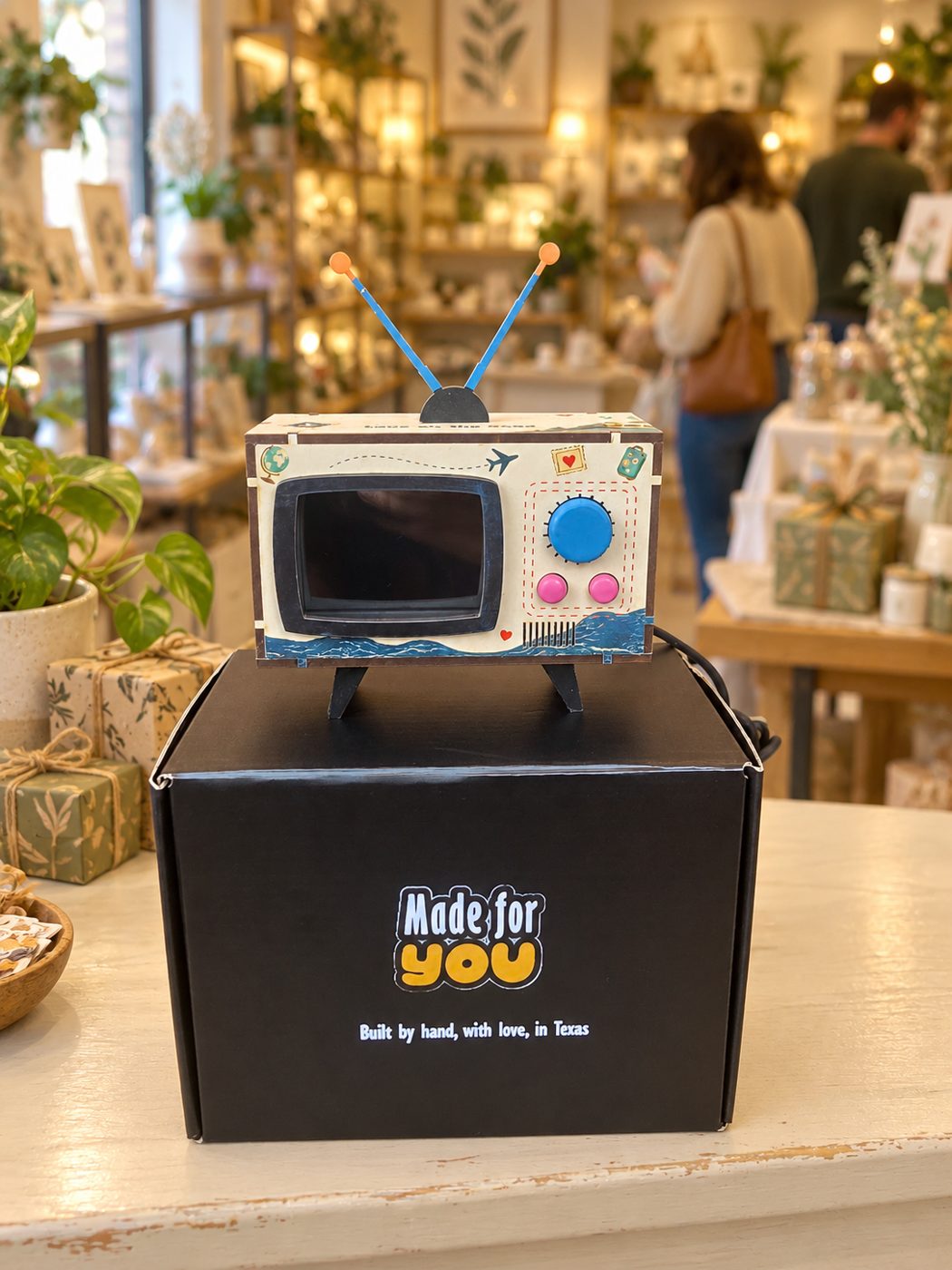
The Mini Memory TV is a small handcrafted retro television, sized for a palm or a shelf: five inches wide, just under three inches tall (5.8 inches once you count the antenna and the little legs), and under two inches deep. Behind the glass is a real screen, and on that screen plays one video that exists nowhere else in this form: yours. It’s built from your own photos and clips and scored with an original song composed by AI for that video alone.
You build the whole thing yourself online, and it honestly takes minutes. You choose from seventeen artwork designs. You add your text, names, dates, a line that means something, rendered in engraved style in each design’s own typefaces, so it looks like it was made that way. Because it was. Then we handcraft the TV here in Texas, load your video onto it, and ship it ready to hand over. Prices start at $80. There’s no setup on the recipient’s end, no app, no account, no password. They press play. The click is the entire instruction manual.
And here’s the part we want to be extra clear about, because it answers the “but digital is more practical” objection completely: nothing is locked inside the TV. Every order includes a downloadable copy of the video, plus a private share page reachable by a QR code that plays at the end of the video itself. Grandma gets the object on her shelf, between the framed wedding photo and the good vase. The cousins in three time zones scan the code and watch on their phones. Backup handled. Sharing handled.
You don’t have to choose between something they can hold and something everyone can watch. The little TV comes with both.
The object anchors the memory in physical space, where eyes and hands can find it without being asked. The file and the share page let it travel anywhere. That was the whole design brief, honestly. Keep the warmth of a thing. Lose the limitations.
The Shelf Test
We’ll leave you with a simple filter for any sentimental gift: where is it in five years? A gift card is long spent. Flowers are gone in a week. A link is forty scrolls deep in a chat nobody opens anymore. But a tiny television that plays your mother’s laugh doesn’t end up in a drawer. It ends up on the shelf people walk past every day, and some quiet afternoon she’ll stop, press play, and hear it again.
If there’s a camera roll full of somebody you love sitting in your pocket right now, we’d be glad to help it become something they can hold. Building a Mini Memory TV takes a few minutes at watchnwow.com: pick a design, add your photos, clips, and words, hear the song, and we’ll craft the TV and ship it ready to gift. Your footage has waited in the cloud long enough. Let it live somewhere someone can press play.
Sources & research
-
Atasoy, O., & Morewedge, C. K. (2018). “Digital Goods Are Valued Less Than Physical Goods.” Journal of Consumer Research. ↩
-
Sedikides, C., & Wildschut, T. (2006–present). Nostalgia research program, University of Southampton. Findings published in journals including the Journal of Personality and Social Psychology and Current Directions in Psychological Science. ↩
-
Van Boven, L., & Gilovich, T. (2003). “To Do or to Have? That Is the Question.” Journal of Personality and Social Psychology. ↩
-
Kumar, A., & Gilovich, T. Follow-up research on experiential purchases, anticipation, and retelling. ↩