Table of Contents
Gifts That Last: Why a Moment Attached Beats a Box
Gifts that last work in three windows: the wait before, the shared moment, and the object left behind. What eight studies say about experience vs material gifts.
The group chat for Dad’s sixtieth has split into two camps. Your sister wants to take him to a game. Your brother wants to buy him the watch he has been not-buying for a decade. Both sides are sure, and both can quote a headline about how experiences beat things.
Here is the short answer. Gifts that last are the ones that work in three windows: the wait before, the moment itself, and whatever is left on a shelf afterward. The research on experiences and possessions doesn’t crown a winner. It describes those three windows, and the best gifts, including some very ordinary objects, manage to show up in all of them.
Key Takeaways
- Waiting for an experience feels better than waiting for a thing. Across four studies in Psychological Science, people found the anticipation of experiential purchases more pleasant and exciting than waiting for material goods (Kumar, Killingsworth & Gilovich, 2014).
- A gift strengthens a relationship through the emotion felt while using it, not at the handover (Chan & Mogilner, 2017, Journal of Consumer Research).
- Givers chase the reaction. In six studies, givers passed up gifts that would satisfy more for gifts that would get a bigger smile, and that bias weakened when they knew they wouldn’t be in the room (Yang & Urminsky, 2018).
- To honor a milestone, a physical keepsake carried people back to the feeling better than a celebration did. People predicted the opposite and picked the party (Goodman, Malkoc & Stephenson, 2016).
- The practical move is a hybrid: a physical object with one specific moment attached to it, that the person can replay.
Gifts that last are not a choice between experiences and things
Read enough gift advice and you will meet the same sentence: experiences make people happier than possessions, so give experiences. It is true as far as it goes, and it leaves out most of what a gift-giver needs to know.
Listen to how people describe the problem. “My mom says she doesn’t want anything, and she means it.” “I got my husband concert tickets, the show was great, and now there is nothing to show for it.” “Grandpa is 84 and not going zip-lining.” “Every year it is a candle, and I know where the candles go.” None of these are solved by the word “experience.” The tickets were an experience. The candle was a thing. Both landed in the same place: nowhere.
The research has been quietly saying something more useful for twenty years. A gift lives across time, and each stretch of that time runs on different psychology. The weeks before you hand it over run on anticipation. The handover and the first use run on shared emotion, plus a reward the giver collects for themselves. The years afterward run on retrieval: whether the memory can be found again and whether something physical keeps pointing at it.
Experiences are strong in the first two windows and weak in the third. Things in a box are weak in the first two and, done right, strong in the third. Which is why the honest answer to the experience gifts vs material gifts question is “yes”: the memorable gifts tend to be things that carry an experience, or experiences that leave something behind.
What the research actually says
Before: the wait is part of the gift
Anticipation is consumption. In 2014, Amit Kumar, Matthew Killingsworth and Thomas Gilovich published four studies in Psychological Science under the title “Waiting for Merlot.” They asked people about real purchases they were planning, ran a large experience-sampling study that pinged people during their day, and analyzed news stories about people waiting in line to buy something. Across all three methods, waiting for an experience was more pleasant and more exciting than waiting to receive a material good. The authors’ point was that most of the “experiences make us happier” literature looked at what happens after the purchase; they found a difference before it.
For a gift-giver, the implication is odd and practical. Most gifts are built to be a surprise, which means they have no “before” at all for the person receiving them. The anticipation window belongs entirely to the giver. The Kumar studies looked at people buying for themselves, so the leap to gifts is ours, not theirs. But if waiting for an experience is itself enjoyable, a gift that announces itself (“something is coming on Saturday, and it involves 1987”) hands the recipient a window that a wrapped box skips.
During: the feeling while using it does the work, and the giver gets paid too
The handover matters less than the using. In 2017, Cindy Chan and Cassie Mogilner reported in the Journal of Consumer Research that experiential gifts (an event to take part in) produced larger improvements in relationship strength than material gifts (an object to keep), and that this held whether or not the giver and recipient consumed the gift together. The mechanism was not the moment of receipt. It was the intensity of emotion evoked when the recipient actually consumed the gift. A cooking class strengthened the bond through the two hours of chopping, not the envelope the voucher came in.
Now look at the giver’s side of the same table. Adelle Yang and Oleg Urminsky’s six studies in Psychological Science (2018) found that givers often forgo the gift that would satisfy the recipient most and choose the one expected to produce a bigger immediate reaction, the smile at the unwrapping. That preference was mitigated when givers anticipated not giving the gift in person. In other words, part of what we are buying is the right to watch. (We wrote about why givers chase the unboxing reaction and what recipients want instead.)
That watching is not vanity; it feeds a loop. Lara Aknin, Elizabeth Dunn and Michael Norton (2012, Journal of Happiness Studies) had 51 university students recall in detail the last time they spent $20 or $100 on themselves or on someone else, rate their happiness, then choose how to spend a small windfall. People who recalled spending on someone else reported being happier, with the same effect at $20 as at $100, and the happier they felt, the more likely they were to choose to spend the windfall on someone else again. It is one small study on one campus, and the authors call it initial evidence. But it fits a larger body of work on prosocial spending: giving feels good, and feeling good makes you give again. The shared moment is where the giver collects.
After: something has to keep pointing at the memory
Here is where the “experiences win” story gets complicated, and more useful.
The foundation is Leaf Van Boven and Thomas Gilovich’s 2003 paper in the Journal of Personality and Social Psychology, the one every “give experiences” article descends from. In two surveys and lab experiments, respondents from a range of demographic groups said experiential purchases made them happier than material ones, and the authors proposed three reasons: experiences are more open to positive reinterpretation over time, more central to identity, and more social. Notice what all three have in common. They are about retrieval. An experience keeps paying because it gets retold, reframed and folded into who you are.
Retrieval needs a handle. Gal Zauberman, Rebecca Ratner and B. Kyu Kim (2009, Journal of Consumer Research) showed across five studies that people treat memories of special events as assets to protect: they avoid repeating a special experience when they think a repeat might interfere with the original, and they deliberately acquire “memory pointers,” photographs and souvenirs, when they expect future events to crowd the memory out. The object is not the memory. It is the index card that finds it.
And people value that index card more when they can hold it. Ozgun Atasoy and Carey Morewedge (2018, Journal of Consumer Research) ran five experiments with books, photographs and films and found people paid more, were willing to pay more, and were more likely to buy the physical version than an identical digital one. The driver was psychological ownership, the sense that a thing is yours; when the researchers manipulated ownership cues (how long you expect to keep it, how tied to your identity it is, how much control you have), the gap shrank. We covered this in more depth in why a gift you can hold is valued more than the same file.
The study that closes the loop is less famous. Joseph Goodman, Selin Malkoc and Brittney Stephenson (2016, Journal of the Association for Consumer Research) asked what happens when you honor a special life event, a graduation or a promotion, with a celebratory experience versus a commemorative material item. Studies 1 and 2 found a material advantage: the commemorative object gave people a stronger connection to the past event and carried them back to the positive emotions they felt at the time. Studies 3A to 3C found that people predicted the opposite and chose the celebration. When participants in studies 4 and 5 were prompted to think about permanence, their forecasts corrected and they chose the material option more often.
Read those last three together and the hybrid writes itself. A memory needs a pointer (Zauberman). A pointer is valued more when it is physical (Atasoy & Morewedge). And when the memory is a milestone, the physical pointer brings the feeling back better than a party does, even though we are sure it won’t (Goodman).
The limits, plainly. Much of this work comes from student or online samples, and nearly all of it studies purchases for oneself rather than gifts; Chan & Mogilner and Yang & Urminsky are the exceptions. The Aknin study is small. “Experiential” and “material” are categories people sort differently, and a guitar is a thing that produces experiences; the literature is still arguing about where those belong. Treat the three-window frame as a reading of this research, not a finding from it.
Three kinds of gift, scored across all three windows
The table sorts gifts by how they perform before, during and after, rather than by what they cost.
| Gift type | What it does well | Where it fails | Evidence |
|---|---|---|---|
| A thing in a box (ready-made, no story attached) | Permanent, visible, easy to feel ownership of; fits people who can’t travel or stand for long | No anticipation for the recipient; the handover reaction is the whole payoff, and givers over-buy for that reaction | Atasoy & Morewedge 2018; Yang & Urminsky 2018 |
| An experience (tickets, a trip, a class) | Pleasant to wait for; emotion during use strengthens the relationship; gets retold and reframed for years | Leaves no pointer behind; depends on schedules, health and the event going well; hard for a recipient to “keep” | Kumar et al. 2014; Chan & Mogilner 2017; Van Boven & Gilovich 2003 |
| A thing with a moment attached (a keepsake made from or for one specific memory, given in person, replayable) | Can be announced and waited for; the first use is a shared moment; the object stays and keeps the memory retrievable | Takes effort and lead time; a generic “custom” object with no real moment behind it collapses into the first row | Goodman et al. 2016; Zauberman et al. 2009; Chan & Mogilner 2017 |
| Cash or a gift card | Satisfying to receive; zero risk of the wrong thing | No window at all: nothing to wait for, no shared moment, nothing left | Yang & Urminsky 2018 (givers dislike it for exactly this reason) |
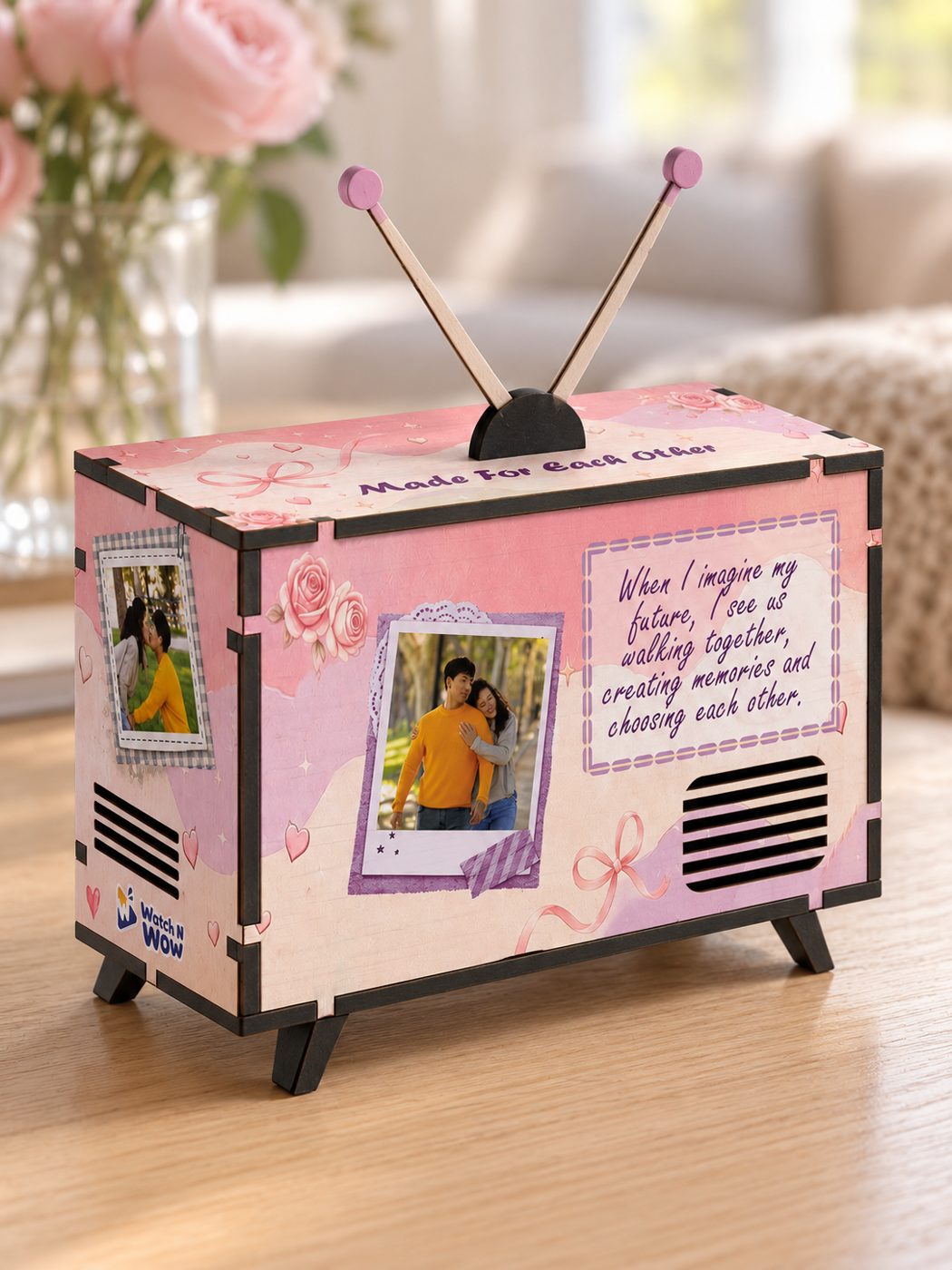
The third row is not a product category; it is a design. A framed ticket stub from the game you went to together is a thing with a moment attached. So is a recipe card in your grandmother’s handwriting, a voice message saved on something that still plays, or a photo book from one trip rather than “the year.” What unites the gifts that create memories is that the object exists because of a moment and makes that moment easy to find again.
What to actually do
Tell them something is coming
Give the recipient a before. Kumar and colleagues found waiting for experiences was more enjoyable than waiting for things, so lend your gift the shape of an experience: a date on the calendar, one clue, a reason to wonder. “Clear Sunday afternoon, bring tissues” costs nothing and converts a surprise into a wait. The failure mode is over-promising; anticipation that outruns the gift turns into the disappointment Yang and Urminsky’s recipients already report too often.
Be in the room, or build the room
Chan and Mogilner’s relationship effect came from the emotion at consumption, not receipt, and it held even when the gift was not consumed together. But Yang and Urminsky found that the giver’s own reward is tied to being present. If you can, give it in person and stay for the first use: sit through the first play of the recording, the first page of the album. If you can’t, build the moment on purpose. A video call scheduled for the opening is a moment. A box that arrives on a Tuesday with no one watching is a delivery.
Attach one specific moment, not a theme
Goodman and colleagues’ material advantage came from commemorating a specific event, and Zauberman’s participants acquired pointers for particular memories, not categories. “Our wedding” is a theme. “The rain delay at our wedding when your uncle started singing” is a moment. Put the date, the place or the line someone said on the object. A generic engraving says “custom”; a specific one says “I was there.”
Make it replayable
Van Boven and Gilovich’s three reasons experiences endure (reinterpretation, identity, retelling) all require the memory to be revisited. An object that can be played, read aloud or opened beats one that can only be looked at, because looking goes invisible within weeks and replaying does not. A song, a recorded voice, a letter that gets re-read every birthday: these are experiences stored in a thing. If you want to understand why the replay hits harder each year, read how nostalgia makes a gift feel bigger.
Keep ownership obvious
Atasoy and Morewedge’s gap between physical and digital shrank when people felt more ownership: longer expected tenure, identity relevance, control. Translate that. Their name on it. A place in the house that is theirs. Nothing that requires your login, your subscription or your phone to open. A memory stored on your account is a loan.
What not to do
Don’t buy the gasp by itself. The reaction-maximizing gift is the one givers over-choose, and once the surprise is spent the object has to earn shelf space on ordinary merits. And don’t try to recreate the special moment exactly; Zauberman’s participants avoided repeats because they feared the copy would blur the original. Point at the memory. Don’t try to overwrite it.
How to make it personal
If you have 10 minutes
Write down one moment, not a theme. The specific afternoon, who was there, the thing someone said. If you can’t produce a moment for this person, that is the real finding: you need to ask, not shop. Text their sibling or their oldest friend: “What’s the story everyone tells about them?”
If you have a weekend
Build the pointer. Collect the three to five photos that belong to that one moment, from your phone and from relatives who were there. Record yourself, or the people who were there, telling it in under two minutes. Decide on the physical form and write the three sentences that only you could write. Then set a date to hand it over, and tell them the date.
If you want it to last years
Give it a physical body and their name. Make sure it can be replayed without you: no password, no subscription, no “ask me and I’ll find the file.” Put the date of the moment on it somewhere, because dates are what people use to find things decades later. And give it in person at least once, so the object carries the memory of its own arrival.
The question to ask yourself: “Which window am I shopping for: my moment of handing it over, or their years of keeping it?”
Frequently asked questions
Are experience gifts really better than material gifts?
For relationship strength, yes, in Chan and Mogilner’s 2017 experiments with real gift exchanges, and experiences are also more pleasant to wait for (Kumar et al., 2014). But Goodman and colleagues (2016) found a material advantage when the point is to honor a specific event, and people mispredicted it. The useful question is not which category but which windows the gift covers.
What gifts last the longest?
The gifts that last tend to have three things: a physical form the person feels they own (Atasoy & Morewedge, 2018), a specific memory they point at (Zauberman et al., 2009), and a way to be replayed rather than only displayed. Price was not the deciding variable in any of these studies; specificity and permanence were.
Is it better to give a gift in person or mail it?
In person, if you can. Yang and Urminsky (2018) found givers’ reaction-seeking dropped when they wouldn’t be present, which also means the giver’s own reward depends on being there. If the gift must travel, schedule the opening: a call, a shared meal, a set time. The point is a shared first use, not the shipping.
What if the person can’t do experiences, like an elderly parent or a new mom?
Give the experience in reverse: a thing that carries one. A recorded conversation, a photo book from one specific trip, a letter read aloud at the handover. Chan and Mogilner’s effect came from emotion during use, which a replayable keepsake can deliver from an armchair. Goodman’s work suggests a commemorative object is often the better choice for milestones anyway.
How do I make a material gift feel like an experience?
Announce it so there is a wait, be present for the first use, attach one dated moment to it, and make it replayable. Each step maps to a finding: anticipation (Kumar et al., 2014), emotion during consumption (Chan & Mogilner, 2017), memory pointers (Zauberman et al., 2009) and the commemorative advantage (Goodman et al., 2016).
About the author
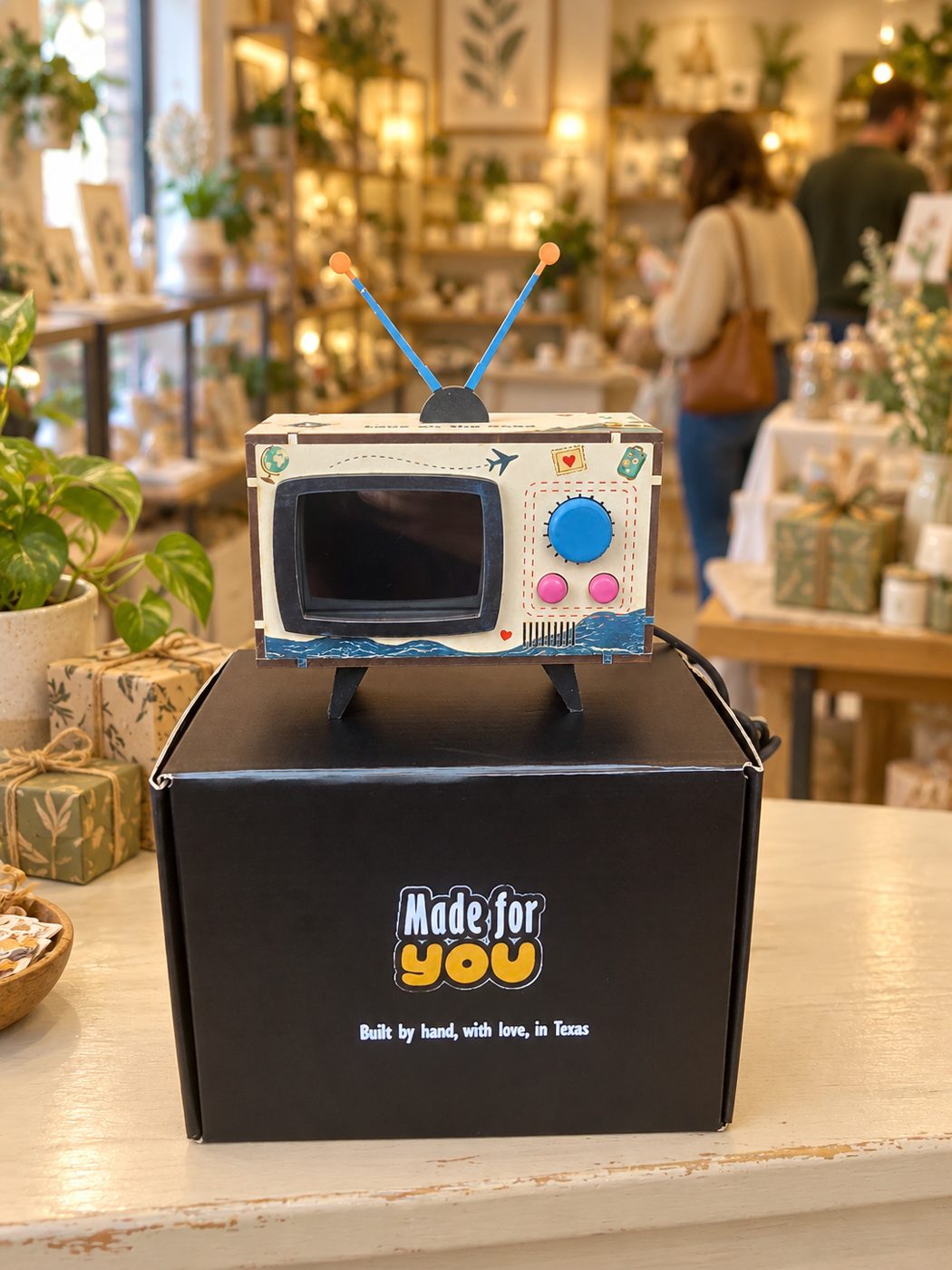
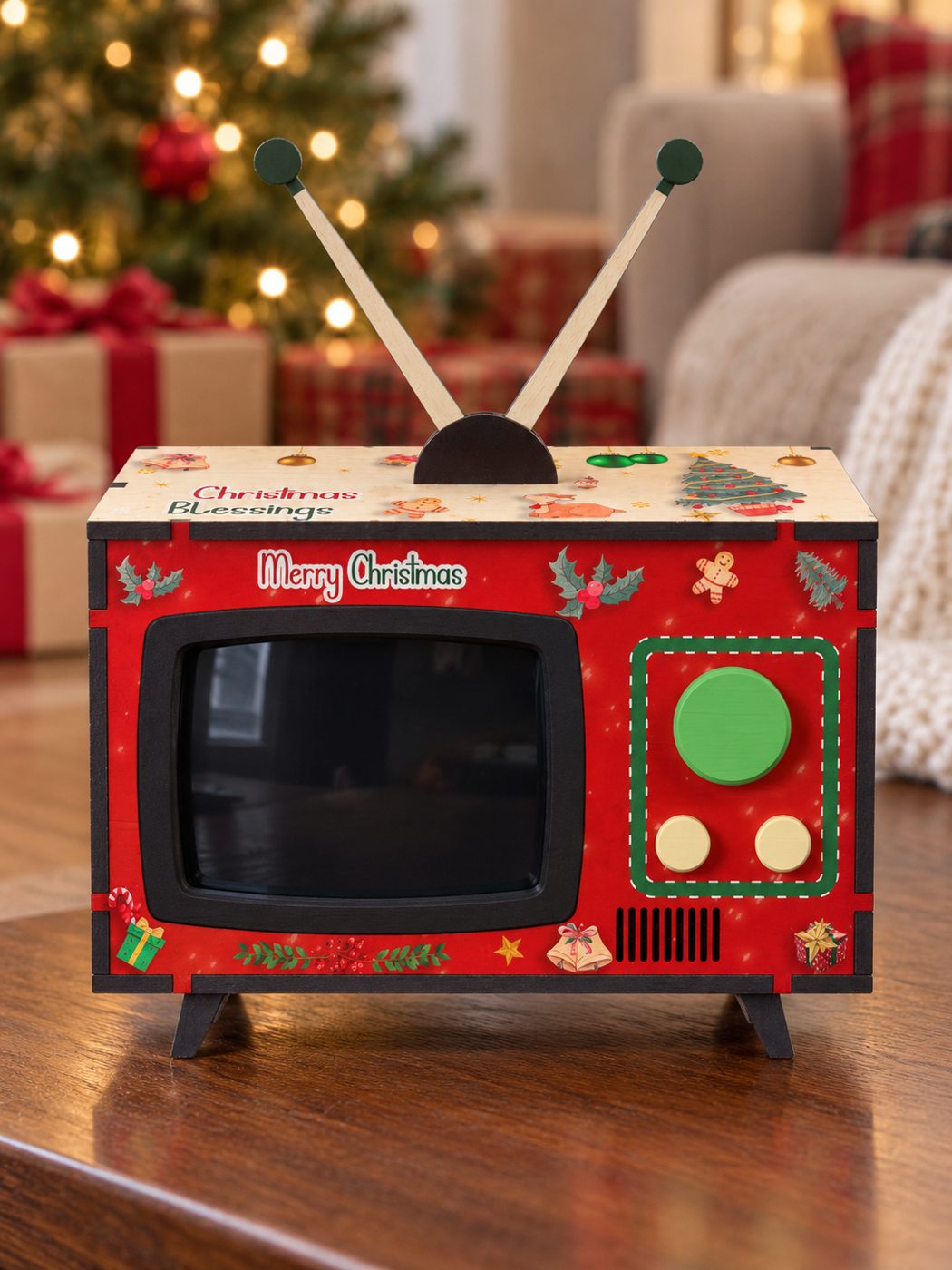
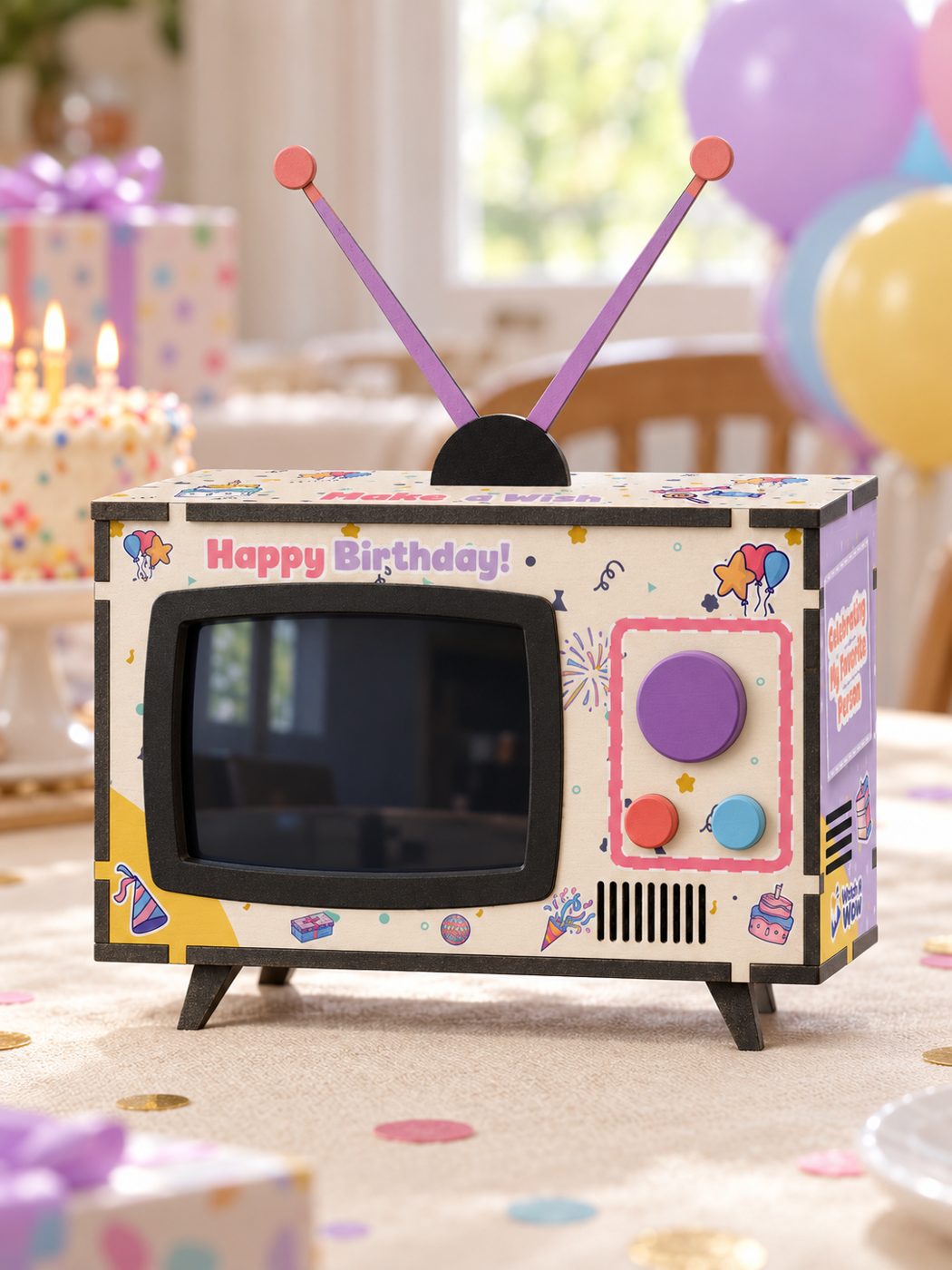
Ricky Flores is the founder of Watch N Wow and an electrical engineer with 15+ years of experience building consumer technology at Apple, Samsung, and Texas Instruments. In Dallas, Texas, he builds the Mini Memory TV by hand: a small retro TV that plays a video, a message and an original song made from your photos and your story. Read more at watchnwow.com.
Sources
- Kumar, A., Killingsworth, M. A., & Gilovich, T. (2014). “Waiting for Merlot: Anticipatory consumption of experiential and material purchases.” Psychological Science, 25(10), 1924–1931. https://doi.org/10.1177/0956797614546556
- Chan, C., & Mogilner, C. (2017). “Experiential gifts foster stronger social relationships than material gifts.” Journal of Consumer Research, 43(6), 913–931. https://doi.org/10.1093/jcr/ucw067
- Yang, A. X., & Urminsky, O. (2018). “The smile-seeking hypothesis: How immediate affective reactions motivate and reward gift giving.” Psychological Science, 29(8), 1221–1233. https://doi.org/10.1177/0956797618761373
- Van Boven, L., & Gilovich, T. (2003). “To do or to have? That is the question.” Journal of Personality and Social Psychology, 85(6), 1193–1202. https://doi.org/10.1037/0022-3514.85.6.1193
- Aknin, L. B., Dunn, E. W., & Norton, M. I. (2012). “Happiness runs in a circular motion: Evidence for a positive feedback loop between prosocial spending and happiness.” Journal of Happiness Studies, 13(2), 347–355. https://doi.org/10.1007/s10902-011-9267-5
- Atasoy, O., & Morewedge, C. K. (2018). “Digital goods are valued less than physical goods.” Journal of Consumer Research, 44(6), 1343–1357. https://doi.org/10.1093/jcr/ucx102
- Zauberman, G., Ratner, R. K., & Kim, B. K. (2009). “Memories as assets: Strategic memory protection in choice over time.” Journal of Consumer Research, 35(5), 715–728. https://doi.org/10.1086/592943
- Goodman, J. K., Malkoc, S. A., & Stephenson, B. L. (2016). “Celebrate or commemorate? A material purchase advantage when honoring special life events.” Journal of the Association for Consumer Research, 1(4), 497–508. https://doi.org/10.1086/688352