Table of Contents
What the Science of Gift-Giving Gets Wrong About Wow
Givers chase the big unboxing reaction. Research says recipients want something else entirely — and the best gifts manage to deliver both.
You know the feeling. Eleven browser tabs, a birthday nine days out, and the person you’re shopping for “has everything.” Your mom. Your grandfather. The friend who buys herself anything under fifty dollars the moment she wants it. You scroll. You add a candle to the cart. You take it back out, because it would be her third candle this year and you know exactly where the first two went: the hallway closet, still in their gift bags, tissue paper undisturbed.
We’ve all stood in that closet doorway. It’s not just candles in there. It’s the bath set, the novelty apron, the picture frame that never got a picture. A little museum of good intentions, curated by people who love each other and keep missing anyway.
Here’s the uncomfortable part. That closet isn’t full because you’re bad at gifts. It’s full because of how nearly all of us shop for them. There’s a real body of research on gift-giving, and it keeps circling one finding: givers and recipients are quietly optimizing for two different things. Givers chase a moment. Recipients live with what’s left when the moment passes.
We think about this constantly at Watch N Wow, because we build a gift that is, frankly, an attempt to cheat that trade-off. But before we get to our little TV, let’s walk through the science honestly, including the part that should make anyone selling “wow” a little nervous.
The smile trap
In 2018, researchers Adelle Yang and Oleg Urminsky published a paper in Psychological Science with a name that gives the game away: the smile-seeking hypothesis. Their finding, in plain English: gift givers systematically favor gifts they expect will produce a strong reaction right at the moment of exchange. The gasp. The grin. The phone coming out to film it. Recipients, meanwhile, put more weight on something far less photogenic: how valuable the gift will actually be to own and use over time.1
Read that again, because the gap is not small. The giver is buying a reaction. The recipient is receiving an object. Those are different products that happen to share a box.
And the giver’s logic makes emotional sense. The exchange is the only part of the gift’s life we get to watch. We hand it over, we see the face, and then the thing disappears into someone else’s home and someone else’s routine. Of course we optimize for the one scene we appear in. The unboxing is our whole movie — for the recipient, it’s the opening credits.
Givers buy the reaction. Recipients keep the object. Those are two different products that happen to share a box.
None of this makes givers shallow. It makes them human. It also explains an enormous amount about that closet.
Where the flashy gift falls apart
So suppose you lean into wow. A drone. A massage gun shaped like a power tool. Anything that lights up. And the moment delivers: real surprise, real laughter, a genuinely great thirty seconds. You drive home feeling like a champion.
Then February happens. The drone has flown twice, once into a fence. The massage gun lives under the bed with the resistance bands. The reaction-optimized gift has a weakness the research predicts perfectly: once the surprise is spent, the object has to earn its shelf space on ordinary merits, and it usually can’t, because it was chosen for the gasp and not for the years.
Flip it around and the practical gift has the mirror-image problem. The recipient may quietly appreciate a very good cutting board for a decade. But the exchange itself lands with a thud. You watch them say “oh, nice” in the tone people reserve for cutting boards, and some small part of you deflates. Nobody films the unboxing of a slow cooker.
The gift card deserves a mention here, because it’s the strange truce in this whole war. Recipients tend to be perfectly fine with them. Givers squirm, and now you know why: a gift card produces no scene. Nothing to watch, nothing to film, no face to see. Which quietly reveals what part of the purchase was for us all along.
That’s the real bind, and it’s worth saying plainly: most gifts force you to pick a lane. Thrilling now, or valued later. And because givers do the choosing, the smile-seeking bias usually wins, the closet fills, and everyone politely pretends this is fine.
What the relationship actually remembers
Here’s where the research gets more interesting, because it doesn’t stop at “buy practical things.”
In 2017, Cindy Chan and Cassie Mogilner published a study in the Journal of Consumer Research comparing experiential gifts, like tickets or a dinner out, with material ones. The experiential gifts did more to strengthen the relationship between giver and recipient.2 But the mechanism is the part worth writing on your hand before you shop: the relationship boost came from the emotion the recipient felt while consuming the gift. Not while opening it. The two hours inside the concert did the work, not the envelope the tickets arrived in.
That finding sits on top of an older, famous one. In 2003, Leaf Van Boven and Thomas Gilovich showed in the Journal of Personality and Social Psychology that experiential purchases tend to produce more enduring happiness than material ones.3 Part of the reason is what happens afterward: experiences get retold. They come up at dinner. They improve slightly with each telling, the way family stories do. Over time they stop being things that happened to you and become part of who you are. A material thing mostly sits there. An experience becomes identity. (Think about which stories your family repeats at every holiday table. They’re almost never about objects, unless the object caught fire.)
Put the two findings together and the assignment changes shape. A great gift isn’t really an object, and it isn’t only a moment either.
A great gift is a delivery mechanism for repeated feeling.
Which raises an obvious question: can an object be built to behave like an experience?
Nostalgia is doing heavier lifting than you think
There’s one more branch of research that gift guides almost never mention, and it may be the most useful one here.
Since around 2006, psychologists Constantine Sedikides and Tim Wildschut have been running a long research program on nostalgia. For most of the twentieth century, nostalgia had a terrible reputation, filed somewhere between homesickness and a mild disorder. Their work flipped that completely. Across study after study, nostalgic reflection reliably increases social connectedness, strengthens self-continuity (the felt thread between who you were and who you are now), and raises people’s sense that life is meaningful.4
In plain terms: remembering together is good for us. Not as a sentimental indulgence. As psychological maintenance, like stretching, except for the self.
That reframes the whole “memory gift” category. A gift built from someone’s own past isn’t merely sweet. It’s a trigger for exactly the kind of reflection this research keeps finding benefits in. And unlike a vacation or a concert, it can fire on a random Tuesday. The kids at the lake in 2009. Your grandfather laughing at his own joke before he reaches the punchline. Each replay is a small dose of connectedness and continuity, available on demand, no plane ticket required.
Why most memory gifts only get halfway there
So personalized memory gifts should be the perfect answer, right? Mostly, honestly: no. And we say that as a company that sells one.
Walk through the usual suspects. The photo mug is personal, but the unboxing lands soft (“a mug, with our faces, great”), and by March it’s just the mug at the back of the cabinet. The canvas print carries real meaning, but decorators have a phrase for what happens to wall art: it goes invisible. After a few weeks you stop seeing what hangs in your own hallway. It doesn’t do anything. It can’t be turned on. The photo book might be the most honest of the bunch, and it lives in a drawer, opened twice a year, usually while someone is hunting for something else.
Notice the pattern. Each of these chooses meaning over moment, and then the meaning goes static. They’re memories in storage, not memories in play. Meanwhile the novelty gifts choose the moment and forfeit the years. Almost nothing in the category genuinely delivers both, and “just put a photo on it” doesn’t automatically get you there.
What would? Something that surprises like a wow gift at the exchange, then behaves like an experience ever after. Playable. Rewatchable. Showable to guests. Something that makes the memory move instead of framing it.
A small case study in threading the needle
This is the part where we tell you what we make, and you can hold it up against the research yourself.
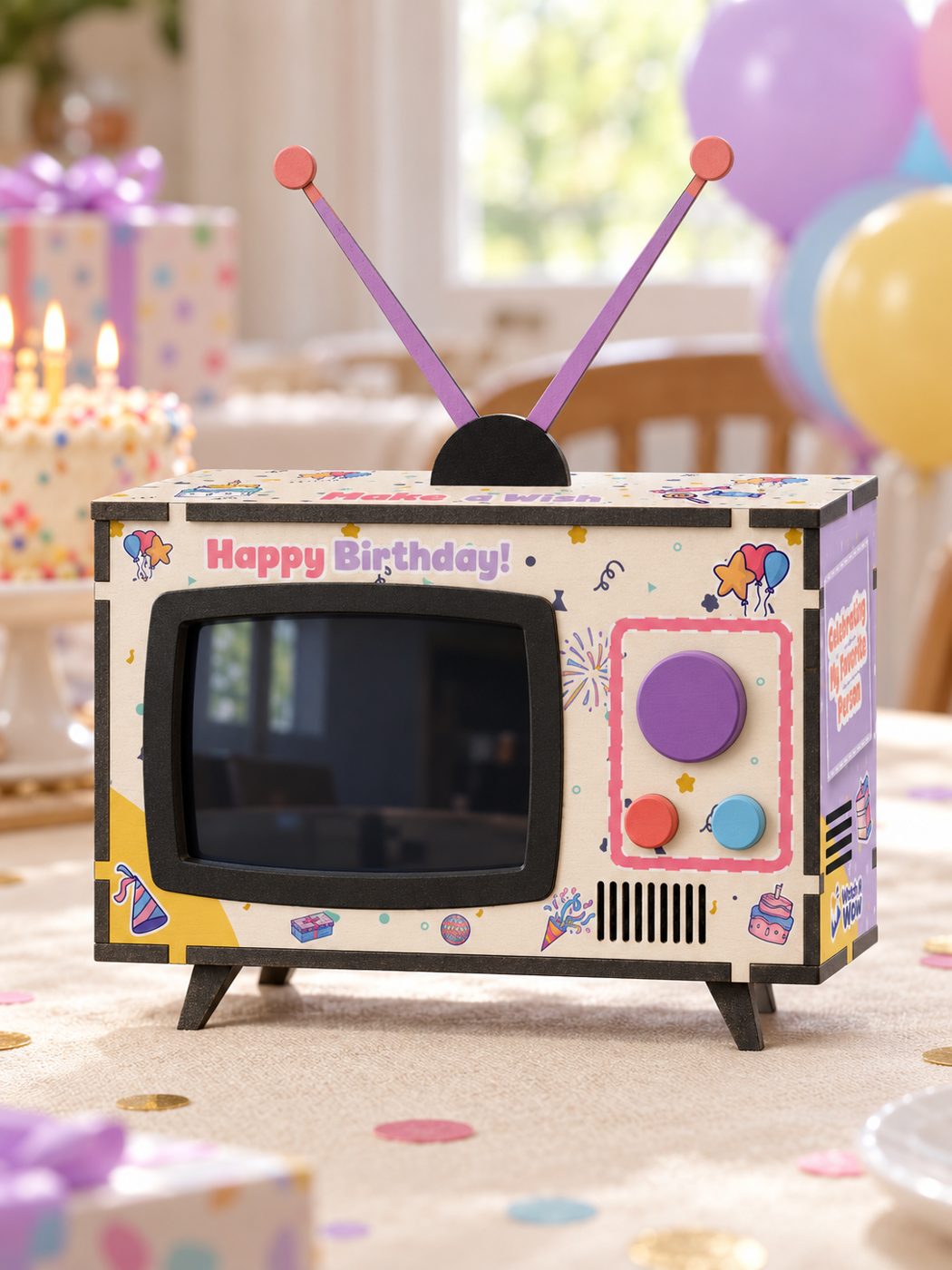
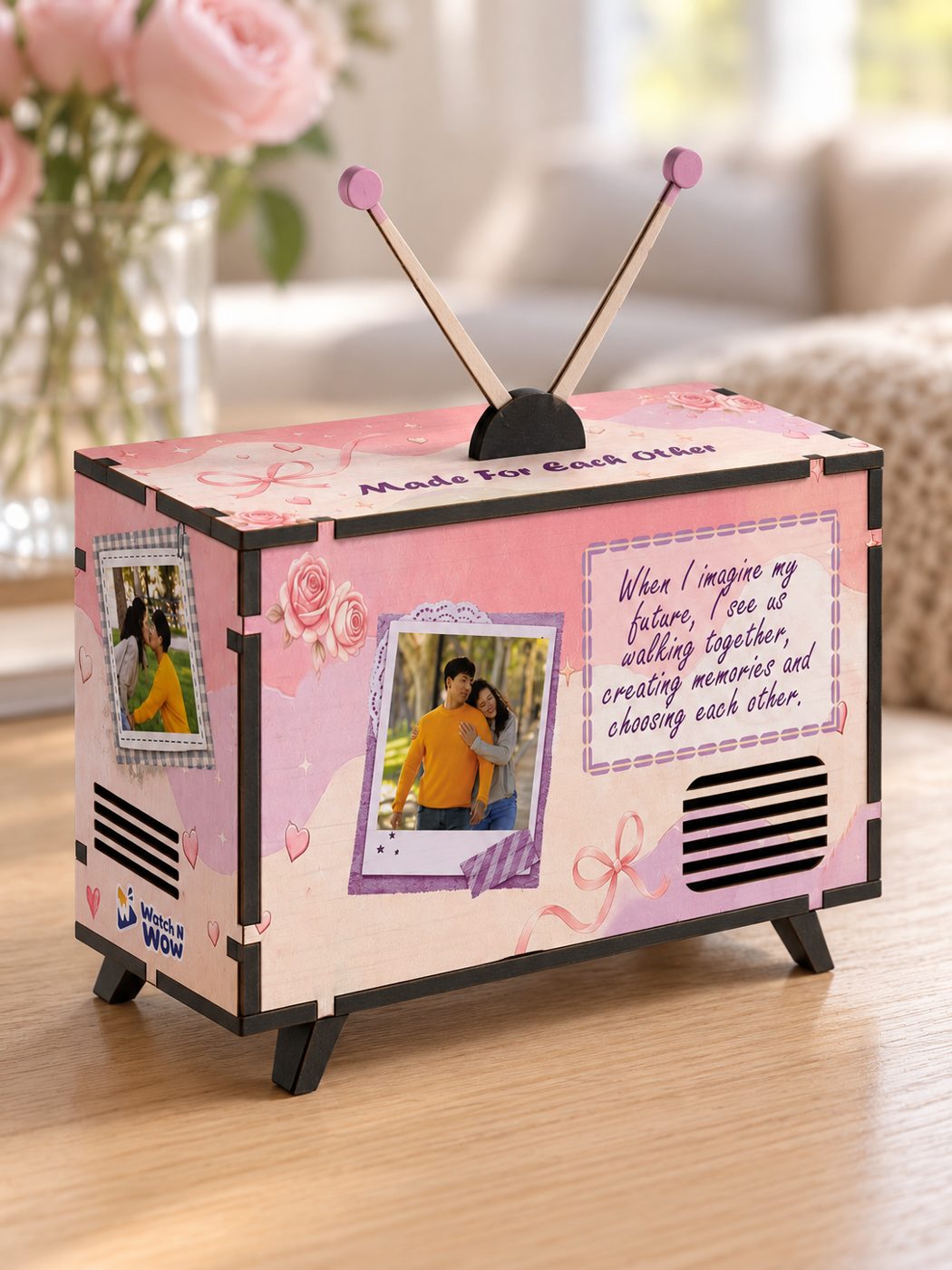
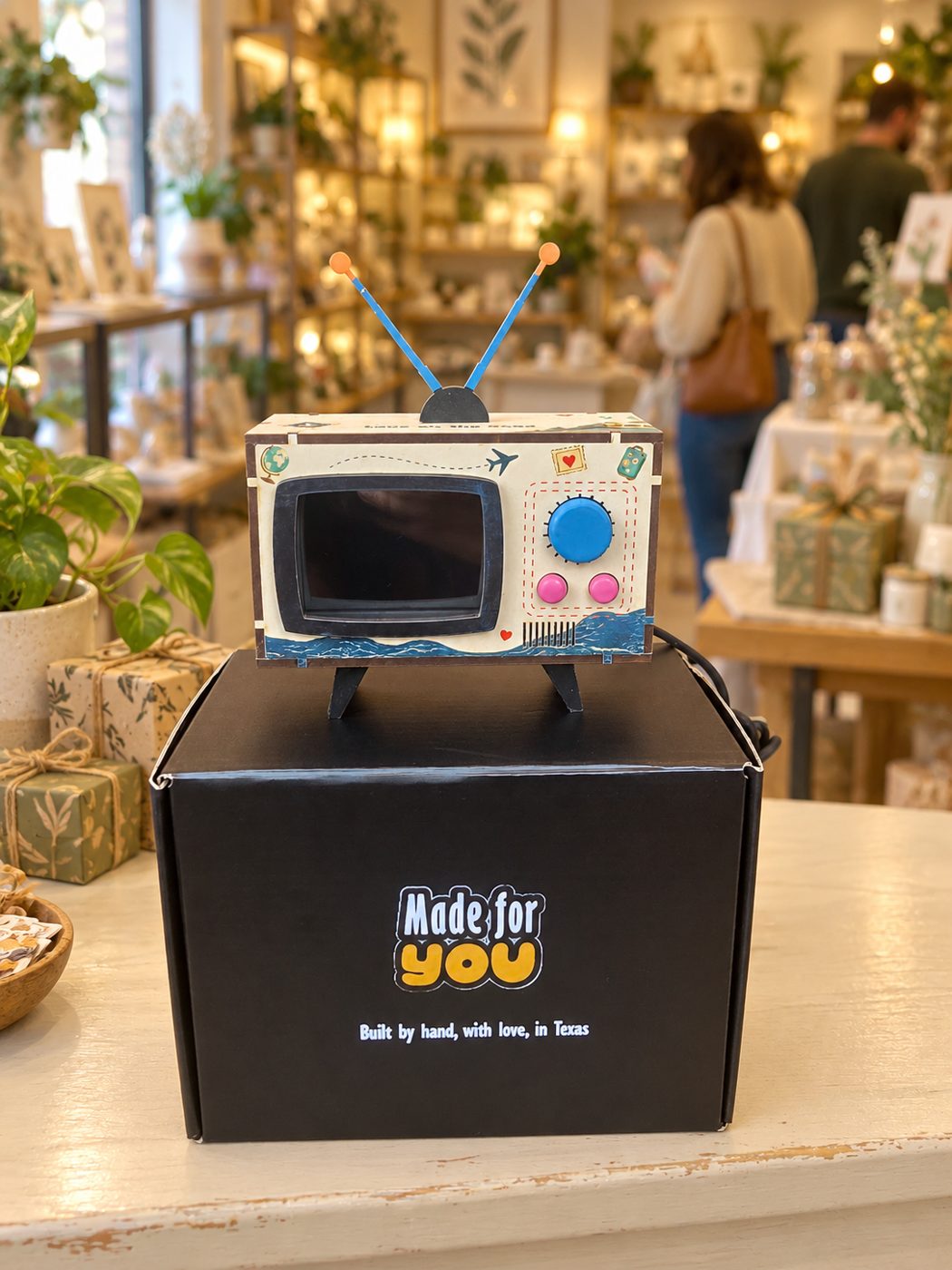
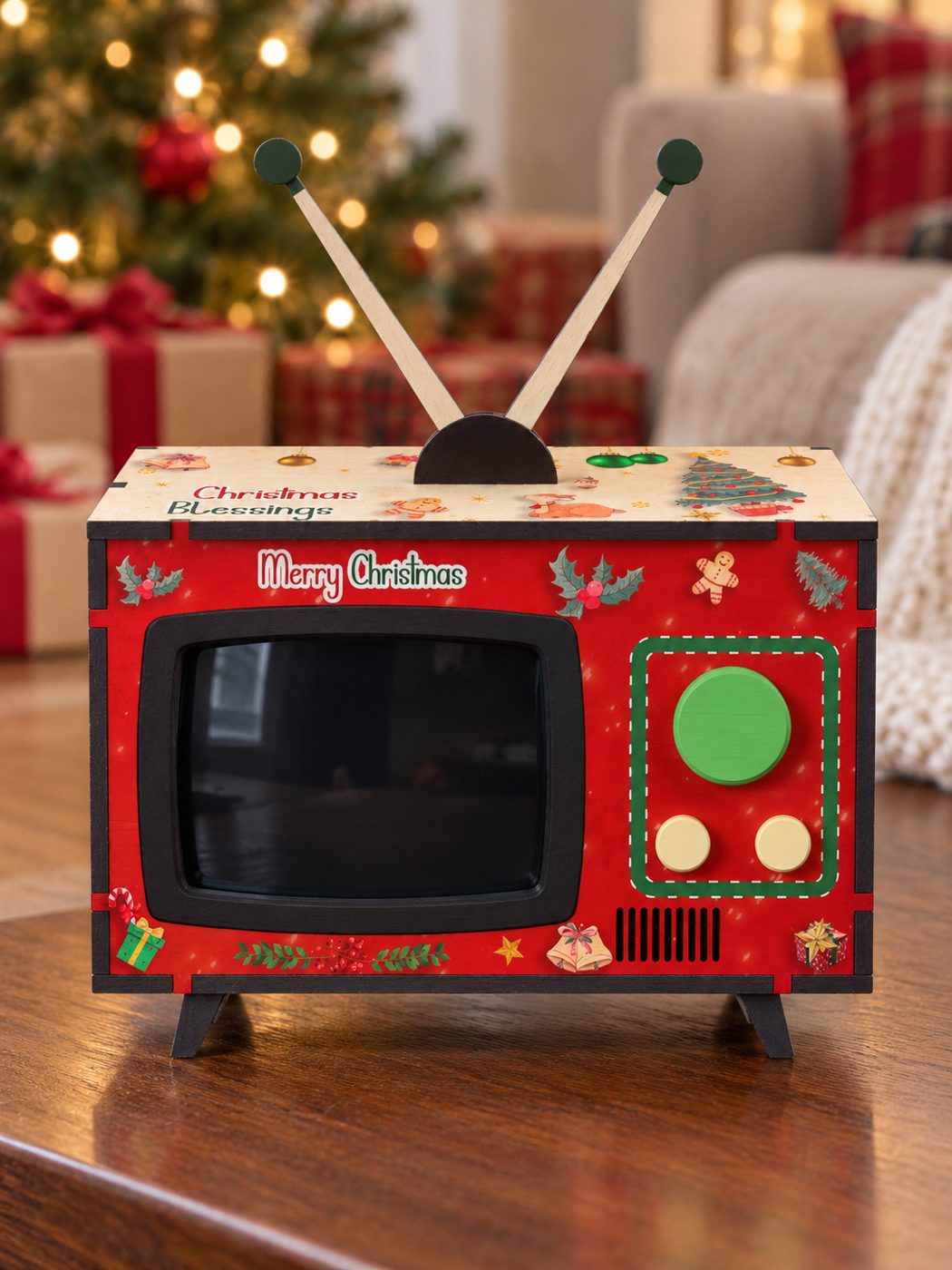
The Mini Memory TV is a small handcrafted retro television. Five inches wide, just shy of three inches tall (5.8 once you count the antenna and the little legs), under two inches deep. It sits in an open palm. Inside is a real screen, and on that screen plays a video built from your own photos and clips, scored with a custom song composed by AI for that one person. You build the whole thing online in minutes: choose from 17 artwork designs, add your own words in each design’s own typefaces, load in the photos and clips, and the finished TV ships to you already loaded, ready to hand over. From $80. No design skills required, either. The words you type are set in typefaces matched to the artwork you picked, so a nickname across the front looks like it rolled off a factory line that somehow knew your family.
Now map it against everything above. At the exchange: a tiny television that switches on and starts playing someone’s own life, set to a song that didn’t exist last week. That’s the gasp Yang and Urminsky’s givers are chasing, and it’s earned honestly rather than borrowed from novelty. After the exchange: it lives on a shelf and plays on demand. It gets switched on when the person it’s about walks in the door. It’s the object visitors get shown, which matters, because showing is retelling, and retelling is the Van Boven and Gilovich mechanism working exactly as described.
The video travels, too. Every order includes a downloadable copy, and at the end of the video a QR code appears that opens a private share page, so the film inside the TV can reach phones across the whole family. Picture an aunt who has watched the same 60-second video eleven times and tears up at the same eight-second mark every time. That’s not a malfunction. According to Sedikides and Wildschut, that’s the maintenance schedule.
We won’t claim a small Texas company has repealed the laws of gift-giving; the closet is undefeated, and some candles are genuinely lovely. But we did build the Mini Memory TV around what the research keeps saying: the moment matters, the years matter more, and memory is one of the few materials that can carry both at once. If someone you love has a shelf that needs a reason and a camera roll nobody rewatches, you can build them one in a few minutes at watchnwow.com.
Sources & research
-
Yang, A. X., & Urminsky, O. (2018). “The Smile-Seeking Hypothesis: How Immediate Affective Reactions Motivate and Reward Gift Giving.” Psychological Science. ↩
-
Chan, C., & Mogilner, C. (2017). “Experiential Gifts Foster Stronger Social Relationships Than Material Gifts.” Journal of Consumer Research. ↩
-
Van Boven, L., & Gilovich, T. (2003). “To Do or to Have? That Is the Question.” Journal of Personality and Social Psychology. ↩
-
Sedikides, C., & Wildschut, T. (2006–present). Research program on nostalgia and its links to social connectedness, self-continuity, and meaning in life. Journal of Personality and Social Psychology and related journals. ↩