Table of Contents
Funny Sentimental Gifts for a Partner Who Prefers Humor to Poetry
Funny sentimental gifts for a partner who'd rather laugh than cry: what the research on humor says about inside jokes, teasing and where to draw the line.
Some people cry at the end of every movie. Your partner is not one of those people. Give them a sonnet and they’ll read it in a dramatic voice. Give them a framed quote about soulmates and it’ll end up in the guest bathroom as a bit.
That doesn’t mean they don’t want sentiment. It means they want it in their language. Funny sentimental gifts for a partner like this are built on the jokes the two of you already share: the mispronounced word, the disastrous camping trip, the running gag about the neighbor’s cat. The research on humor in relationships says this isn’t a lesser form of romance. Done right, it may be one of the strongest. Done wrong, it’s one of the few gifts that can actively hurt.
Key Takeaways
- A meta-analysis of 43 samples and 15,177 participants found positive types of humor were linked to higher relationship satisfaction, and most negative types to lower satisfaction (Hall, 2017).
- Shared, relational humor showed the largest link with satisfaction; your own sense of humor rated alone showed only small links (Hall, 2017). The jokes that matter are the ones you share.
- Couples who spent more of a “how we met” conversation laughing together reported higher relationship quality and closeness (Kurtz & Algoe, 2015).
- Teasing is a playful provocation that can turn affiliative or hostile depending on context and who’s doing it (Keltner et al., 2001). Know the line.
- The rule: laugh about a shared moment, never at their insecurity; keep it private unless they’d tell the joke themselves.
When poetry doesn’t fit your relationship
People with humor-first partners describe the dilemma clearly. “Every sentimental gift I find is so cheesy he’d laugh at it, and not in a good way.” “She hates sappy stuff but I still want her to know I mean it.” “Our whole relationship is inside jokes. How do I make a gift out of that?” “I got him a funny mug and it felt like I didn’t try.”
That last one is the real risk. The obvious funny gift, a novelty item with a generic joke, often reads as low effort. It’s funny to anyone, which means it’s about no one. The sentimental gift, meanwhile, feels like a costume. Neither fits.
The space between is where the best gifts for these couples live: specific, affectionate, built from a joke only the two of you get, with a sincere sentence hiding underneath. The humor is the wrapping. The meaning is inside.
What the research actually says
Shared humor matters more than being funny
Jeffrey Hall’s meta-analysis in Personal Relationships (2017) combined 43 samples from 39 studies, 15,177 participants with an average age of 34. He sorted humor along three dimensions: within-person versus relational, positive versus negative, and instrumental versus content-free. All six positive types of humor were positively associated with relationship satisfaction. Four of five negative types were negatively associated. Instrumental humor (using humor to get something, like to defuse a fight) had no association.
The most useful finding is the relational dimension. A person’s self-reported humor showed small associations with satisfaction. Partner-perceived humor showed medium effects. Relational humor, the humor a couple creates and shares together, showed large effects. In other words: being funny isn’t what predicts a happy relationship. Being funny together is.
That’s the case for building a gift from your inside jokes rather than buying something “funny.” A store-bought joke is within-person humor at best. An inside joke is relational by definition.
Laughing together is a marker of closeness
Laura Kurtz and Sara Algoe (Personal Relationships, 2015) recorded 71 couples talking about how they met and coded every laugh. Controlling for all other laughter, the share of the conversation spent laughing simultaneously with the partner was uniquely associated with higher relationship quality, closeness and social support. It wasn’t laughing in general. It was laughing at the same time, at the same thing.
Reminiscing about laughter raised satisfaction
Doris Bazzini and colleagues (Motivation and Emotion, 2007) randomly assigned 52 couples to one of four reminiscing tasks. Couples who reminisced about shared laughter reported higher relationship satisfaction afterward than those in the three control conditions, and the difference wasn’t explained by mood. A gift that brings back a funny shared memory is, in effect, a reminiscence prompt.
Laughter opens people up
Alan Gray, Brian Parkinson and Robin Dunbar (Human Nature, 2015) showed participants video clips that made them laugh more or less, then had them write self-disclosing statements. After laughter, observers rated people’s disclosures as more intimate, though participants themselves didn’t notice the change. This is why the funny-then-sincere structure works: the joke lowers the guard, and the sincere line lands in the opening.
Teasing has a line, and context sets it
Dacher Keltner and colleagues reviewed the research on teasing in Psychological Bulletin (2001). They defined a tease as a playful provocation commenting on something relevant to the target, and showed teasing can lead to affiliative or hostile outcomes. Teasing was more frequent and more hostile when it came from higher-status and familiar others. Gift translation: the same joke that’s affectionate between the two of you at home can feel like a dig in front of their boss or their family.
Limits: Hall’s meta-analysis is correlational; humor may reflect a good relationship as much as create one. Kurtz and Algoe’s sample was heterosexual couples. Gray’s study used strangers and video clips. None tested gifts.
Which kind of humor makes a good gift
The table sorts humor types by how they translate into gifts, using Hall’s positive/negative split and Keltner’s teasing research.
| Humor type | Gift example | Lands well because | Risk | Evidence |
|---|---|---|---|---|
| Shared inside joke (relational, positive) | A framed “certificate” for the time they parallel-parked in one try; a custom crossword of your running gags | Only you two get it; relational humor has the largest link to satisfaction | Low, if private | Hall 2017 |
| Funny shared memory | A short video or photo book of your best disasters, with captions | Reminiscing about shared laughter raised satisfaction | Low | Bazzini et al. 2007; Kurtz & Algoe 2015 |
| Self-deprecating from the giver | A card listing your own worst habits with an apology coupon | Shows vulnerability; puts the joke on you | Can undercut the sincere part if overdone | No direct study; keep it light |
| Gentle tease about a harmless quirk | A mug that says “World’s Okayest Parallel Parker” | Affectionate if the quirk is one they joke about too | Becomes hostile if it touches an insecurity | Keltner et al. 2001 |
| Joke about their insecurity (weight, job, family) | Any | Doesn’t land | High; negative humor linked to lower satisfaction | Hall 2017; Keltner et al. 2001 |
| Generic novelty gift | Store-bought joke item | Quick | Feels like no effort; not relational | Hall 2017 (within-person humor small effect) |
The pattern is clear: the more the joke belongs to both of you, the better the gift. The more it targets one of you, the riskier.
What to actually do
Build it from a joke you both already tell
List the running gags: the word they mispronounce, the song you both hate-love, the vacation that went sideways, the made-up name for the neighbor’s dog. Choose the one you both bring up without prompting. That’s relational humor in Hall’s sense, and it’s the material that predicts satisfaction.
Put one sincere line under the joke
Gray’s laughter-and-disclosure finding suggests a structure: make them laugh first, then say the real thing. A fake “award certificate” for surviving your cooking, signed, with one handwritten line at the bottom: “Seriously, you make every bad dinner a good night.” The joke gets them to read it. The line is why they keep it.
Run the insecurity check
Before you commit, ask: is this about something they joke about themselves, or something they’re sensitive about? A quirk they laugh at is fair game. Their weight, their job, their family, their age, unless they lead those jokes, is not. Keltner’s review shows the same tease can be affectionate or hostile depending on context.
Keep it private by default
Give the funny gift at home, or somewhere only close friends will see. Keltner found teasing turns more hostile in some social contexts. A joke that’s sweet between two people can sting in front of an audience, and posting their reaction online adds an audience you can’t control.
Make the funny memory replayable
Collect your best shared disasters into something they can revisit: a photo book of “times we got lost,” a short video of bloopers, a playlist of the songs from your worst road trip. Bazzini’s reminiscence finding suggests the laughing-again is part of the benefit.
What not to do
Don’t use a gift to make a point disguised as a joke (“a book on punctuality, haha”). That’s instrumental humor at best, a criticism at worst. And don’t make the whole gift a bit with no sincere moment; for a partner who deflects with humor, the one serious line may be the part they needed.
How to make it personal
If you have 10 minutes
Write down your three most-repeated inside jokes. Under each, write the true thing it secretly says (“the parallel-parking joke” = “I trust you with the car and with everything else”). Pick one pair. That’s your gift and your card.
If you have a weekend
Make a small “museum of us”: three to five framed or boxed items from your funniest shared moments, each with a deadpan museum label, and one last label that’s sincere. For ideas on giving it a lasting form, see why a gift with a moment attached lasts longer.
If you want it to last years
Start a running record of your jokes: a notebook, a shared note, a jar. Add to it every month. In ten years it’ll be a history of your relationship told entirely in bits, which for some couples is the most accurate history there is. Our piece on turning your first-date story into a gift is a good place to find the first entry.
The question to ask yourself: “Would my partner tell this joke about themselves?”
Frequently asked questions
What is a good sentimental gift for someone who isn’t sentimental?
Something built on an inside joke you share, with one sincere line hidden inside. Hall’s 2017 meta-analysis found shared, relational humor had the strongest link to relationship satisfaction, so a joke only you two get can carry more meaning than a sappy quote.
Are funny gifts romantic?
They can be. Couples who laughed together more while describing how they met reported higher relationship quality (Kurtz & Algoe, 2015). The romance comes from the joke being shared and specific, not generic.
How do I make a funny gift without being mean?
Laugh about a shared moment, never at your partner’s insecurity, and only use quirks they joke about themselves. Keltner and colleagues (2001) found teasing can turn hostile depending on context, so keep it private and affectionate.
What are some inside joke gift ideas?
A fake award certificate for a shared running gag, a custom crossword or bingo card of your phrases, a framed “museum label” for a ridiculous object you kept, a photo book of your best disasters, or a playlist from a trip that went wrong. Add one sincere sentence to each.
Is a gag gift appropriate for an anniversary?
A generic gag gift often reads as low effort. A personalized joke gift paired with a sincere note can work well for humor-first couples. Hall (2017) found humor you create together matters far more than humor that’s simply funny.
About the author
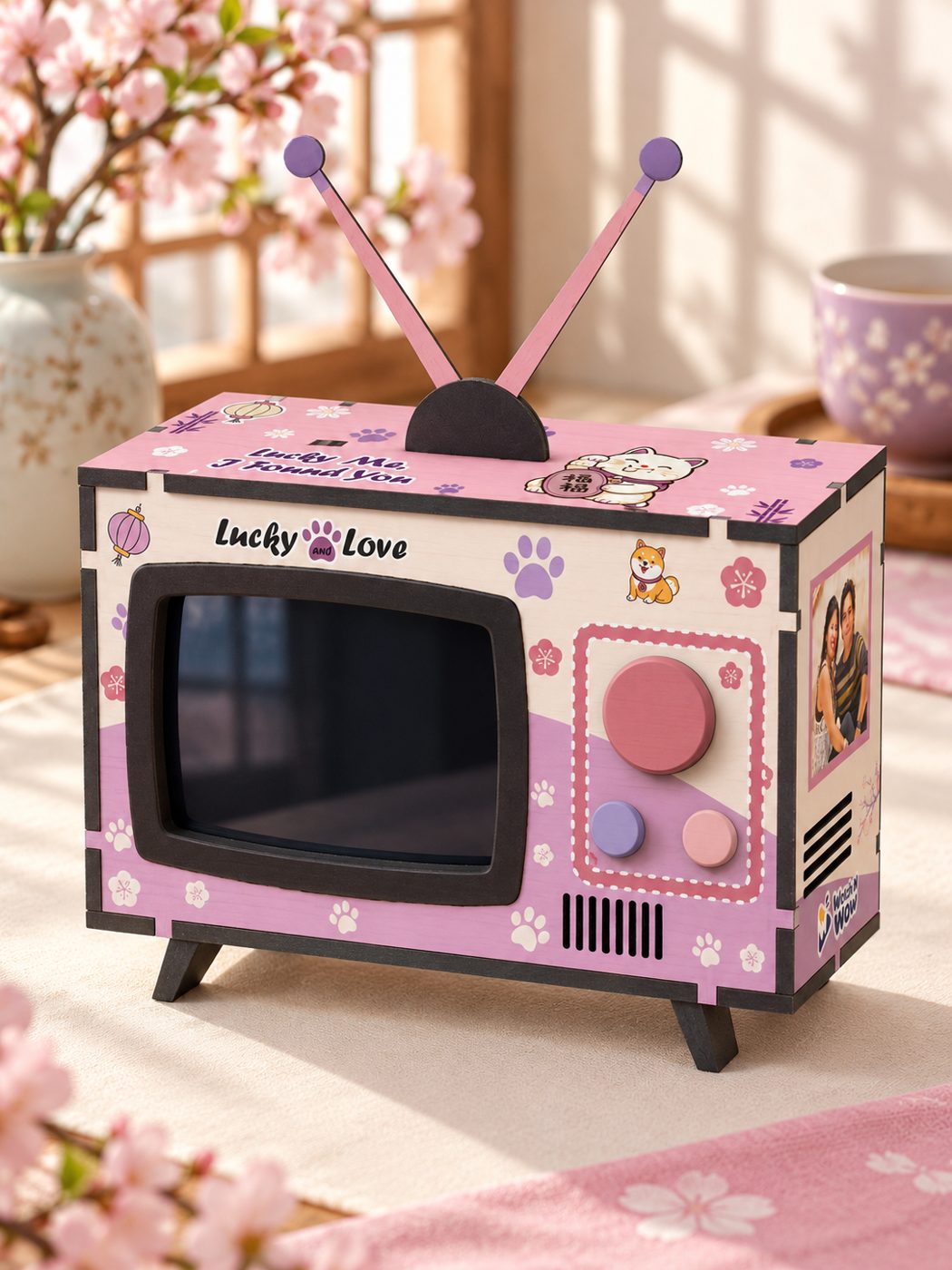
Ricky Flores is the founder of Watch N Wow and an electrical engineer with 15+ years of experience building consumer technology at Apple, Samsung, and Texas Instruments. In Dallas, Texas, he builds the Mini Memory TV by hand: a small retro TV that plays a video, a message and an original song made from your photos and your story. Read more at watchnwow.com.
Sources
- Hall, J. A. (2017). “Humor in romantic relationships: A meta-analysis.” Personal Relationships, 24(2), 306–322. https://doi.org/10.1111/pere.12183
- Kurtz, L. E., & Algoe, S. B. (2015). “Putting laughter in context: Shared laughter as behavioral indicator of relationship well-being.” Personal Relationships, 22(4), 573–590. https://doi.org/10.1111/pere.12095
- Bazzini, D. G., Stack, E. R., Martincin, P. D., & Davis, C. P. (2007). “The effect of reminiscing about laughter on relationship satisfaction.” Motivation and Emotion, 31(1), 25–34. https://doi.org/10.1007/s11031-006-9045-6
- Gray, A. W., Parkinson, B., & Dunbar, R. I. (2015). “Laughter’s influence on the intimacy of self-disclosure.” Human Nature, 26(1), 28–43. https://doi.org/10.1007/s12110-015-9225-8
- Keltner, D., Capps, L., Kring, A. M., Young, R. C., & Heerey, E. A. (2001). “Just teasing: A conceptual analysis and empirical review.” Psychological Bulletin, 127(2), 229–248. https://doi.org/10.1037/0033-2909.127.2.229