Table of Contents
How Much Personalization Is Too Much? Personalized Gift Etiquette
Personalized gift etiquette: where names, photos and private jokes help, and where they make a gift awkward to use or display. A research-backed guide.
Good personalized gift etiquette comes down to one test: does the personal detail make the gift easier to love, or harder to live with? A name on a cutting board passes. Your partner’s face printed on a throw pillow for the living room, where her coworkers will sit during the holiday party, might not.
Most of us have opened one of these. The shirt with a private nickname on the back. The mug with a wedding photo that includes an ex-sister-in-law. The calendar where every month is the same person’s face. The giver meant well, and the item went into a closet, not because the recipient was ungrateful but because there was nowhere to put it.
Key Takeaways
- Givers who try hardest to be thoughtful tend to over-tailor: shopping for several people, they pick unique gifts even when recipients would like a shared option better (Steffel & LeBoeuf).
- Receivers weigh how usable a gift is more than givers do (Baskin et al.), and heavy personalization often reduces where a gift can be used or displayed.
- The line usually isn’t the amount of personalization but its audience: details meant for two people shouldn’t be printed for a room.
- Anyone else in the photo gets a vote. Children in one survey voiced frustration with parents posting about them online (Hiniker et al.), a useful reminder that personal images carry other people’s privacy.
- One meaningful detail, placed where the recipient controls who sees it, usually beats ten.
The real complaint behind “too personalized”
When people describe an over-personalized gift, they rarely say “it was too thoughtful.” They say “I can’t use it at work,” “my in-laws would see it,” “it’s his face, on everything,” or “I didn’t want my kid’s photo on display for every guest.” The objection is almost always about exposure or flexibility, not about meaning.
Three things tend to cross the line:
- Audience mismatch. A private joke or pet name printed on something public. What is sweet between two people can feel like oversharing in a shared kitchen or an office.
- Lost versatility. A gift so specific it fits one room, one outfit or one moment. Monogrammed luggage is lovely until it needs to be lent, sold or replaced.
- Other people’s images. Group photos, children, former partners, people who have passed away. The recipient now has to decide whether to display someone who didn’t agree to be on a pillow.
None of this means personalization is bad. It means it has a placement problem.
What the research says about over-tailoring
Thoughtfulness can push givers to over-individuate
Mary Steffel and Robyn LeBoeuf, in a set of six experiments published in the Journal of Consumer Research, studied people shopping for more than one recipient. Givers tended to pass up gifts that would be better liked in favor of giving each person something different, even when the recipients would never compare. The cause wasn’t misjudging preferences; it was the effort to treat each person as unique. Encouraging givers to be “thoughtful” made the effect stronger, and focusing them on what recipients actually prefer reduced it. Personalization runs on the same fuel: a strong wish to make a gift unmistakably “theirs” can override the question of whether they’ll like it.
Receivers think about everyday use
Ernest Baskin and colleagues, also in the Journal of Consumer Research, found that givers construe gifts abstractly and weigh desirability, while receivers give more weight to feasibility: how easy the gift is to use. A highly personalized item scores high on desirability in the giver’s head (“it has her name and our photo!”) and can score low on feasibility in the receiver’s home (“where would this go?”).
Customizing for others raises expectations
C. Page Moreau, Leff Bonney and Kelly Herd, in the Journal of Marketing, ran real customization tasks on working websites. People designing products as gifts valued their own time and effort more and were willing to pay more than people designing for themselves. Design support, though, was less effective for gift designers: it raised their expectations without raising their evaluations. A practical reading: when you customize for someone else, it’s easy to feel that more effort equals a better gift, while the recipient only sees the result.
Gifts can threaten the giver’s identity too
Morgan Ward and Susan Broniarczyk, in the Journal of Consumer Research, found that buying a gift that runs against your own identity for a close friend can feel threatening to the giver, who later reasserts their identity. This cuts the other way as well: personalization that reflects the giver’s taste more than the recipient’s can turn a gift into a statement about the giver.
Images carry other people’s privacy
Alexis Hiniker, Sarita Schoenebeck and Julie Kientz surveyed 249 parent–child pairs across 40 U.S. states about family technology rules. Among their findings, children (ages 10–17) expressed frustration with the common parent practice of posting about them online. A printed gift isn’t a social media post, but the principle carries over: a photo of a person is partly theirs, and displaying it is a choice they may want a say in.
These studies weren’t designed to measure “too much personalization” directly. Together, they point to a consistent pattern: givers optimize for meaning at the moment of giving, receivers live with the object afterward.
Where personal details help and where they backfire
Use this matrix to check a detail before you commit to it.
| Detail | Usually helps when… | Usually backfires when… | Safer alternative |
|---|---|---|---|
| Their name or initials | Item is theirs alone (journal, tool, robe) | Item may be shared, lent or resold | Initials inside, not outside |
| A photo of the two of you | Displayed where they choose (desk, nightstand) | Printed on public-facing items (pillows, shirts) | Small frame or a photo inside a lid |
| Children’s photos | The child is young and the gift stays at home | Teens, or items seen by guests and coworkers | Ask the child; use a drawing they made |
| Private joke or pet name | Hidden or only legible to the recipient | Visible to family, office or strangers | Engrave on the back or the inside |
| Group or family photos | Everyone in it is still in the picture, so to speak | Includes exes, estranged relatives, the recently deceased | Crop, or pick a candid with fewer people |
| Dates and places | A milestone they’re proud of | A painful date, or a place tied to a hard memory | Let them choose what to commemorate |
| Many details at once | Each detail does a different job | It all repeats the same face or name | One strong detail, well placed |
The thread running through the table is control. When the recipient decides who sees a personal detail, it reads as intimate. When the object decides for them, it can read as exposure.
What to actually do
Decide who the audience is before what the detail is
Ask where the gift will live. Kitchen counters, office desks, cars and clothing are seen by others. Nightstands, journals, the inside of a watch and phone lock screens are not. Put the most private details in the most private places.
Keep one strong detail and cut the rest
The urge to add the name, the date, the photo and the quote is the over-individuation instinct Steffel and LeBoeuf described. Pick the detail that only you could know, and let the rest of the object stay versatile. If you want to understand why one specific detail outperforms a name on a mug, see what “personalized” should really mean.
Ask before you use someone else’s face
If a photo includes children, partners or friends, a quick “is it okay if I use this photo for a gift for Mom?” takes ten seconds. With teenagers, ask directly. With a person who has died, ask the closest family member first.
Make the personalization removable or hidden when in doubt
A printed card inside a box, a photo slipped behind a frame’s back panel, an engraving under the base. The recipient can show it or not.
Respect a known preference for plain
Some people dislike their name on things. That’s a preference, not a challenge. For them, a specific memory in a note does more work than any monogram. If they also dislike sentimental gestures, the ideas in sentimental gifts that aren’t cheesy translate well.
What not to do
Don’t print a private nickname on anything worn outside the house. Don’t use photos of someone’s ex or estranged relatives, even in the background. And don’t personalize a gift the recipient asked for in a specific plain form; you’ll have changed the thing they wanted.
How to make it personal
If you have 10 minutes
Write down where the gift will physically live. If the answer is a shared or public space, move your personal detail to the inside, the back or a separate card.
If you have a weekend
Pick the one photo or phrase that matters most and ask anyone in it whether they’re comfortable. Print it small, for a frame they can place themselves.
If you want it to last years
Choose a durable object they’ll use either way, and add a detail that ages well: a place, a small handwritten line, a moment, rather than a trend, a font or a joke that only works this year.
The question to ask yourself: “If they had friends over tomorrow, would this detail make them smile or make them explain?”
Frequently asked questions
Is it rude to personalize a gift?
No. Personalization is usually appreciated when it shows real knowledge of the person. It becomes awkward when it exposes private details to others, limits where the gift can be used, or features other people without permission. One well-placed detail is rarely a problem.
Should I put someone’s photo on a gift?
It depends on where the gift will live. Photos work well in frames, albums, phone screens and items the recipient controls. They’re riskier on clothing, pillows or office items. If other people appear in the photo, especially children, ask them first.
Can a personalized gift be returned?
Usually not, because it can’t be resold. That’s one reason to choose personalization carefully: if the detail is wrong, the recipient is stuck with it. Check the seller’s policy and the preview before you pay.
What do you write on a personalized gift?
Keep it short and specific: a name or initials, a place, or a phrase only the two of you would recognize. Private messages work best inside, on the back or on a separate card, so the recipient decides who reads them.
How many personal details is too many?
There’s no fixed number, but repeating the same face or name across an item rarely adds meaning. A good rule is one detail per job: one to identify it as theirs, one to carry a memory. More than that often reduces versatility.
About the author
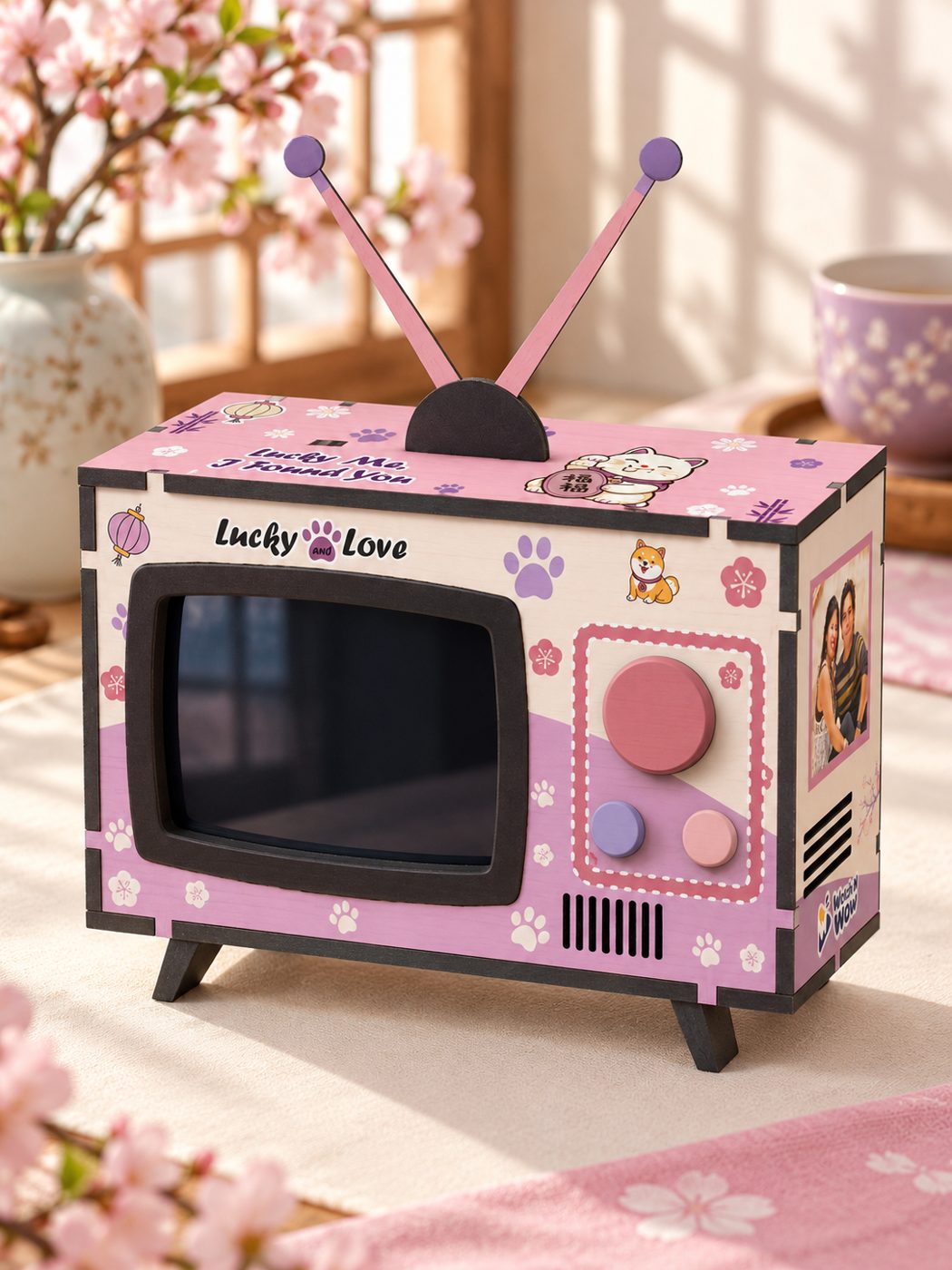
Ricky Flores is the founder of Watch N Wow and an electrical engineer with 15+ years of experience building consumer technology at Apple, Samsung, and Texas Instruments. In Dallas, Texas, he builds the Mini Memory TV by hand: a small retro TV that plays a video, a message and an original song made from your photos and your story. Read more at watchnwow.com.
Sources
- Steffel, M., & LeBoeuf, R. A. (2014). “Overindividuation in gift giving: Shopping for multiple recipients leads givers to choose unique but less preferred gifts.” Journal of Consumer Research, 40(6), 1167–1180. https://doi.org/10.1086/674199
- Baskin, E., Wakslak, C. J., Trope, Y., & Novemsky, N. (2014). “Why feasibility matters more to gift receivers than to givers: A construal-level approach to gift giving.” Journal of Consumer Research, 41(1), 169–182. https://doi.org/10.1086/675737
- Moreau, C. P., Bonney, L., & Herd, K. B. (2011). “It’s the thought (and the effort) that counts: How customizing for others differs from customizing for oneself.” Journal of Marketing, 75(5), 120–133. https://doi.org/10.1509/jmkg.75.5.120
- Ward, M. K., & Broniarczyk, S. M. (2011). “It’s not me, it’s you: How gift giving creates giver identity threat as a function of social closeness.” Journal of Consumer Research, 38(1), 164–181. https://doi.org/10.1086/658166
- Hiniker, A., Schoenebeck, S. Y., & Kientz, J. A. (2016). “Not at the dinner table: Parents’ and children’s perspectives on family technology rules.” Proceedings of the ACM Conference on Computer-Supported Cooperative Work (CSCW). https://doi.org/10.1145/2818048.2819940