Table of Contents
How a Personalized Mini TV Is Made, From Photos to Painted Knob
A maker walks through how a personalized mini TV gets made: your photos, story and song on your phone, then a laser-cut body printed, painted and loaded by hand.
A personalized mini TV starts as a folder of photos on your phone and ends as a small wooden television with your person’s face on the start screen and a song about them on the memory card. Everything between those two points happens in two places: the creator, where you do the shaping, and a workbench in Dallas, where I do the cutting, painting and loading. People ask me what they’re paying for with a made-to-order gift. Fair question. Here is the whole process, including the slow parts and the parts that depend on you.
Key Takeaways
- The Mini Memory TV is made in two halves: the video, message and original song you shape in the creator, and the laser-cut MDF body that is printed, painted and loaded by hand in Dallas, Texas.
- You see every side in 2D and a 3D model, plus estimated ship and arrival dates from the real build queue, before you pay. Nothing is cut until then.
- The video is only as good as the photos you give it, and the song can be regenerated a limited number of times. Every song version stays saved.
- The finished TV plays with no Wi-Fi, no app and no account. Internet is only needed for the share page the QR code opens at the end of the video.
- Research on handmade goods finds the “contains love” bonus mostly when the gift is for someone close (Fuchs et al., 2015). That is the honest case for a made-to-order gift, and also its limit.
Why “how is it made” is the right question for a made-to-order gift
A made-to-order gift asks you for two things a shelf product doesn’t: your material and your patience. You hand over photos, a story and a few decisions, then you wait while someone turns them into an object. If you’ve never seen the inside of that process, the wait feels like a black box, and the questions pile up. Is it a template with my name dropped in? What if the draft is bad? How long is “made to order,” really? What happens if it breaks?
Those are the right questions, and most product pages dodge them. I’d rather answer them with the actual pipeline, because the answers are the product. I’ve written before about what “personalized” should mean and why one editable text field doesn’t qualify. This is the practical sequel: how a personalized gift is made, stage by stage, with what you control at each one and the mistake I see most often there.
Two things to know first. The halves are not equal in time: the part on your phone can take an evening, while the part on my bench can’t be rushed, because every TV is built one at a time and the queue is real. And the halves are not equal in importance. The body is what people see in the photo. The video is what they watch forty times. Give the video the better half of your attention.
What the research actually says about made-by-hand and made-by-you
Handmade is not automatically better, and I’d be a poor engineer if I claimed it was. But there is real research on why made-by-hand gifts land differently, and it maps onto this process in specific places.
The handmade effect is real, and it’s about closeness. A 2015 paper in the Journal of Marketing by Christoph Fuchs, Martin Schreier and Stijn van Osselaer ran four studies on products described as handmade versus machine-made. Handmade products were rated more attractive, and the authors traced much of the effect to a perception that handmade things symbolically “contain love,” after controlling for effort, quality, uniqueness, authenticity and pride. The moderator is the part worth screenshotting: people showed stronger intentions to buy handmade when the gift was for a loved one, but not for a more distant recipient. The studies manipulated the stated production mode, so they describe perception, not any particular workshop. Still, the direction is clear. A hand-built gift for your mother carries something it would not carry for a coworker. The sibling post on why made-by-hand feels like love goes deeper.
Your own labor raises your own valuation. Norton, Mochon and Ariely’s 2012 “IKEA effect” paper in the Journal of Consumer Psychology had participants assemble IKEA boxes, fold origami and build Lego sets. People valued their own amateur creations about as highly as expert work, and expected others to agree. The effect vanished when the task wasn’t completed or the creation was destroyed. Two caveats: this measures the maker’s valuation, not the receiver’s, and editing a drafted message is lighter work than assembling a box. But it’s the reason the creator lets you change anything in the draft instead of locking it. Your hand in the gift makes it better and makes you more attached to it, which matters when you’re the one writing the card.
Physical beats digital, for a stated reason. Atasoy and Morewedge (2018, Journal of Consumer Research) found across five experiments that people assign less value to digital goods than to identical physical ones, with photographs, books and films among the categories tested. The mechanism they supported is psychological ownership: a physical object is easier to feel as “mine.” That is why the video doesn’t live only in a link. It lives on a memory card inside an object someone can put on a nightstand.
Waiting is the unflattering part. Kumar, Killingsworth and Gilovich (2014, Psychological Science) found that waiting for an experience is more pleasant than waiting for a material good. A made-to-order TV is a material good, so I won’t dress the wait up as a feature. What I can say is that the checkout shows estimated ship and arrival dates from the actual build queue, so the wait is at least a known quantity.
Music reaches memory. Petr Janata’s 2009 study in Cerebral Cortex played 30-second excerpts of chart hits from participants’ youth during brain scans; the dorsal medial prefrontal cortex tracked both the music’s structure and how autobiographically salient each song was. Thirteen undergraduates is a small sample, and he tested familiar songs, not songs written about the listener. I’ve covered what a song does to a memory that a photo can’t elsewhere; here, the practical point is that the song is the reason a slideshow becomes something people replay.
The whole pipeline in one table
Here is every stage in order, with what you do at each one and the pitfall I see most often.
| Stage | What happens | What you do | Typical pitfall |
|---|---|---|---|
| 1. Design | You pick one of more than 20 themed designs (Christmas, birthdays, couples, pets, travel, Thanksgiving, New Year, family, Texas) | Choose for the person, not the occasion | The loudest art for someone who likes quiet things |
| 2. Material | You add photos, clips and a short story | Pick sharp photos with faces; write three sentences only you could write | Screenshots, blurry group shots, a story that reads like a résumé |
| 3. Draft | The creator drafts the message and the video | Read it as them, then change anything | Approving the first draft because it’s “fine” |
| 4. Song | An original song about them, in the style you choose | Pick a style they would put on themselves | Spending regenerations on your taste instead of theirs |
| 5. Preview | Every side in 2D plus a 3D model; estimated ship and arrival dates at checkout | Check every side, the spelling of the name, and the dates against the event | Only looking at the front |
| 6. Body | Laser-cut MDF, assembled and finished by hand | Nothing; you get email updates | Expecting a shelf-product timeline |
| 7. Artwork | Printed on the front, back, both sides and top | Nothing | Assuming the sides are blank |
| 8. Paint | Antenna, legs and knobs hand-painted to match the design | Nothing | None; this one is on me |
| 9. Load | Video loaded onto the memory card; start screen set with their photo and “Press Play” | Nothing | None |
| 10. Share | A QR code at the end of the video opens the online page | Tell them the page exists | Nobody scans the code because nobody mentioned it |
Notice where the “you” column goes quiet. Stages 1 through 5 are yours, and they decide how good the gift is. Stages 6 through 10 are mine, and they decide how good the object is. Both can fail. Only one can be fixed after you pay.
Part one: on your phone, before anything gets cut
Choosing a design
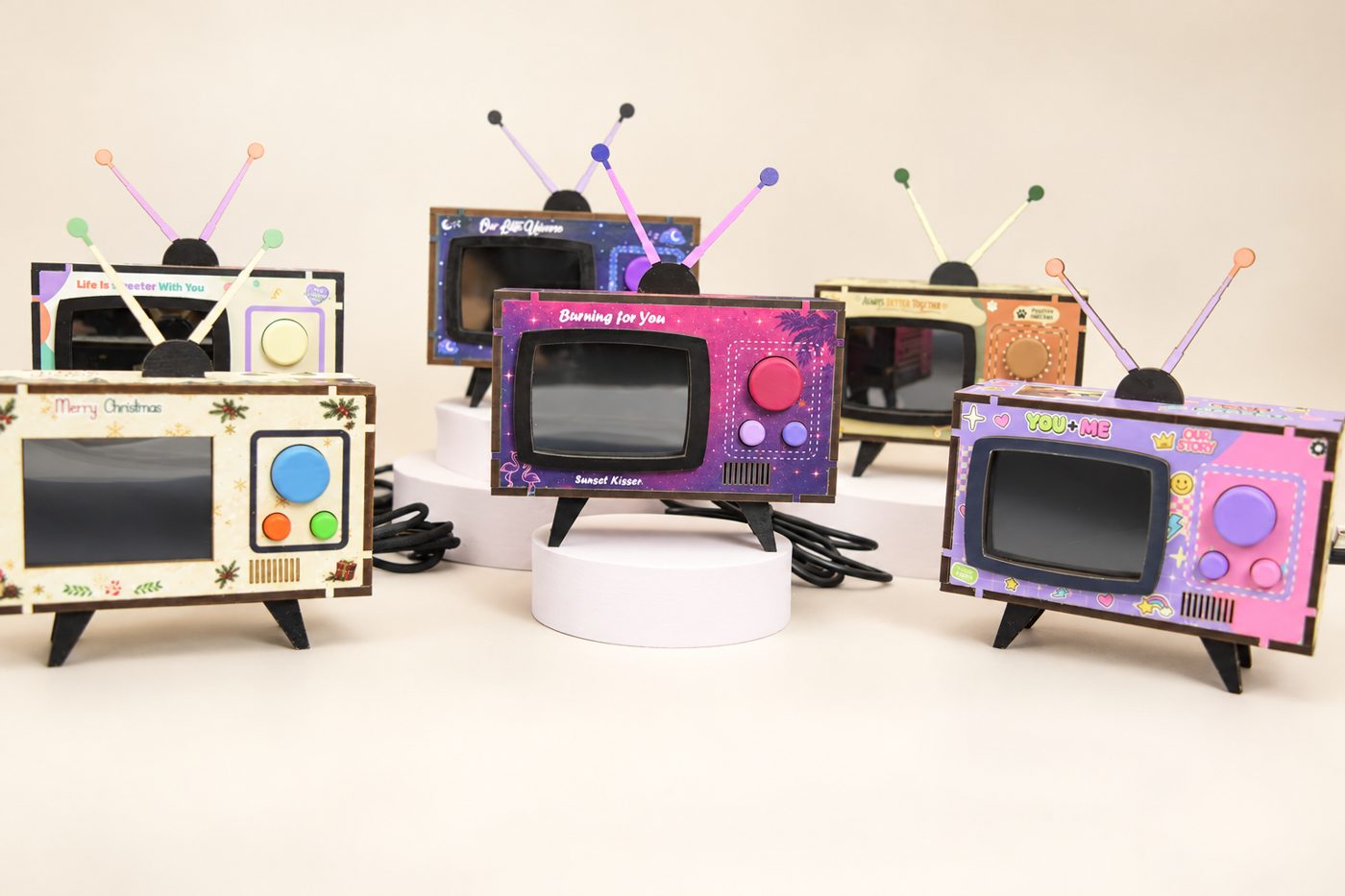
The design is the printed artwork on the body plus the matching colours on the antenna, legs and knobs. There are more than 20 themes, from Christmas and birthdays to couples, pets, travel, Thanksgiving, New Year, family and Texas. Pick for the person. A quiet grandmother and a loud best friend should not get the same retro mini TV gift.
Adding photos, clips and a short story
This is the stage that decides the gift, and it’s the one people rush. The creator builds the video from the photos, clips and short story you give it. A sharp photo with a face in it looks good on a small screen; a screenshot of a photo, or a crowd shot from across a room, looks like exactly that. The story doesn’t need to be long. Three specific sentences beat a paragraph of adjectives, because the message and the song are drafted from them.
The draft, and why you should change it
The creator drafts the message and the video first; then you review and change anything: wording, order, which photos lead. The draft exists so you don’t face a blank page, not so you can skip the reading. Read it out loud as if you were them. If a line could have been written about anyone, replace it.
The song, in a style they would choose
The song is an original piece written about the recipient in a style you pick, in English or Spanish. Songs made with this same pipeline have come out as merengue, salsa, norteña, acoustic country, pop ballads, indie pop and R&B. The first few versions are included, more are unlocked after you verify a phone number and again after you order, and extra credits can be added beyond that. Every version stays saved, so you can go back to the second one if the fifth got worse. The limit is the honest trade-off: settle the style first, then spend regenerations on the lyrics.
Previewing every side, then the dates
Before you pay, you see every side of the TV in 2D and as a 3D model, and the checkout shows estimated ship and arrival dates from the real build queue. Look at the back and the top, not only the front. Check the spelling of the name wherever it appears. Then check the arrival date against the actual event, because made to order means the queue is real.
Part two: how the personalized mini TV gets built in Dallas
The body
The body is laser-cut MDF, assembled and finished by hand. Done, it measures 5 inches wide, 2.9 inches high (5.8 with the antenna and legs) and 1.9 inches deep. Small enough for a nightstand, which is where most of them end up.
The artwork
Your design is printed and applied to the front, the back, both sides and the top. The sides are not an afterthought; they’re what people see when the TV sits at an angle on a shelf.
The antenna, legs and knobs
The antenna and legs are laser-cut and hand-painted to match the design. The three knobs on the front are painted in the design’s colours, and they aren’t decoration: they are the three physical buttons, Power, Bluetooth and Settings. Painting them is slow. It’s also the step that makes two TVs of the same design feel different in the hand.
The screen and the sound
The screen is a real touchscreen LCD. Tap it to play or pause. A Settings screen holds the video controls and a greeting for the recipient. Sound comes from a built-in speaker, and the Bluetooth button sends the audio to any Bluetooth speaker; a matching speaker is sold as an optional upgrade for anyone who wants the song louder than a small cabinet allows.
The lights
Six soft blue LEDs sit underneath and glow while the video plays. On a dark nightstand, that glow is the first thing you notice.
Loading the memory card
The finished video goes onto a memory card inside the TV. It needs no Wi-Fi, no app and no account to play, which matters for grandparents and for anyone whose Wi-Fi password is a rumor. The start screen shows the recipient’s photo and a “Press Play” button. At the end of the video a QR code appears; scanning it opens the online page for that gift, where anyone can watch again, download the video and the song, and share them. That page is the only part of the gift that needs the internet.
After it leaves the bench: box, warranty and email
You can add a branded gift box, or a personalized box printed with their photo and your words, so the outside matches the inside. Updates arrive by email at each step; there are no text-message updates, so watch the inbox you ordered with. The electronics carry a limited 30-day warranty from delivery. And the photos and story you upload are used only to make the gift. They are never sold or shared.
What to have ready before you start
If you have 10 minutes
Find five photos with their face in them, sharp and well lit, from different years. Write down one thing they say that nobody else says. That line belongs in the message.
If you have a weekend
Ask two relatives for the photos you don’t have: the ones from before you were born, the one from the wedding nobody scanned. Pull two short clips where you can hear their voice. Write the three sentences only you could write about this person, and decide what music they would put on in the car. That’s your song style.
If you want it to last years
Decide now who gets the share page link besides the recipient. Keep the downloaded video and song somewhere of your own as well. And give the object a spot where it will be seen: the case for a physical keepsake, in Atasoy and Morewedge’s work, rests on it being in front of the person.
The question to ask yourself: “Would they recognize this as their life, or as my idea of their life?”
The trade-offs, said plainly
Made to order takes time, and a built-by-hand gift can’t be overnighted. The video is only as good as the photos you give it, because no amount of assembly fixes a blurry source. The song can be regenerated a limited number of times, and the first version is sometimes the best one. And a personalized mini TV is a small object, meant for a nightstand, not a wall. If those trade-offs sound right for the person you have in mind, you can see how the Mini TV is made in motion, every side of it, before you decide anything.
Frequently asked questions
How long does a personalized mini TV take to make?
It’s made to order, so the timeline depends on the build queue at the moment you order. The checkout shows estimated ship and arrival dates computed from that real queue, before you pay. Order earlier for Christmas and other peaks, and check the arrival date against the event rather than against your hopes.
Can I see what the TV will look like before I pay?
Yes. The creator shows every side (front, back, both sides and top) in 2D and as a 3D model, with your artwork, message and photos in place. Check the spelling of the name on every side, because the artwork is printed and the parts are painted to match exactly what you approve.
What if I don’t like the message or the video draft?
Change it. The creator drafts the message and the video so you have a starting point, and you can edit the wording, the order and the photos before anything is built. Read the draft as the recipient would; if a line could be about anyone, rewrite it.
What if the song isn’t right?
Pick a different version or regenerate it. A limited number of versions are included, with more after you verify a phone number and after you order, and every version stays saved so you can return to an earlier one. Choose the style first (merengue, norteña, pop ballad, R&B and so on), in English or Spanish; then spend regenerations on the lyrics.
Does the Mini Memory TV need Wi-Fi or an app?
No. The video is loaded onto a memory card inside the TV, and it plays with no Wi-Fi, no app and no account. Internet is only needed for the share page that the QR code at the end of the video opens, where you can watch again, download the video and the song, and share them.
What happens if something stops working?
The electronics are covered by a limited 30-day warranty from delivery. If something stops working in that window, get in touch with your order details and a description of what you’re seeing. Updates and correspondence for an order go by email, so use the inbox you ordered with.
About the author
Ricky Flores is the founder of Watch N Wow and an electrical engineer with 15+ years of experience building consumer technology at Apple, Samsung, and Texas Instruments. In Dallas, Texas, he builds the Mini Memory TV by hand: a small retro TV that plays a video, a message and an original song made from your photos and your story. Read more at watchnwow.com.
Sources
- Fuchs, C., Schreier, M., & van Osselaer, S. M. J. (2015). “The Handmade Effect: What’s Love Got to Do with It?” Journal of Marketing, 79(2), 98–110. https://doi.org/10.1509/jm.14.0018
- Norton, M. I., Mochon, D., & Ariely, D. (2012). “The IKEA effect: When labor leads to love.” Journal of Consumer Psychology, 22(3), 453–460. https://doi.org/10.1016/j.jcps.2011.08.002
- Atasoy, O., & Morewedge, C. K. (2018). “Digital Goods Are Valued Less Than Physical Goods.” Journal of Consumer Research, 44(6), 1343–1357. https://doi.org/10.1093/jcr/ucx102
- Kumar, A., Killingsworth, M. A., & Gilovich, T. (2014). “Waiting for Merlot: Anticipatory Consumption of Experiential and Material Purchases.” Psychological Science, 25(10), 1924–1931. https://doi.org/10.1177/0956797614546556
- Janata, P. (2009). “The Neural Architecture of Music-Evoked Autobiographical Memories.” Cerebral Cortex, 19(11), 2579–2594. https://doi.org/10.1093/cercor/bhp008