Table of Contents
The Handmade Effect: Why Made-by-Hand Gifts Feel Like Love
The handmade effect is real: people see handmade gifts as containing love. What the studies found, when it fades, and how to put a human hand into any gift.
Your grandmother’s crocheted blanket has a dropped stitch near one corner. You know exactly where it is. You have owned softer blankets, warmer ones, blankets that cost more than she spent on yarn in a decade, and none of them made it through three moves. That one did.
The handmade effect is the name researchers gave to that feeling: people find products more attractive when they are told the products were made by hand, and a large part of the reason is that handmade things seem to carry love inside them. It is a measurable effect, it has limits, and once you know where those limits are, you can use it on almost any gift, including ones you can’t make yourself.
Key Takeaways
- The handmade effect is real and specific. In four studies, products described as handmade were rated more attractive than identical machine-made ones, largely because people felt they symbolically “contain love,” even after controlling for effort, quality, uniqueness, authenticity and pride (Fuchs, Schreier & van Osselaer, 2015).
- It depends on who the gift is for. People preferred handmade when buying for loved ones, but not for more distant recipients, and paid more for handmade when the goal was to convey love rather than to get the best-performing product.
- Effort alone makes things look better: a poem said to take 18 hours was rated higher than the same poem said to take 4 (Kruger et al., 2004). That finding only partly replicated, so treat it as a nudge, not a law.
- A visible human trace can carry the effect without the whole object being handmade. Handwritten-looking type raised attachment to products (Schroll, Schnurr & Grewal, 2018), and simply saying a mug was made “by people using machines” rather than “by machines run by people” raised its value (Job et al., 2017).
- Givers underestimate this. They choose preference-matching gifts over sentimental ones far more often than receivers would like (Givi & Galak, 2017).
”Is a handmade gift cheap, or is it the best gift?”
Read any thread about handmade gifts and you’ll find two camps talking past each other. One says: “My mom still has the clay ashtray I made in second grade and nobody in our family smokes.” The other says: “My aunt knits us scarves every Christmas and I don’t know what to do with eleven scarves.” Somewhere in the middle sits the question people actually type into search bars: is a handmade gift cheap? Will they think I couldn’t afford a real one?
Both camps are right. Handmade gifts can land with a weight store-bought gifts rarely match, and they can also feel like an obligation or a clutter problem. The difference isn’t craft skill. Plenty of beloved handmade gifts are lumpy.
The difference, according to the research, comes down to three things: who the gift is for, what the object is supposed to do, and whether the person receiving it can see the hand that made it. Get those three right and a modest handmade gift beats an expensive one. Get them wrong and you’ve made something nobody asked for.
This matters even if you never pick up a knitting needle. Most gifts now sit somewhere between handmade and factory-made: printed on demand, assembled by a small shop, customized by a maker. The research tells you which parts of “made by a person” the receiver responds to, so you can choose or add them on purpose.
What the research actually says
The love account: handmade things seem to carry the maker’s feeling
The anchor study is “The Handmade Effect: What’s Love Got to Do with It?”, published in the Journal of Marketing in 2015 by Christoph Fuchs, Martin Schreier and Stijn van Osselaer. They call it the first systematic set of studies on whether stated production mode (handmade versus machine-made) changes how attractive a product is. Across four studies, it did. Products described as handmade were rated more attractive than the same products described as machine-made.
The interesting part is why. The obvious explanations (more effort, better quality, uniqueness, authenticity, the maker’s pride) were all measured and controlled for, and a large part of the effect remained, driven by the perception that handmade products symbolically “contain love.” Then the authors tested that account by changing how much love mattered. People showed stronger purchase intentions for handmade than for machine-made products when buying a gift for a loved one, but not for a more distant recipient. And they paid more for handmade gifts when the purchase was meant to convey love than when it was meant to get the best-performing product.
Two limits. The studies manipulated what people were told about production, so they measure perception, not any real workshop. And participants were evaluating products, not unwrapping gifts from their own grandmother.
Effort reads as quality, especially when quality is hard to judge
A decade earlier, Justin Kruger, Derrick Wirtz, Leaf Van Boven and William Altermatt published “The effort heuristic” in the Journal of Experimental Social Psychology (2004). They showed people the same poem and told some it took 4 hours to write and others 18 hours; the 18-hour version was rated as better and worth more. They found the same pattern with paintings, and in a third experiment the effort cue mattered more when the object was harder to evaluate.
The honest footnote: in 2023 Ignazio Ziano and colleagues ran two preregistered replications in Collabra: Psychology with 1,405 U.S. participants. The paintings result replicated. The poem result did not in the first attempt, and in a revised second attempt effort raised liking and perceived quality but not monetary value. Effort seems to make people like things more; whether it makes them seem worth more money is shakier, which for a gift is the less important half.
A related study adds a condition. Andrea Morales, in the Journal of Consumer Research (2005), found across three experiments that people reward visible extra effort with higher evaluations and willingness to pay, even when the product isn’t actually better, and that this reward runs through gratitude. When people suspected the effort was a persuasion tactic, the gratitude, and the reward, disappeared. Effort counts when it reads as done for someone, not done at them.
Why a human trace rubs off on an object
Contagion is the intuition that objects absorb something from the people and places that touched them. George Newman and Ravi Dhar showed in the Journal of Marketing Research (2014) that consumers saw products from a brand’s original factory as more authentic and valuable than identical products made elsewhere, and that this ran through a belief in transferred “essence,” not through inferences about quality. People more sensitive to contagion showed the effect more strongly.
You don’t need a famous maker for this to work. Veronika Job, Jana Nikitin, Sophia Zhang, Priyanka Carr and Gregory Walton reported in Personality and Social Psychology Bulletin (2017) that simply describing mugs and gift wrap as made “by people using machines” instead of “by machines run by people” raised their perceived value. The mechanism: people imagined the attention the object had received from someone, saw it as having warmer social qualities (“friendly”), and valued it more. A stranger’s attention was enough. A loved one’s is the strong version.
Symbolic objects get the biggest boost; functional ones can go the other way
Two later papers mark the edges of the effect. Armin Granulo, Christoph Fuchs and Stefano Puntoni found across six studies in the Journal of Consumer Psychology (published online 2020, in the 2021 volume) that people prefer human over robotic labor more for products with higher symbolic value, the ones that say something about who you are, because they link human labor with uniqueness.
And Roland Schroll, Benedikt Schnurr and Dhruv Grewal showed in the Journal of Consumer Research (2018) that typefaces that look handwritten create a sense of human presence, which raised emotional attachment and product evaluations in lab and field studies. Two boundaries came with it: the boost was weaker for brands people were already attached to, and it reversed for products positioned as functional. A handwritten label on a chocolate bar helps. On a power drill, it hurts. The same logic applies to gifts: the hand helps most on objects whose job is to mean something.
Givers underuse all of this
Julian Givi and Jeff Galak, in the Journal of Consumer Psychology (2017), asked givers to choose between a sentimentally valuable gift and one matching the recipient’s stated preferences (in one study, a framed photo of a friend’s favorite musician versus a framed photo of the two friends on a great day together). Across three studies, givers picked the preference-matching gift much more often than receivers would have preferred. The reason was certainty: givers felt sure the “favorite band” gift would be liked and unsure about the sentimental one. Receivers didn’t share the doubt.
When the handmade effect helps, and when it doesn’t
Here is where a human hand adds value, and where it doesn’t.
| Situation | Does “made by hand” help? | Why | Source |
|---|---|---|---|
| Gift for a partner, parent, close friend | Yes, strongly | The value of handmade is tied to conveying love, which matters most with loved ones | Fuchs et al., 2015 |
| Gift for a coworker or distant acquaintance | Little or no advantage | The love signal isn’t what the relationship calls for | Fuchs et al., 2015 |
| Symbolic object (keepsake, decor, something that expresses identity) | Yes | Human labor reads as uniqueness, which matters more for symbolic products | Granulo et al., 2021 |
| Functional object (tool, appliance, kitchen gadget) | Can backfire | Handwritten cues lowered evaluations for functional products | Schroll et al., 2018 |
| Effort is visible and clearly for them | Yes | Visible effort raises evaluations through gratitude | Morales, 2005; Kruger et al., 2004 |
| Effort feels like a performance or a pitch | No | When effort reads as persuasion, gratitude and the reward vanish | Morales, 2005 |
| You made it yourself and love it | Check yourself | Makers value their own creations close to expert work and expect others to agree | Norton, Mochon & Ariely, 2012 |
Read the middle column top to bottom and a rule appears: the hand helps when the gift’s job is to say something to someone close. It fades when the job is to work well, or when the relationship isn’t close enough for “love” to be the right message. The last row is the maker’s trap: the IKEA effect inflates your judgment of your own handiwork. That’s not a reason to stop making things, only to make them for the right person.
What to actually do
Save handmade for the inner circle
Fuchs and colleagues found the handmade advantage for gifts to loved ones and not for distant recipients. Spend your making time on the four or five people for whom “this carries love” is the right message. For the office exchange, a well-chosen bought gift does the job without handing a coworker more feeling than the relationship holds.
Make the hand visible
Every study above depends on the person knowing or perceiving the human trace; they can’t guess it. Job and colleagues raised value just by naming people in the production story. So say it, lightly: “I sanded this one twice.” “Your cousin took the photo, I picked the frame.” If the object came from a small maker, a note about who made it does part of the work. As we’ve covered before, thought that stays invisible earns little credit.
Add a handwritten layer to anything
If you can’t make the whole gift, make one part of it. Schroll’s handwriting finding suggests that even the appearance of a human hand creates a sense of presence. A real handwritten card is the cheapest version; their name on the box or a line on the back of a printed photo works too. Keep it specific: a sentence only you could write beats a paragraph anyone could.
Put the hand on a symbolic object, not a functional one
A hand-painted mug for a coffee obsessive works because the mug’s real job is to say “I know you.” A homemade knife block for a serious cook may not, because its job is to be a good knife block, and Schroll’s reversal suggests the human signal can read as a quality risk on functional things. If they need it to work well, buy it well made and add your hand to the wrapping, the note, or a personal detail.
Choose the sentimental option more often than feels safe
Givi and Galak’s givers chose the safe preference-matching gift; receivers wanted the sentimental one more often than givers guessed. If you’re stuck between the band poster and the framed photo of the two of you at that concert, the research points to the photo. This pairs well with what nostalgia research says about specific memories: one real moment with a real person in it.
What not to do
Don’t make it a performance. Morales found effort stops earning gratitude once it reads as persuasion, and a speech about the 40 hours you spent turns love into a bill. Don’t make things for people who have told you they’re drowning in stuff; a handmade object they must keep out of guilt is a burden with good intentions. And don’t confuse your attachment with theirs. The IKEA effect means you’ll love your creation more than any outside observer, so ask whether they would choose it.
How to make it personal
If you have 10 minutes
Write one handwritten card with three specific sentences: a place, a year, and a detail only you would know. Tuck it into whatever gift you’ve already bought. It turns a purchase into something with a human trace on it, which is the cheapest version of the handmade effect available.
If you have a weekend
Make one small part of the gift yourself. Print one photo and write the story on the back, decorate the box, record a short voice note, or ask two relatives to each write one line by hand. You don’t need craft skills: the studies measured perceived human involvement, not finish.
If you want it to last years
Keepsakes that survive have four things: a physical form, their name or face in it, a moment attached, and something they’ll replay or reread. The handmade effect adds a fifth: visible evidence that a person spent time on it for them. That can be your own hand or the hand of someone who built it to order, as long as the trace shows. It’s also the difference between real personalization and a name on a mug.
The question to ask yourself: “Will they be able to see the hand that made this, and is it a hand they love?”
Frequently asked questions
Why do handmade gifts feel more special?
Because people perceive them as carrying love. Fuchs, Schreier and van Osselaer (2015) found handmade products were rated more attractive than identical machine-made ones, largely because they seemed to “contain love,” even after controlling for effort, quality, uniqueness and authenticity. The effect was strongest when the gift was for someone close, which is why a homemade gift from family can outrank an expensive bought one.
Is a handmade gift cheap or tacky?
Not to the people closest to you. In the handmade effect studies, people preferred handmade gifts for loved ones and were willing to pay more for them when the goal was to show love. The risk is with distant recipients, functional items, or gifts that add clutter. For a partner or parent, a modest handmade gift is usually read as care, not cost-cutting.
Do people value things more when they take more effort to make?
Often, yes. Kruger and colleagues (2004) found a poem said to take 18 hours was rated better than the same poem said to take 4. A 2023 replication confirmed the effect for paintings and for liking, but not for monetary value. Morales (2005) adds a condition: effort earns gratitude only when it looks done for the receiver, not as a sales pitch.
Does a gift still count as handmade if a machine helped?
It can. Job and colleagues (2017) found that describing products as made “by people using machines” rather than “by machines run by people” raised their value. What people respond to is the human attention in the object. A gift assembled, finished or personalized by a person carries that trace even if tools did part of the work.
What should I make if I’m not crafty?
Something where the trace matters more than the finish. A handwritten letter, photos with the story written on the back, a recorded voice note, or a box you decorated. The research measured perceived human involvement and sentimental value, not skill. Givi and Galak (2017) found receivers want sentimental gifts more often than givers expect, so a simple one is likely to land.
About the author
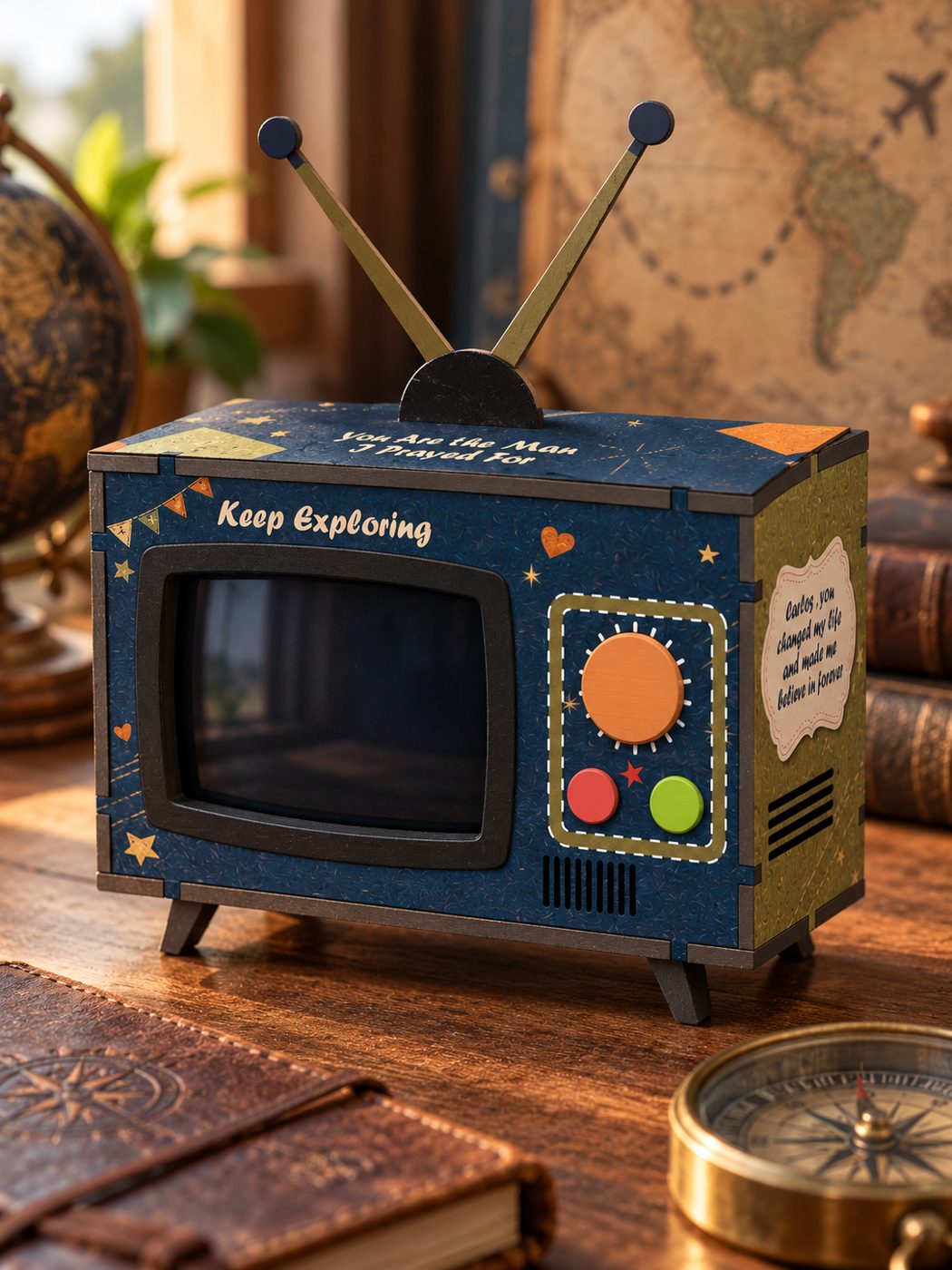
Ricky Flores is the founder of Watch N Wow and an electrical engineer with 15+ years of experience building consumer technology at Apple, Samsung, and Texas Instruments. In Dallas, Texas, he builds the Mini Memory TV by hand: a small retro TV that plays a video, a message and an original song made from your photos and your story. Read more at watchnwow.com.
Sources
- Fuchs, C., Schreier, M., & van Osselaer, S. M. J. (2015). “The Handmade Effect: What’s Love Got to Do with It?” Journal of Marketing, 79(2), 98–110. https://doi.org/10.1509/jm.14.0018
- Kruger, J., Wirtz, D., Van Boven, L., & Altermatt, T. W. (2004). “The effort heuristic.” Journal of Experimental Social Psychology, 40(1), 91–98. https://doi.org/10.1016/S0022-1031(03)00065-9
- Ziano, I., Yeung, S. K., Lee, C. S., Shi, J., & Feldman, G. (2023). “‘The Effort Heuristic’ Revisited: Mixed Results for Replications of Kruger et al. (2004)‘s Experiments 1 and 2.” Collabra: Psychology, 9(1). https://doi.org/10.1525/collabra.87489
- Morales, A. C. (2005). “Giving Firms an ‘E’ for Effort: Consumer Responses to High-Effort Firms.” Journal of Consumer Research, 31(4), 806–812. https://doi.org/10.1086/426615
- Newman, G. E., & Dhar, R. (2014). “Authenticity Is Contagious: Brand Essence and the Original Source of Production.” Journal of Marketing Research, 51(3), 371–386. https://doi.org/10.1509/jmr.11.0022
- Job, V., Nikitin, J., Zhang, S. X., Carr, P. B., & Walton, G. M. (2017). “Social Traces of Generic Humans Increase the Value of Everyday Objects.” Personality and Social Psychology Bulletin, 43(6), 785–792. https://doi.org/10.1177/0146167217697694
- Granulo, A., Fuchs, C., & Puntoni, S. (2021). “Preference for Human (vs. Robotic) Labor Is Stronger in Symbolic Consumption Contexts.” Journal of Consumer Psychology, 31(1), 72–80. https://doi.org/10.1002/jcpy.1181
- Schroll, R., Schnurr, B., & Grewal, D. (2018). “Humanizing Products with Handwritten Typefaces.” Journal of Consumer Research, 45(3), 648–672. https://doi.org/10.1093/jcr/ucy014
- Givi, J., & Galak, J. (2017). “Sentimental value and gift giving: Givers’ fears of getting it wrong prevents them from getting it right.” Journal of Consumer Psychology, 27(4), 473–479. https://doi.org/10.1016/j.jcps.2017.06.002
- Norton, M. I., Mochon, D., & Ariely, D. (2012). “The IKEA effect: When labor leads to love.” Journal of Consumer Psychology, 22(3), 453–460. https://doi.org/10.1016/j.jcps.2011.08.002
