Table of Contents
Road Trip Recap Video Ideas: Turn the Trip Into 3 Minutes
Road trip recap video ideas that work: a simple route map, three short stories and a strong ending instead of every clip. A step-by-step, research-backed guide.
You drove through five states. Your phone has 2,300 photos, 140 videos and one 47-minute clip of the dashboard because someone forgot to stop recording. Everyone in the car said “we have to make a video of this.” It has been three weeks and the footage is still sitting in the camera roll, because where would you even start?
Here is the short answer: five states do not need fifty minutes. The best road trip recap video ideas use a simple route as the backbone, three short stories built from moments that changed the trip, real sound from the road and a deliberate ending. Memory research says that’s how people remember experiences anyway: by a few strong moments, not by duration. This guide walks you through it in six steps with tools you already have.
Key Takeaways
- People’s memory of an experience depends on snapshots of its strongest moments, with little weight on how long it lasted. In two studies, the length of film clips barely affected how people rated them afterward (Fredrickson & Kahneman, 1993).
- The brain divides ongoing activity into discrete events at points where something unexpected happens (Zacks et al., 2007). Those event boundaries are your natural story beats.
- In a study of 6.9 million online video sessions, median watching time was at most 6 minutes, and viewers often quit videos longer than 9 minutes before the halfway mark (Guo, Kim & Rubin, 2014). A recap of a few minutes is more likely to be finished and rewatched.
- Taking photos increased enjoyment when it increased engagement with the experience (Diehl, Zauberman & Barasch, 2016), but cameras pull memory toward sights and away from sounds (Barasch et al., 2017). Recover the sound.
- The structure: route map → three stories → ending. Two to four minutes.
Why road trip videos never get finished
People who search for road trip video help tend to be stuck in the same places. “I have way too much footage.” “Every time I start editing I get overwhelmed.” “My last one was 20 minutes and nobody watched past the first state.” “How do I make a travel video that isn’t just a slideshow?”
The root problem is that the default plan is chronological and complete: every stop, in order, with every good clip. That plan has no end point while you’re editing and no shape for the person watching. A road trip is long, repetitive in places (highways, gas stations, motels) and punctuated by a few moments everyone talks about afterward. A complete chronological edit gives the boring stretches the same screen time as the moments that mattered.
The fix is to edit the way memory edits. Keep the route as a simple frame, so viewers know where they are. Then tell three stories, each built around a moment that changed the trip. End on purpose.
What the research says about how we remember trips
Peaks and endings matter more than length
Barbara Fredrickson and Daniel Kahneman’s 1993 paper in the Journal of Personality and Social Psychology documented “duration neglect.” In two experiments, participants watched pleasant and aversive film clips that varied in length and intensity, rating their feelings moment by moment and then evaluating each clip overall. The effect of duration on the overall evaluations was small, and it shrank further when people ranked the clips from memory. Retrospective evaluations looked like a weighted average of snapshots of the experience, as if duration didn’t matter.
The studies used film clips in a lab, not road trips. But the implication for a recap video is direct. Viewers (and the people who were on the trip) will judge it by its best moments and how it ends, not by how many states it covers.
Event boundaries are your story beats
Jeffrey Zacks and colleagues’ review in Psychological Bulletin (2007) proposes that people perceive ongoing activity as discrete events, and that an event boundary is perceived when predictions about what happens next suddenly fail. Those boundaries regulate attention and memory.
On a road trip, the boundaries are the surprises: the detour that led to the best taco stand, the thunderstorm in Oklahoma, the moment the kids saw the ocean. Those are where memory chunks the trip, so those are where your stories should start.
Shorter videos get watched
Philip Guo, Juho Kim and Rob Rubin analyzed 6.9 million video-watching sessions on edX for a Learning @ Scale paper (2014), measuring engagement by how long students watched. Video length was the strongest predictor of engagement: median watching time was at most 6 minutes regardless of how long the video was, and students often made it less than halfway through videos longer than 9 minutes. These were educational videos and learners, not families, so the exact numbers don’t transfer. The direction is still a useful warning: a 20-minute recap asks a lot of a viewer.
Cameras help when they engage you, but they miss the sound
Kristin Diehl, Gal Zauberman and Alixandra Barasch’s nine studies in the Journal of Personality and Social Psychology (2016) found that taking photos increased enjoyment of positive experiences when photo-taking increased engagement, and directed more visual attention to the parts of the experience worth photographing. A follow-up by Barasch, Diehl, Silverman and Zauberman in Psychological Science (2017) found people with cameras remembered more of what they saw and less of what they heard.
That means two things for your video. Your footage is probably rich in sights. And the sounds of the trip (the playlist everyone sang to, the wind at the overlook, a conversation in the back seat) are the part most worth bringing back, because memory let them slip.
Recap video structures compared
| Structure | Typical length | Strengths | Weaknesses | Best for |
|---|---|---|---|---|
| Full chronological edit | 10–30 min | Complete record | Rarely finished; boring stretches; viewers drop off | A private archive |
| Fast montage set to one song | 1–3 min | Energetic; easy to share | No story; every trip looks the same | Social posts |
| Route map + three stories + ending | 2–4 min | Clear shape; peaks and ending; rewatchable | Requires choosing what to cut | Family keepsake, gift |
| Day-by-day episodes | 1–2 min each | Manageable to edit | Many files; no overall ending | Long trips (10+ days) |
| Single-moment short | 30–90 sec | Strongest emotional punch | Leaves out the rest | A gift for one person in the car |
The middle row is the recommendation for most trips. It keeps the route visible, gives three peaks room to breathe and saves energy for the ending. You can always keep the full archive separately.
How to make the video, step by step
Step 1: Back up and cull to 60 clips
Copy everything from every phone into one folder first. Then do one fast pass: mark anything with a face reacting, a surprise, a laugh or a great sound; skip duplicates and dashboard footage. Aim for about 60 clips and 40 photos. Why: you can’t build peaks from 2,300 items. Common mistake: editing directly from the camera roll and losing the originals. Our guide to rescuing your photos explains how to gather originals from several phones.
Step 2: Draw the route as your spine
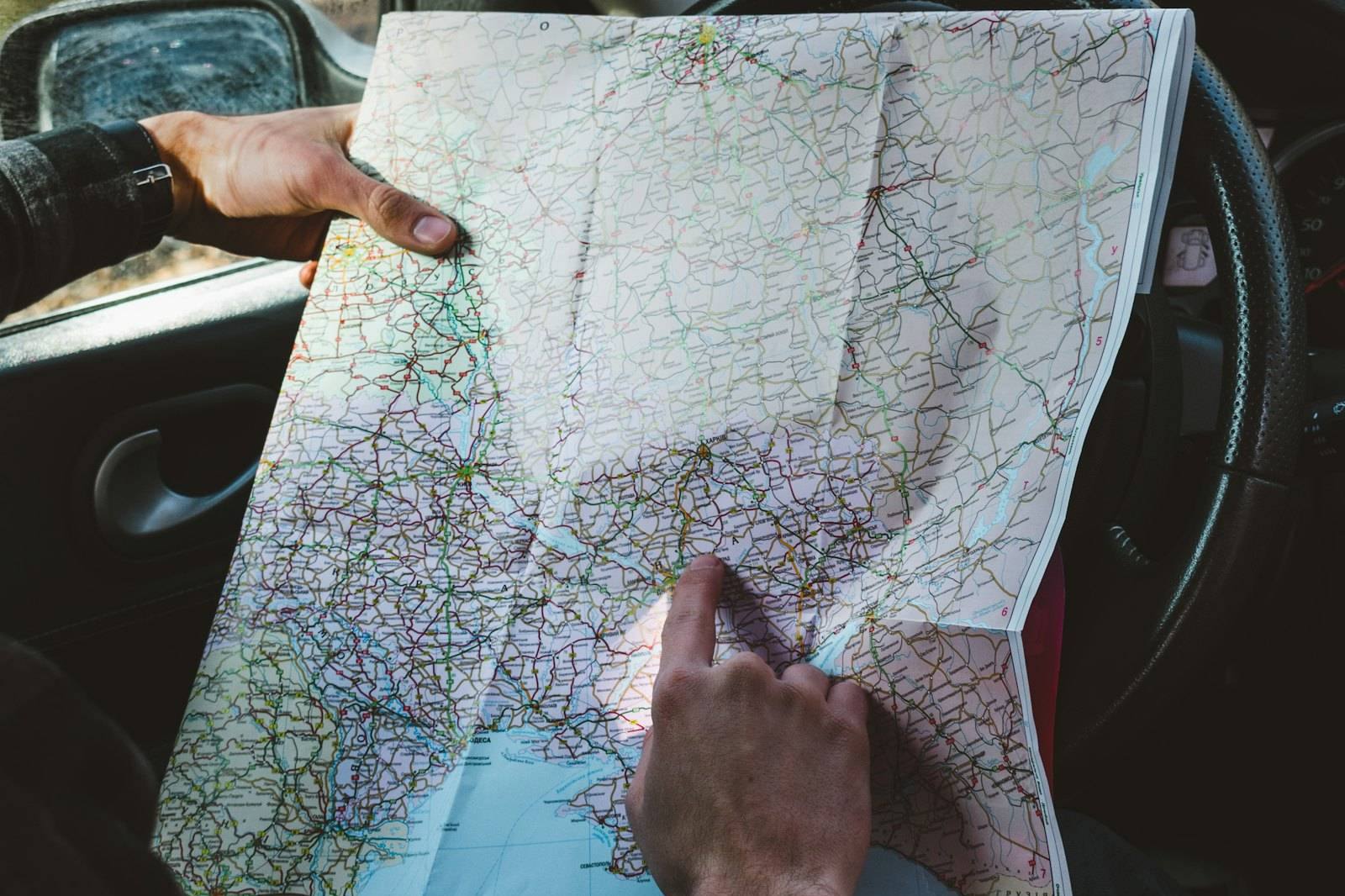
Make a simple map graphic (a screenshot of the route with dots, or a hand-drawn map you film) and plan to show it three or four times: start, between stories, end. Why: the map tells viewers where they are, so you don’t need clips of every state to keep them oriented. Common mistake: a title card for every town.
Step 3: Pick three moments that changed the trip
Ask everyone who was in the car: “What are the three moments we’ll still talk about in ten years?” Look for surprises: the detour, the breakdown, the stranger, the first sight of something. Build a short story around each, 30 to 60 seconds, with a setup (what you expected), the turn (what happened) and the payoff (a reaction). Why: event boundaries form where predictions fail (Zacks et al., 2007), and retrospective judgments rest on snapshots of strong moments rather than running time (Fredrickson & Kahneman, 1993). Common mistake: picking the prettiest scenery instead of the moments with people in them.
Step 4: Put the real sound back
Use ambient sound from the clips (the waves, the diner, the kids yelling at the cows) and a few seconds of conversation. Add the song from the trip, the one that was on repeat, as the backbone. Why: cameras pull memory toward sights and away from sounds (Barasch et al., 2017); sound is what brings the trip back. Common mistake: covering every clip with music so no one ever hears a voice. If you’d like a song written specifically about the people in the car, see the science of a song written about you. If you post publicly, check the platform’s rules on copyrighted music.
Step 5: End on purpose
Choose the final ten seconds deliberately: the last sunset, everyone asleep in the back seat, the house key turning on the way home, a line someone said. Hold it a beat longer than feels natural, then cut to black or the map with the full route drawn. Why: if memory keeps snapshots rather than running time (Fredrickson & Kahneman, 1993), the final image is one you get to choose. Common mistake: ending on the last clip in chronological order, which is usually a parking lot.
Step 6: Trim to under four minutes and share it with the people who were there
Watch it once with someone who wasn’t on the trip. Cut anything they glaze over. Then watch it together with the people who were there, the first time, in one room or on a call. Why: shorter videos hold attention better (Guo et al., 2014), and a shared first viewing becomes part of the memory. Common mistake: emailing a link and never watching it together.
You can do all of this in any basic editor, including the one built into most phones’ photo apps; you only need trimming, ordering, a still image and the ability to lower music under speech.
What not to do
Don’t include every state because you feel you should. And don’t erase the bad moments. The flat tire is often the best story, because nostalgia tends to redeem a bad scene with a good ending, as we explain in our piece on travel keepsakes that do more than list where you went.
How to make it personal
If you have 10 minutes
Text everyone who was on the trip: “Name the three moments we’ll still talk about in ten years.” Their answers are your three stories.
If you have a weekend
Back up and cull to 60 clips, make the route map, build the three stories and choose the ending. Use one song from the trip and keep at least three moments of real conversation.
If you want it to last years
Save the finished video and the culled clips in two places, title the file with the route and the year, and give a copy to everyone who was there. Add the date and the names on a closing card. Rewatching a short video every year turns it into part of the family’s story.
The question to ask yourself: “If someone who was in the car watched only this, would they hear us, or just see the scenery?”
Frequently asked questions
How long should a road trip video be?
Two to four minutes for a recap people will actually finish and rewatch. Research on memory shows experiences are judged by snapshots of their strongest moments more than by duration (Fredrickson & Kahneman, 1993), and engagement with online videos drops as length increases (Guo et al., 2014). Keep a longer archive separately if you want a complete record.
How do I make a travel video that isn’t boring?
Give it a shape: a route map to show where you are, three short stories built around surprising moments, real sound from the trip, and a deliberate ending. Cut the highway and the parking lots. Surprises are where memory naturally divides an experience into events (Zacks et al., 2007).
What should I film on a road trip for a recap video?
Reactions, surprises and sound. Film people as well as scenery, keep clips short (10 to 20 seconds), record ambient sound at stops, and capture a few moments of conversation. A clip of someone laughing at a roadside sign is worth more than ten landscape pans.
What app should I use to make a road trip video?
Any editor that can trim clips, reorder them, add a still image and lower music under voices will work, including the editor in most phones’ photo apps. The structure (map, three stories, ending) matters far more than the software.
If you’d rather have the trip’s photos and clips turned into a short video with an original song about your crew, loaded onto a small retro TV for the shelf, that is what we make at Watch N Wow.
About the author
Ricky Flores is the founder of Watch N Wow and an electrical engineer with 15+ years of experience building consumer technology at Apple, Samsung, and Texas Instruments. In Dallas, Texas, he builds the Mini Memory TV by hand: a small retro TV that plays a video, a message and an original song made from your photos and your story. Read more at watchnwow.com.
Sources
- Fredrickson, B. L., & Kahneman, D. (1993). “Duration neglect in retrospective evaluations of affective episodes.” Journal of Personality and Social Psychology, 65(1), 45–55. https://doi.org/10.1037/0022-3514.65.1.45
- Zacks, J. M., Speer, N. K., Swallow, K. M., Braver, T. S., & Reynolds, J. R. (2007). “Event perception: A mind-brain perspective.” Psychological Bulletin, 133(2), 273–293. https://doi.org/10.1037/0033-2909.133.2.273
- Guo, P. J., Kim, J., & Rubin, R. (2014). “How video production affects student engagement: An empirical study of MOOC videos.” Proceedings of the First ACM Conference on Learning @ Scale, 41–50. https://doi.org/10.1145/2556325.2566239
- Diehl, K., Zauberman, G., & Barasch, A. (2016). “How taking photos increases enjoyment of experiences.” Journal of Personality and Social Psychology, 111(2), 119–140. https://doi.org/10.1037/pspa0000055
- Barasch, A., Diehl, K., Silverman, J., & Zauberman, G. (2017). “Photographic memory: The effects of volitional photo taking on memory for visual and auditory aspects of an experience.” Psychological Science, 28(8), 1056–1066. https://doi.org/10.1177/0956797617694868