Table of Contents
Travel Memory Gift Ideas That Do More Than List Places
The best travel memory gift ideas capture one surprising moment, a local sound or a shared joke, not a checklist of cities. What memory research says works.
The scratch-off map on the wall has fourteen states scratched. The shadow box has ticket stubs from three museums and a cathedral. The photo book runs in perfect order: airport, hotel, landmark, landmark, landmark, airport. And when you ask what they remember most about the trip, they tell you about the street musician playing an accordion outside a laundromat, or the night the rental car got a flat in the rain and you ended up eating gas-station tamales on the hood.
That story isn’t in the scrapbook. It rarely is. The best travel memory gift ideas start where the itinerary ends: one surprising moment, a local sound, a shared joke. Research on how we remember trips suggests that’s not sentimentality. It’s how memory works.
Key Takeaways
- People recall personal events more positively than they experienced them at the time, a “rosy view” found in all three of Mitchell and colleagues’ studies of personal events (1997).
- Taking photos shifts attention toward what you see and away from what you hear. In four studies, people with cameras recognized more visual details and fewer auditory ones (Barasch et al., 2017).
- Tourists buy souvenirs mainly as evidence of the experience, as memory triggers and as gifts (Wilkins, 2011). Evidence of “we were there” is easy; evidence of what it felt like is harder.
- People deliberately collect “memory pointers” when they expect later events to crowd out a special memory (Zauberman, Ratner & Kim, 2009).
- Nostalgic memories typically feature close others and often redeem a bad moment with a better ending (Wildschut et al., 2006). The flat tire becomes the best part.
Why most travel keepsakes are checklists
Ask people what to do with travel memories and you hear the same search: “travel memory gift ideas,” “what to do with vacation photos,” “travel scrapbook ideas,” “gift for someone who loves to travel.” The usual answers are scratch-off maps, pin maps, coordinate necklaces, shadow boxes of tickets and photo books in chronological order.
All of those answer one question: where did you go? That’s a fair question, and a map with pins can be lovely. But it isn’t the question people answer when they talk about a trip. They tell you about a moment. The waiter who taught them a word. The song in the taxi. The fight about directions that turned into the running joke of the whole week.
The gap is structural. Cameras and souvenirs are good at proving presence: the landmark, the ticket, the postcard. They are bad at capturing what made the trip feel like a trip. That part lives in sounds, small accidents and the people who were there.
What the research says about how we remember trips
We remember trips better than we lived them
Terence Mitchell, Leigh Thompson, Erika Peterson and Randy Cronk published three studies on what they called the “rosy view” in the Journal of Experimental Social Psychology (1997). In all three studies, which followed people through real personal events, expectations before the event were more positive than the experience during it, and later recollections were also more positive than the actual experience. The studies weren’t only about travel, so applying them to trips is our step. But anyone who has heard a family retell a vacation will recognize it: the rain, the blisters and the boredom fade; the high points stay.
That has a practical meaning for gifts. The memory of a trip is already an edited version, and a keepsake joins that edit. A gift that leans into the moments people already retell is working with memory, not against it.
Cameras see; they don’t listen
Alixandra Barasch, Kristin Diehl, Jackie Silverman and Gal Zauberman ran one field study and three lab studies for a paper in Psychological Science (2017). People who could freely take photos during an experience later recognized more of what they saw and less of what they heard, compared with people who couldn’t take photos, even without looking at the pictures again. Merely taking “mental photos” had similar effects. The authors argue photo-taking shifts attention toward visual aspects of an experience and away from auditory ones.
Linda Henkel’s museum study in Psychological Science (2014) adds a twist. Participants who photographed whole objects on a guided art museum tour remembered fewer objects and fewer details than those who only looked at them. But when they zoomed in on a specific detail, the memory impairment disappeared.
Together these suggest two things. Travel photos are biased toward sights, so the sounds of a trip (the street musician, the ocean at night, the market vendor calling out prices) are the part most at risk of being lost. And photos of specific details may carry more memory than the wide landmark shot everyone takes.
Souvenirs are evidence, memory and gifts
Hugh Wilkins’s study of tourists’ souvenir purchases, in the Journal of Travel Research (2011), identified the core importance of souvenirs as evidence of the experience, along with the roles of memory and gift-giving. People like to be reminded of special moments and to hold evidence of them.
“Evidence” is the key word. The keychain proves you went. It doesn’t say what it was like. That’s why so many souvenirs end up in a drawer: they answer a question nobody keeps asking.
People collect pointers to protect special memories
Gal Zauberman, Rebecca Ratner and B. Kyu Kim’s five studies in the Journal of Consumer Research (2009) found that people treat memories of special experiences as assets to protect. They avoid situations that might threaten special memories, and they seek “memory pointers” (photos, souvenirs) to cue those memories later when they expect interference from future events. The pointer isn’t the memory; it is the index card that finds it. A good travel keepsake is a sharp pointer to one memory rather than a vague pointer to a whole trip.
The best stories redeem a bad moment
Tim Wildschut, Constantine Sedikides, Jamie Arndt and Clay Routledge’s seven studies in the Journal of Personality and Social Psychology (2006) found that nostalgic memories typically feature the self interacting with close others or in momentous events, contain more positive than negative feeling, and often depict a negative scene redeemed by a later triumph. Nostalgia also bolstered social bonds and positive mood. That is the flat-tire story exactly: a bad moment, people you love, a good ending. Those are the travel memories that become family lore.
Travel keepsakes compared
| Keepsake | What it captures | What it misses | Memory angle |
|---|---|---|---|
| Scratch-off or pin map | Where you went | Any single moment; sounds; people | Evidence only |
| Shadow box of tickets and receipts | Proof of presence, some texture | What it felt like | Evidence (Wilkins, 2011) |
| Chronological photo book | Sights, in order | Sounds, jokes; often too long | Visual bias (Barasch et al., 2017) |
| One-moment keepsake (a framed photo with the story written beneath) | A specific memory and its meaning | The rest of the trip | Sharp memory pointer (Zauberman et al., 2009) |
| Sound keepsake (a recording of the place, the song from the trip) | What cameras miss | Visuals, unless paired | Restores auditory memory |
| A shared-joke object (the thing that became the running gag) | Relationship, humor | Context for outsiders | Nostalgia with close others (Wildschut et al., 2006) |
| Short video combining photos, ambient sound and the song of the trip | Sights and sounds together | Takes editing | Combines visual and auditory pointers |
The bottom four rows are where travel keepsakes become more than a list. You don’t need to choose one. A map can carry a single pin with a story attached; a photo book can end with three pages about one night.
What to actually do
Find the moment they retell
Before you make anything, listen. What’s the story they tell about the trip at dinner? That’s the moment the “rosy view” research says their memory has already selected. Build the keepsake around that, not around the itinerary.
Bring back the sound
Look through phone videos for ten seconds of ambient sound: the market, the waves, the band at the wedding, the cousin singing in the car. Find the song that was playing everywhere that week. Barasch and colleagues’ work suggests sound is the part photos let slip, which makes it the most valuable thing to recover. If you’re turning a trip into a video, our guide on how to turn a road trip into a short memory video covers using ambient sound.
Zoom in on details
Choose one or two close-up photos (the hand-painted sign, the bowl of soup, the key to the room) over the wide landmark shot. Henkel’s museum study found zoomed-in photos didn’t carry the memory cost of whole-object shots. Details are also less generic: everyone has the same photo of the cathedral.
Write the story down beneath it
A memory pointer works best when it points somewhere specific. Write two or three sentences under the photo: what happened, who said what, the date. In twenty years the line “the night the tire blew and Tía Lupe found the tamales” will matter more than the image.
Make the inside joke the object
If a trip produced a running joke (the terrible souvenir hat, the phrase the guide kept repeating), turn it into the keepsake. Wildschut’s research shows nostalgia centers on close others; a shared joke is the purest form of that.
What not to do
Don’t try to include everything. A 200-photo book of a week-long trip is a record nobody rereads. And don’t erase the bad parts; the redemption arc (bad moment, good ending) is often what makes the memory beloved.
How to make it personal
If you have 10 minutes
Ask the person: “What’s the one moment from that trip you think about most?” Write down the answer word for word. That sentence is the caption.
If you have a weekend
Find the photo or video that matches that moment, plus ten seconds of sound from the trip and the song that was playing everywhere. Pair the photo with the written story. If you want to understand why the song will bring it all back, read why nostalgia makes a gift feel bigger.
If you want it to last years
Give the moment a physical form with the date, the place and the names. Make the sound replayable without hunting through a phone. A keepsake that points at one specific moment outlasts one that points at a whole trip, a pattern we explore in why a moment attached beats a box.
The question to ask yourself: “Does this keepsake say where we went, or what it was like to be there together?”
Frequently asked questions
What is a good gift for someone who just came back from a trip?
Something built around one moment from the trip rather than the whole itinerary: a framed photo of a specific detail with the story written beneath, a short recording of a sound from the place, or an object tied to a joke from the trip. People tend to recall personal events more positively than they lived them (Mitchell et al., 1997), so the moments they retell are the ones worth keeping.
What can I do with travel photos besides a photo book?
Pick one moment and give it room: a single print with a written caption, a short video that pairs photos with ambient sound and the song of the trip, or a small set of close-up detail shots. Photos favor sights over sounds (Barasch et al., 2017), so adding sound helps restore what the camera missed.
Why do souvenirs end up in a drawer?
Many souvenirs are evidence that you went somewhere, which is their main role for tourists (Wilkins, 2011), but they don’t capture what the trip felt like. Once the “proof” is no longer interesting, they lose their job. Keepsakes tied to a specific moment, sound or shared joke keep working as memory pointers.
How do I preserve the sounds of a trip?
Record ten to thirty seconds of ambient sound during the trip (a market, the sea, music on the street), save voice notes of people telling the story that night, and note the songs that were playing. Afterward, pair those sounds with a photo or a short video so they stay findable.
About the author
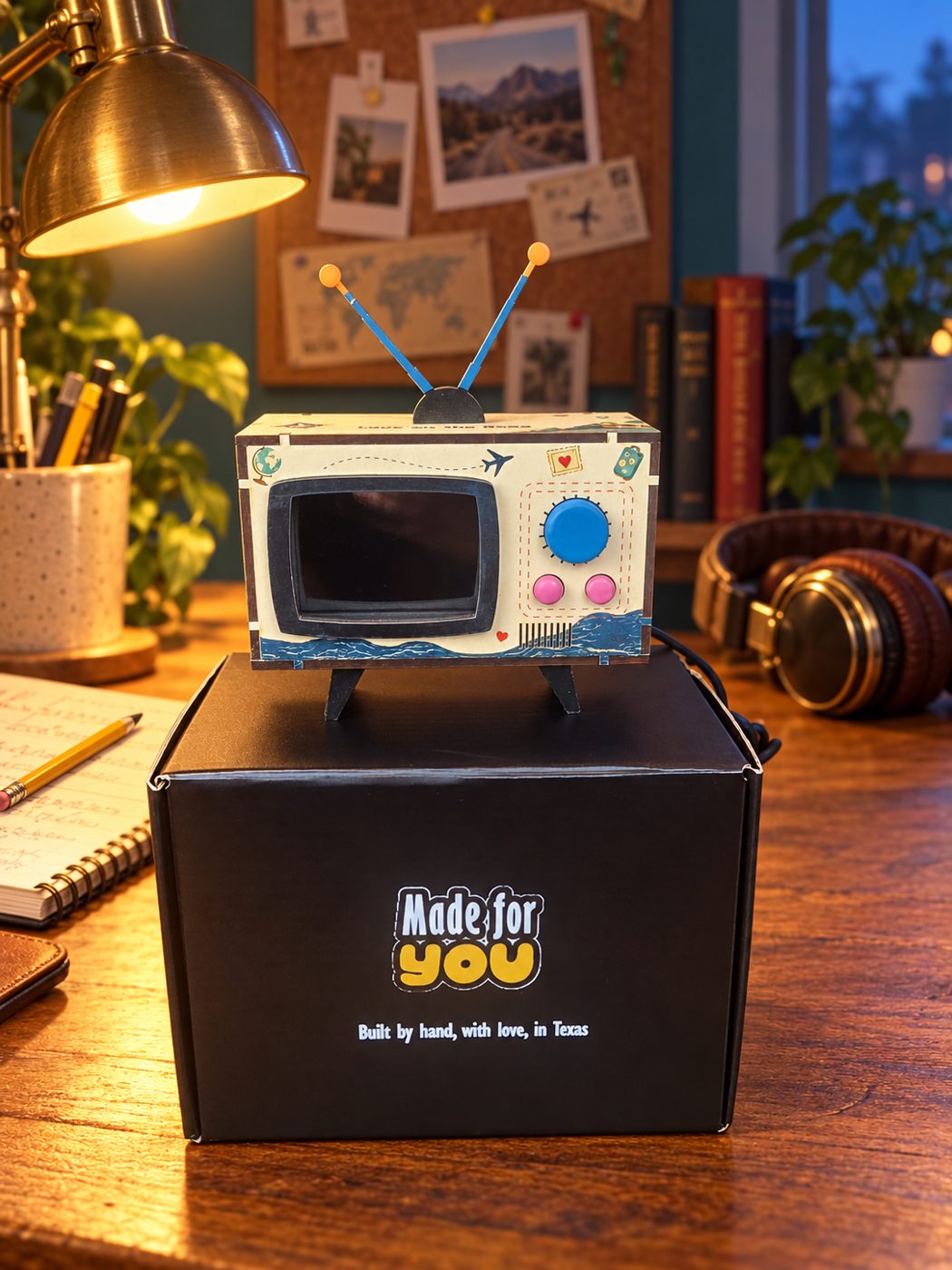
Ricky Flores is the founder of Watch N Wow and an electrical engineer with 15+ years of experience building consumer technology at Apple, Samsung, and Texas Instruments. In Dallas, Texas, he builds the Mini Memory TV by hand: a small retro TV that plays a video, a message and an original song made from your photos and your story. Read more at watchnwow.com.
Sources
- Mitchell, T. R., Thompson, L., Peterson, E., & Cronk, R. (1997). “Temporal adjustments in the evaluation of events: The ‘rosy view.’” Journal of Experimental Social Psychology, 33(4), 421–448. https://doi.org/10.1006/jesp.1997.1333
- Barasch, A., Diehl, K., Silverman, J., & Zauberman, G. (2017). “Photographic memory: The effects of volitional photo taking on memory for visual and auditory aspects of an experience.” Psychological Science, 28(8), 1056–1066. https://doi.org/10.1177/0956797617694868
- Henkel, L. A. (2014). “Point-and-shoot memories: The influence of taking photos on memory for a museum tour.” Psychological Science, 25(2), 396–402. https://doi.org/10.1177/0956797613504438
- Wilkins, H. (2011). “Souvenirs: What and why we buy.” Journal of Travel Research, 50(3), 239–247. https://doi.org/10.1177/0047287510362782
- Zauberman, G., Ratner, R. K., & Kim, B. K. (2009). “Memories as assets: Strategic memory protection in choice over time.” Journal of Consumer Research, 35(5), 715–728. https://doi.org/10.1086/592943
- Wildschut, T., Sedikides, C., Arndt, J., & Routledge, C. (2006). “Nostalgia: Content, triggers, functions.” Journal of Personality and Social Psychology, 91(5), 975–993. https://doi.org/10.1037/0022-3514.91.5.975