Table of Contents
Funny vs Sentimental Custom Song: Which Fits the Occasion?
Funny vs sentimental custom song: choose by the recipient's comfort with attention and the event setting. What research on humor, gratitude and emotion says.
Picture the room. Thirty people at your uncle’s 60th, plates of brisket, a speaker on the patio. The song starts. Will he laugh, or will he stand there with everyone watching him while a stranger’s voice sings about his heart surgery? Now picture the same song on a quiet Sunday, just him and your aunt on the couch.
Same lyrics. Completely different moment. The choice between a funny vs sentimental custom song depends less on the occasion’s label (birthday, anniversary, retirement) and more on two questions: how does this person feel about being the center of attention, and where will they hear it first? Would they laugh, or feel put on the spot?
Key Takeaways
- Decide by the recipient and the setting, not the occasion type. A milestone birthday can call for either.
- Successful humor signals confidence and competence; humor that misses or feels inappropriate lowers how the joker is seen.
- People who express gratitude consistently underestimate how positive the recipient will feel and overestimate how awkward it will be.
- Being moved (sometimes called kama muta) is a distinct, positive emotion that tends to come with warmth, tears and a feeling of closeness; it isn’t the same as sadness.
- For most occasions, a mostly sincere song with one light, affectionate moment is the lower-risk choice.
Would they laugh, or would they feel put on the spot?
People asking about this tend to frame it as a style question: “Should the song for my husband’s 40th be funny or emotional?” “Is a sentimental song too much for a coworker?” “My mom cries at everything, should I keep it light?” The real variable, though, is usually the recipient’s comfort with exposure.
Some people love being roasted in front of friends. Others would rather have a private moment of sincerity than any public attention at all. And many people are comfortable with one in private and the other in public. A heartfelt song played at a crowded party can feel like a spotlight; the same song in a car with one person can feel like a gift.
Givers also bring their own fears. Writing something sincere feels exposed, so humor becomes a shield. Writing something funny feels safer, until you imagine the joke falling flat in front of the family. Both fears are worth checking against evidence, which turns out to point in a clear direction. If you’ve already decided on a joke or two, see our guide to describing an inside joke for a song.
What the research actually says
No study has compared funny and sentimental gift songs. The research below covers the underlying mechanisms: what happens when humor lands or misses, how sincere appreciation is received, what “being moved” is, and how much people feel watched. Most of it comes from lab experiments, which are a starting point, not a verdict on your uncle.
Humor is a high-reward, high-risk move
Bitterly, Brooks and Schweitzer (2017, Journal of Personality and Social Psychology) ran eight experiments on humor and status. Successful humor raised the joke-teller’s status by signaling confidence and competence. Inappropriate humor signaled confidence but low competence, and that mix lowered status. Telling a joke at all signaled confidence, whether it landed or not.
For a gift song, this means a funny song that lands makes the giver look good, and one that misjudges the room reflects on the giver, not the songwriter.
What makes something funny: wrong, but okay
McGraw and Warren (2010, Psychological Science) found across five experiments that people laugh at “benign violations,” situations that seem wrong and not wrong at the same time. Violations became benign when there was an alternative norm, weak commitment to the norm being broken, or psychological distance.
Distance is the key variable for songs. A mishap from years ago has distance; last month’s divorce doesn’t. A joke about Grandpa’s legendary bad driving may be benign at his 80th; a joke about a recent health scare is not.
Sincere appreciation lands better than we expect
Kumar and Epley (2018, Psychological Science) had people write gratitude letters and predict how recipients would feel. Across three experiments, expressers underestimated how surprised and how positive recipients felt, and overestimated how awkward recipients would feel. Those mistaken predictions were linked to people’s reluctance to express gratitude.
This is the most useful finding for anyone leaning toward a funny song out of fear that sincerity will be “too much.” The evidence suggests the awkwardness you expect is larger in your head than in theirs.
Being moved is its own emotion
Zickfeld and an international team (2019, Emotion) studied the experience people describe as being moved or touched across 3,542 participants in 19 countries and 15 languages. They describe it, under the name kama muta, as a positive social-relational emotion triggered by a sudden sense of closeness, typically accompanied by warmth in the chest, tears, chills or a lump in the throat.
That matters because “emotional” doesn’t have to mean sad. A sentimental song can produce tears that are, in the recipient’s experience, positive. The goal is closeness, not grief.
Shared laughter signals closeness too
Kurtz and Algoe (2015, Personal Relationships) found in 71 couples that the share of time partners spent laughing together was associated with relationship quality and closeness. Humor isn’t the opposite of intimacy. A shared laugh can be its own kind of sincerity.
People feel more watched than they are
Gilovich, Medvec and Savitsky (2000, Journal of Personality and Social Psychology) showed that people overestimate how much others notice their actions and appearance. A recipient listening to a song about themselves at a party may feel more exposed than the room is paying attention. Their feeling still sets the tone of the moment.
Funny, sentimental or mixed: a decision matrix
Use this to match the song’s tone to the person and the setting.
| If the person… | And the song will play… | Lean toward… | Avoid… |
|---|---|---|---|
| Loves attention and teasing | At a party with friends | Funny, with one sincere line | Jokes about current sore spots |
| Is private or shy | At a party | Light and warm, short | A tearful tribute in front of a crowd |
| Is private or shy | One-on-one or at home | Sentimental | Public-facing roast humor |
| Cries easily and likes it | With close family | Sentimental, with one light moment | All-sad imagery |
| Is going through something hard | Anywhere | Gentle, sincere, no jokes about the hard thing | Humor that touches the wound |
| You don’t know well (coworker, in-law) | At a group event | Light, affectionate, specific | Inside jokes and deep sentiment |
| Shares a long history of jokes with you | Private listen | Mixed: inside joke plus sincere chorus | Jokes others would need explained |
Two patterns stand out. Setting changes the answer as much as personality does. And “mixed” (mostly sincere with one light moment, or mostly funny with one sincere line) covers most rows. That matches the research: sincerity tends to land better than expected, and a single benign joke adds warmth without much risk.
What to actually do
Picture the first play, specifically
Where will the recipient be, who will be there, and how loud will it be? Write that scene down before choosing a tone. This is the variable most givers skip, and the spotlight research shows why it matters: the recipient’s sense of exposure shapes the moment. The first play is also the part of a gift people tend to remember; we look at why in gifts that last: why a moment attached beats a box.
Ask how they react to public attention
Think of the last time this person was toasted, sung to or surprised. Did they light up or shrink? That’s your best predictor of how a public song will feel.
Default to sincere with one light line
Given Kumar and Epley’s finding that people overestimate the awkwardness of sincere appreciation, lean sincere. Then add one affectionate, benign joke, such as a nickname or a shared running gag, to keep it from feeling heavy.
Test any joke for distance and kindness
Ask: is this old enough to be funny? Would they laugh if their boss or grandkids heard it? Is it teasing with them or about them? Benign violation research says humor depends on the “wrong” feeling safe.
Match the style to the tone
A funny song often works best in an upbeat style; a sentimental one in a slower style with clear vocals. For help with the musical side, see how to pick a music style for someone else.
What not to do
Don’t use humor to avoid saying the thing you mean. And don’t make a sentimental song about loss or illness when the person hasn’t chosen to talk about it publicly. If the occasion includes grief, keep the song gentle and private.
How to make it personal
If you have 10 minutes
Write two lines: the funniest true thing about this person and the most sincere thing you’d want them to hear. Read both aloud and imagine each at the actual event. The one that makes you wince is your answer about what to leave out.
If you have a weekend
Ask someone who knows them well, “Would she rather laugh or cry at her party?” Then ask the follow-up: “Would she rather that happen in front of everyone or just with us?” Plan the song and the first play around the answers.
If you want it to last years
Sincere lines tend to age better than topical jokes. If you include humor, make it the kind that will still be funny in ten years: a family catchphrase, not a reference to this year’s news. The song you play again at the next milestone should still fit.
The question to ask yourself: “Am I choosing this tone for how they’ll feel, or for how I’ll feel while it plays?”
Frequently asked questions
Should a personalized song be funny or emotional?
It depends on the person and where they’ll hear it. Recipients who enjoy attention often love a funny song at a party; private people usually prefer sincerity in a quiet setting. For most occasions, a mostly sincere song with one light, affectionate moment is the safest choice.
Is a sentimental song too much for a birthday?
Usually not. Kumar and Epley (2018) found people underestimate how positively recipients react to sincere appreciation and overestimate the awkwardness. Consider the setting: a heartfelt song may be better played privately than at a crowded party if the person is shy.
What if the joke falls flat?
A missed or inappropriate joke can lower how the joker is seen (Bitterly, Brooks & Schweitzer, 2017), and in a gift song that’s the giver. Reduce the risk by using older, affectionate jokes the person already laughs at, and keep the joke to one line.
Can a song be both funny and sentimental?
Yes, and that’s often the best option. Shared laughter is linked to closeness (Kurtz & Algoe, 2015), and being moved is a positive emotion. A sincere chorus with one funny verse lets the song feel warm without feeling heavy.
Is an emotional song appropriate for a retirement or work event?
Keep it light and specific. Coworkers may not want deep personal sentiment in front of colleagues. Focus on concrete contributions and one affectionate shared joke, and save anything more intimate for family.
About the author
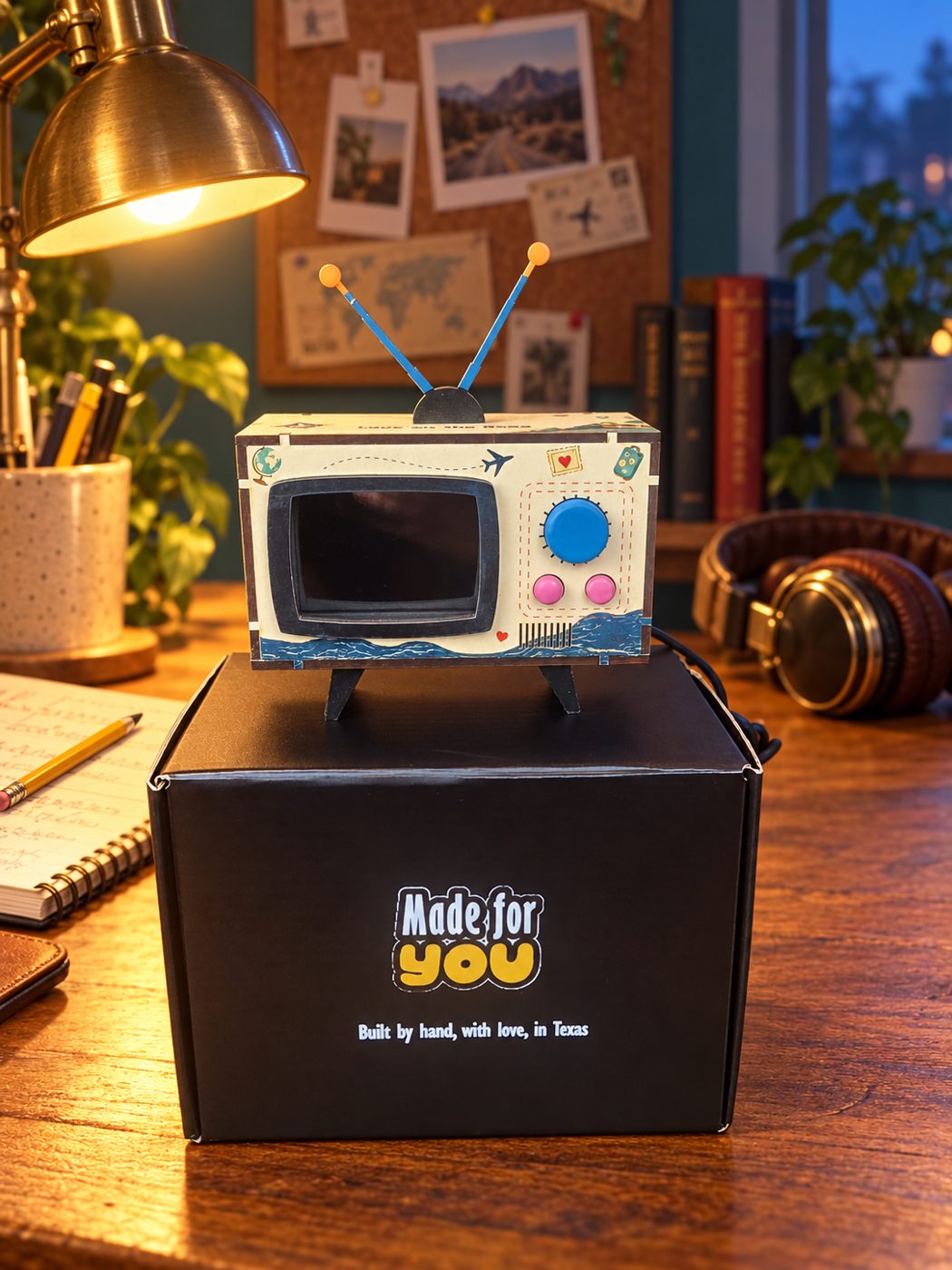
Ricky Flores is the founder of Watch N Wow and an electrical engineer with 15+ years of experience building consumer technology at Apple, Samsung, and Texas Instruments. In Dallas, Texas, he builds the Mini Memory TV by hand: a small retro TV that plays a video, a message and an original song made from your photos and your story. Read more at watchnwow.com.
Sources
- Bitterly, T. B., Brooks, A. W., & Schweitzer, M. E. (2017). “Risky business: When humor increases and decreases status.” Journal of Personality and Social Psychology, 112(3), 431–455. https://doi.org/10.1037/pspi0000079
- McGraw, A. P., & Warren, C. (2010). “Benign violations: Making immoral behavior funny.” Psychological Science, 21(8), 1141–1149. https://doi.org/10.1177/0956797610376073
- Kumar, A., & Epley, N. (2018). “Undervaluing gratitude: Expressers misunderstand the consequences of showing appreciation.” Psychological Science, 29(9), 1423–1435. https://doi.org/10.1177/0956797618772506
- Zickfeld, J. H., Schubert, T. W., Seibt, B., et al. (2019). “Kama muta: Conceptualizing and measuring the experience often labelled being moved across 19 nations and 15 languages.” Emotion, 19(3), 402–424. https://doi.org/10.1037/emo0000450
- Kurtz, L. E., & Algoe, S. B. (2015). “Putting laughter in context: Shared laughter as behavioral indicator of relationship well-being.” Personal Relationships, 22(4), 573–590. https://doi.org/10.1111/pere.12095
- Gilovich, T., Medvec, V. H., & Savitsky, K. (2000). “The spotlight effect in social judgment: An egocentric bias in estimates of the salience of one’s own actions and appearance.” Journal of Personality and Social Psychology, 78(2), 211–222. https://doi.org/10.1037/0022-3514.78.2.211