Table of Contents
Can a Blurry Photo Still Belong in a Sentimental Gift?
A blurry photo in a sentimental gift can mean more than a sharp one. What research says about sentimental value, display quality and AI restoration limits.
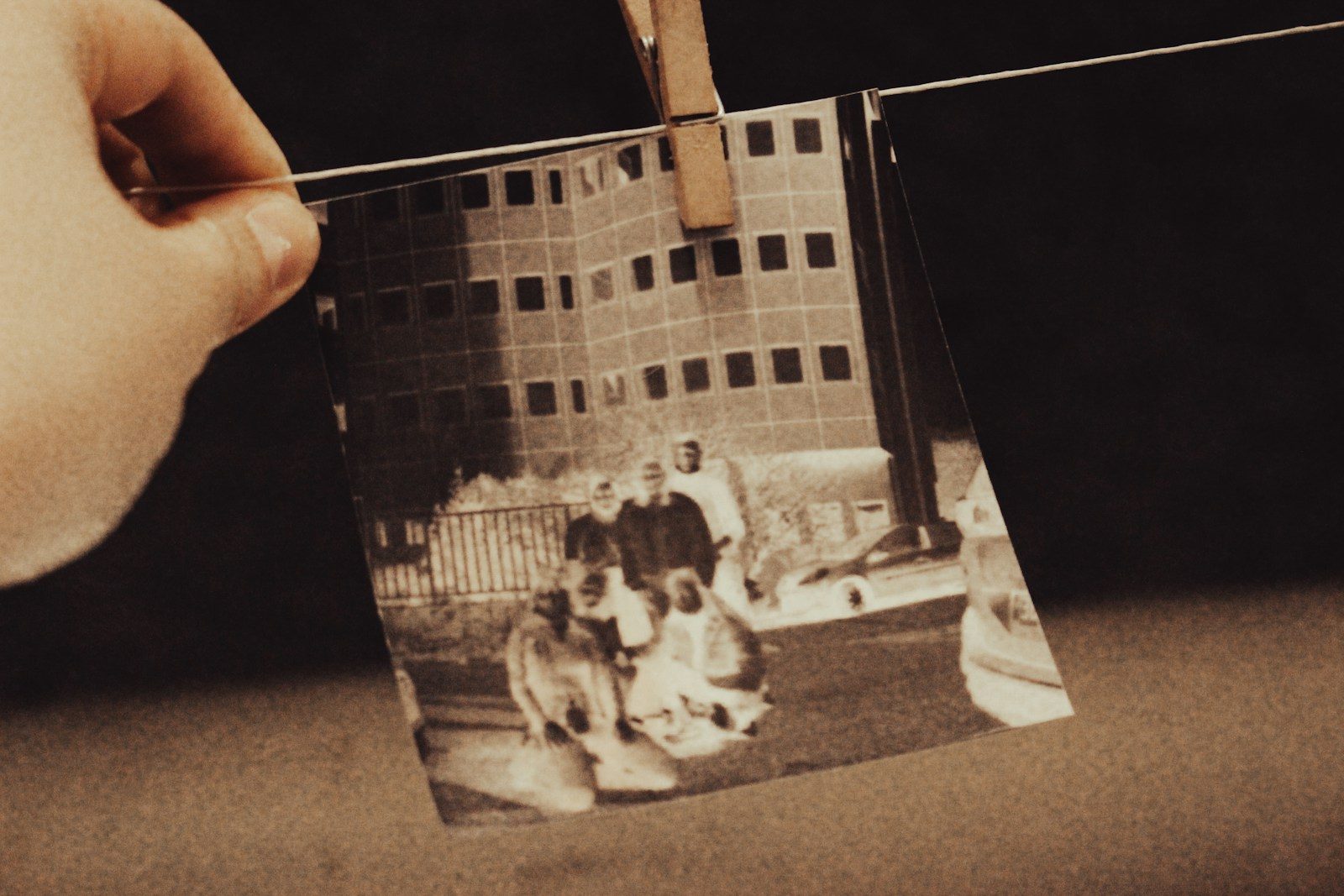
There is one photo of your grandfather holding you as a baby. It’s soft, a little crooked, his face half-turned toward the window. Everyone in the family knows it. It’s also, by any technical standard, a bad photo. And now you’re building a gift and wondering whether it belongs next to the crisp phone pictures from last summer.
The short answer: yes, a blurry photo can belong in a sentimental gift, and it is often the one that matters most. Research on sentimental value suggests people care about an object’s associations far more than its features. But blur has a real cost on screen, because images that are harder to see are harder to feel. The trick is to give the imperfect photo a role that fits its quality, and to be careful with tools that promise to “fix” it.
Key Takeaways
- Sentimental value doesn’t fade the way enjoyment of features does. Across seven studies, it shifted attention from an item’s features to the memories it carried (Yang & Galak, 2015).
- People value objects for their history and contact with someone they love, not only their condition. Bids for well-liked celebrities’ belongings rose with expected physical contact (Newman & Bloom, 2014).
- Clarity still matters to the viewer. Research on processing fluency finds that visually harder information tends to be judged less favorably (Alter & Oppenheimer, 2009).
- AI face restoration can generate detail that wasn’t in the photo. Computer-vision researchers note that many methods largely ignore whether the output keeps the person’s identity (Zhang et al., 2018).
- A practical rule: when a soft photo is the only record of a moment, keep it, show it smaller or shorter, and let the sharper photos carry the long, close-up moments.
The photo that’s technically bad and emotionally essential
People ask this in different ways. “Is it okay to use a blurry photo in a memorial slideshow?” “Can a low-quality photo be printed for a gift?” “It’s the only picture of my dad and me. Should I try an app to fix it?” The worry has two halves. One is aesthetic: it will look wrong next to the good photos. The other is protective: what if fixing it makes it not him anymore?
Both halves are reasonable. Photographs have always been imperfect. Old film cameras had fixed focus, slow shutters and flash that blew out faces. Phone photos taken in a dark kitchen or mid-laugh blur too. Many of the most loved family photos are the ones someone grabbed quickly because the moment was happening. That’s why they’re soft. It’s also why they matter.
There’s a reason the blurry one is often the best one. Photos taken in a rush catch movement, a laugh, a hug, something unposed. Posed photos are sharp because everyone stood still. If you’ve read our piece on what “personalized” should mean, the logic is familiar: the specific, true detail beats the polished, generic one.
What the research says about sentimental value and image quality
Sentimental value lives in associations, not features
Yang Yang and Jeff Galak (2015, Journal of Personality and Social Psychology) introduced sentimental value as a construct and tested it across seven studies. Their central finding concerned hedonic adaptation, the way enjoyment of a possession fades over time. The utility people get from an item’s features declined for everything, as you’d expect. Sentimental value typically did not decline, and it slowed adaptation. The mechanism was a shift in focus: people attended less to the item’s features and more to the associations it carried.
A photo’s sharpness is a feature. Who’s in it, and what was happening, are associations. By Yang and Galak’s account, the associations are what keep the object valuable, and they don’t depend on resolution. The studies looked at possessions in general, not photographs specifically, so this is an application rather than a direct test. It fits what most families already know about their soft, beloved photos.
History and contact add value that condition can’t
George Newman and Paul Bloom (2014, PNAS) studied “contagion,” the intuition that a person’s essence transfers to objects they touched. Using data from three estate auctions, they found that expected physical contact with the original owner raised final bids for items from well-liked figures such as John F. Kennedy, and lowered bids for disliked ones. In a follow-up experiment, participants would pay substantially less for a liked celebrity’s sweater if it had been sterilized. Value tracked history and contact, not just the object’s state.
A family print that was in Grandma’s wallet for forty years carries some of that. The creases are part of the story. So is the blur, in a sense: it’s evidence that this is the actual frame from that moment, not a re-creation. The auction setting is far from a family gift, but the principle travels: people value the real, touched, historical object, flaws included.
Viewers still feel the cost of blur
None of this means blur is free. Adam Alter and Daniel Oppenheimer (2009, Personality and Social Psychology Review) reviewed research on processing fluency, the subjective ease of taking in information. Very different manipulations, including visual clarity, produced similar effects: information that is easier to process tends to feel more true, more liked and more familiar. A blurry face on a screen is literally harder to process.
So there are two audiences with different needs. For the person who knows the photo, its meaning outweighs its softness; they fill in the face from memory. For a viewer who doesn’t know it, a long, enlarged blurry image is mostly effort. A gift is usually seen by both. That’s why the answer isn’t “use it” or “don’t,” but “use it well.”
Nostalgia attaches to people and moments
Tim Wildschut, Constantine Sedikides and colleagues (2006, Journal of Personality and Social Psychology) found across seven studies that nostalgic memories typically involve the self with close others or during important events, and that nostalgia strengthened social bonds and positive feeling. The trigger is the relationship and the moment. A sharp photo of an empty beach rarely carries that; a soft photo of two people on it might. We explore this in why nostalgia makes a gift feel bigger.
Restoration can invent rather than recover
Here’s the caution. Modern apps advertise “unblur,” “enhance” and “restore face.” Some make modest, honest improvements: correcting exposure, reducing noise, removing scratches. Generative restoration does something different. It predicts plausible detail, especially for faces, based on what faces in its training data look like.
Computer-vision researchers have documented the identity problem directly. Kaipeng Zhang and colleagues, presenting at the European Conference on Computer Vision in 2018 (arXiv), noted that earlier face “hallucination” methods, which super-resolve low-resolution faces, largely ignored whether the result preserved the person’s identity. Their method added an identity-matching objective to address it. Newer tools have improved, but the underlying issue remains: when detail wasn’t captured, software can only guess. The guess may look sharp and still not look like your grandfather.
The archival principle is the safe one. The Library of Congress’s guidance on personal digital photographs is to keep the highest-quality version of important photos. An AI-enhanced copy can be a working copy. It should never replace the original file.
The limits, plainly. No study has tested blurry photos in gift videos specifically. Yang and Galak and Newman and Bloom studied possessions and auctions, not images. The fluency research mostly uses text and simple visuals. Read this as an informed argument, not a measured result.
Sentimental value vs. display quality: a decision matrix
| If the photo is… | Use it as… | Avoid… |
|---|---|---|
| The only photo of a person or moment, soft but recognizable | A key moment, shown at modest size or for 3 to 4 seconds | Full-screen enlargement or a long zoom into the face |
| Badly blurred, faces barely legible, but meaningful | A turning point or transition, with a caption or a voice telling the story | Making it the final image, where people look longest |
| Blurry, and a sharp near-duplicate exists | Skip it; keep the sharp one | Including both “to be fair” to the moment |
| Soft because of motion (a laugh, a dance, a hug) | A feature: motion blur reads as life | ”Fixing” it into a stiff, sharpened face |
| Faded or scratched print, details intact | A gently corrected working copy (exposure, dust) | Heavy AI face restoration on the only copy |
| A screenshot or tiny chat copy of a photo that still exists | A placeholder until you get the original | Settling for it; ask for the original file |
The pattern: let meaning decide whether a photo is in, and let quality decide how big and how long it is shown.
What to actually do
Decide by role, not by resolution
Ask what job the photo does in the story: is it the only record of someone, a turning point, a moment of joy? If it carries a job no other photo can, it’s in. Then decide its size and screen time based on how clear it is.
Show it smaller, shorter or framed
On screen, a soft photo looks better smaller. Place it on a plain background or inside a border rather than stretching it to fill a wide frame. In a video, 3 to 4 seconds is often enough; let a sharper photo take the long close-up. In print, keep it small: a 3×4 or 4×6 inch print hides what an 8×10 reveals.
Add a voice or a caption
When a face is hard to see, help the viewer: a short caption (“Grandpa, the day I was born”) or a recorded voice telling the story. That shifts attention from the photo’s features to its associations, which is exactly where Yang and Galak found sentimental value lives.
Use correction lightly, and never on the only copy
Exposure, contrast, dust and scratch removal are safe on a working copy. If you try AI face enhancement, compare the result against other photos of the person, and ask someone who knew them well whether it still looks like them. If it doesn’t, use the honest blurry version.
Get the original before you give up on a photo
Many “blurry” photos are actually small copies: screenshots, chat forwards, social media downloads. Before deciding a photo is too soft, find the original file; our guide to downloading original photos instead of screenshots walks through it.
What not to do
Don’t replace the photo with an AI version and throw away the original. And don’t leave out the only photo of someone because it “doesn’t match” the others. Matching is a design concern. Absence is a much bigger one.
How to make it personal
If you have 10 minutes
Find the softest photo you love and write one sentence about what was happening when it was taken. That sentence is its caption, and it does more work than any sharpening tool.
If you have a weekend
Call the person in the photo, or someone who was there, and record them talking about it for two minutes. Put that voice over the image in your video, or write the story on a small card that sits next to the print.
If you want it to last years
Keep the original file untouched, labeled with names and the story. If you make an enhanced version, name it clearly as a copy. Fifty years from now, someone will want to know which one is real.
The question to ask yourself: “Is this photo worse than the others, or is it just less sharp?”
Frequently asked questions
Is it okay to use a blurry photo in a memorial slideshow?
Yes, especially if it shows the person in a way no other photo does. Show it for a few seconds at a modest size, on a plain background, and consider a short caption or voice to help viewers recognize the moment. Avoid making a very blurry image the final, longest frame.
Can AI fix a blurry photo of a loved one?
It can improve exposure, noise and scratches, and some tools can make faces look sharper. But generative restoration predicts detail that wasn’t captured, and researchers have documented that face super-resolution can fail to preserve identity. Always compare the result with other photos and keep the original untouched.
Can you print a blurry photo for a gift?
Yes, at a small size. Blur becomes more visible as prints get larger, so a soft photo that looks fine at 4×6 inches may look poor at 8×10. A small print in a frame or album, with a handwritten note about the moment, often works better than an enlargement.
Why do blurry photos feel more emotional sometimes?
Often because they were taken during real movement: a laugh, a hug, a dance, a rushed moment someone didn’t want to miss. Research on sentimental value suggests people value objects for their associations rather than their features, so a soft photo of an important moment can matter more than a sharp, posed one.
Should I leave a bad-quality photo out of a gift?
Only if a better photo does the same job, or if the person in it would be embarrassed by it. If it’s the only record of a person or moment, keep it and adjust how it’s shown: smaller, shorter, with context. A missing person in a family gift is usually noticed more than a soft photo.
About the author
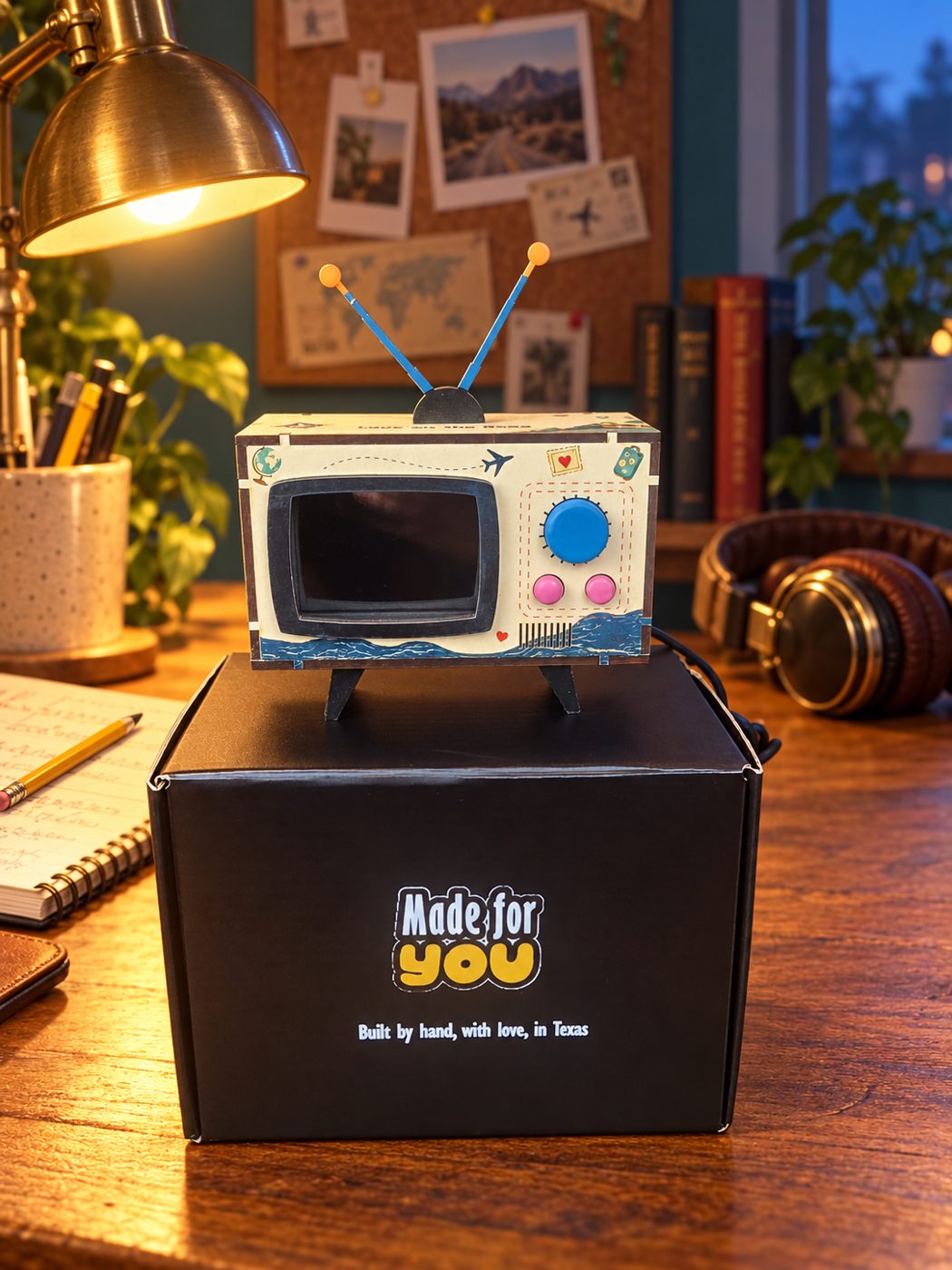
Ricky Flores is the founder of Watch N Wow and an electrical engineer with 15+ years of experience building consumer technology at Apple, Samsung, and Texas Instruments. In Dallas, Texas, he builds the Mini Memory TV by hand: a small retro TV that plays a video, a message and an original song made from your photos and your story. Read more at watchnwow.com.
Sources
- Yang, Y., & Galak, J. (2015). “Sentimental value and its influence on hedonic adaptation.” Journal of Personality and Social Psychology, 109(5), 767–790. https://doi.org/10.1037/pspa0000036
- Newman, G. E., & Bloom, P. (2014). “Physical contact influences how much people pay at celebrity auctions.” Proceedings of the National Academy of Sciences, 111(10), 3705–3708. https://doi.org/10.1073/pnas.1313637111
- Alter, A. L., & Oppenheimer, D. M. (2009). “Uniting the tribes of fluency to form a metacognitive nation.” Personality and Social Psychology Review, 13(3), 219–235. https://doi.org/10.1177/1088868309341564
- Wildschut, T., Sedikides, C., Arndt, J., & Routledge, C. (2006). “Nostalgia: Content, triggers, functions.” Journal of Personality and Social Psychology, 91(5), 975–993. https://doi.org/10.1037/0022-3514.91.5.975
- Zhang, K., Zhang, Z., Cheng, C.-W., Hsu, W. H., Qiao, Y., Liu, W., & Zhang, T. (2018). “Super-identity convolutional neural network for face hallucination.” European Conference on Computer Vision (ECCV). https://arxiv.org/abs/1811.02328
- Library of Congress. “Personal Archiving: Digital Photographs.” https://digitalpreservation.gov/personalarchiving/photos.html