Table of Contents
Music for Couples With Different Tastes: Pick by Mood
Choosing music for a couple with different tastes? Start with the mood, not a favorite song. A worksheet-style guide based on music-preference and memory research.
She loves country; he loves reggaeton. Or he grew up on his dad’s classic rock and she still knows every word of the boy-band albums from middle school. Now there’s an anniversary video to score, a first dance to pick, or a song to choose for a gift, and every suggestion gets a polite “hmm.”
The way through is to choose music for couples with different tastes by mood first, not by favorite song. Decide what the moment should feel like, then find the songs both of you connect with, especially the ones tied to shared memories. The research on music preferences and memory explains why that works better than flipping a coin.
Key Takeaways
- Music tastes cluster into a few broad dimensions: reflective and complex, intense and rebellious, upbeat and conventional, energetic and rhythmic (Rentfrow & Gosling, 2003). Two people who “never agree” often overlap on one dimension.
- Shared music preferences signal shared values, and that perceived similarity drives attraction (Boer et al., 2011). A song you both love says more than a song one of you loves.
- People hold strong memories of music from their late teens and early twenties, and also of their parents’ generation (Krumhansl & Zupnick, 2013). Each partner’s “memory window” is a good place to look.
- Familiar songs tied to personal memories activate a brain region linked to self and autobiographical memory (Janata, 2009). The song from your first road trip may matter more than either person’s favorite genre.
- Check associations before you commit. A song linked to an ex, a funeral or a hard year can spoil the moment.
Why “just pick your favorite song” doesn’t work for two people
The searches here are practical and a little desperate: “first dance song when we like different music,” “anniversary song for couple with different taste,” “how to pick a song that we both like,” “country and hip hop wedding playlist,” “songs that mix genres for couples.” In wedding and relationship forums the stories repeat: “We spent three weeks arguing about our first dance.” “He wants metal at the reception.” “Every song I suggest, she says is too slow.” “I’m making him a video and I don’t know whose music to use.”
Two things go wrong. First, the conversation starts with genres, which are identity badges. Saying “I don’t want country” can land as “I don’t want you.” Second, people pick favorites, and a favorite song is usually tied to the individual (a high-school memory, a breakup album, a concert with friends), not to the couple.
A better starting point is the feeling the music should carry. “Tender and a little nostalgic.” “Celebratory, everyone dancing.” “Funny, with one moment that makes us cry.” Once you agree on the feeling, genre becomes a set of options rather than a battle line.
What the research says about taste, bonding and memory
Taste has structure, and overlap is common
Peter Rentfrow and Samuel Gosling studied more than 3,500 people across six studies, published in the Journal of Personality and Social Psychology in 2003. They found that music preferences organize into four broad dimensions: reflective and complex (think jazz, classical, folk), intense and rebellious (rock, alternative, heavy metal), upbeat and conventional (pop, country, religious and soundtrack music) and energetic and rhythmic (hip-hop, soul, funk, electronic). Preferences were linked to personality traits such as openness, and to self-views.
The practical use: two people with “opposite” taste may share a dimension. Country and pop sit together in the upbeat-conventional cluster. Hip-hop and funk share energetic-rhythmic. Even when the genres differ, the feel a person enjoys may not.
A shared song signals shared values
Diana Boer and colleagues tested why shared music taste draws people together (Personality and Social Psychology Bulletin, 2011). In lab experiments and a field study with pairs of young people, shared preferences led people to see each other as holding similar values, and that perceived value similarity drove attraction. It held across Western and non-Western samples.
For a couple, this suggests the search for common ground is itself worthwhile. Finding the song you both genuinely love is a small reminder of what you have in common.
Everyone has a memory window, and it includes their parents
Carol Lynne Krumhansl and Justin Zupnick asked young adults about popular songs across five and a half decades (Psychological Science, 2013). Memories and emotional responses peaked for music from participants’ own late adolescence and early adulthood, the well-known “reminiscence bump.” They also peaked for music from their parents’ youth, which the authors tied to music heard in childhood at home.
That gives you two windows per person: the songs from their own late teens and early twenties, and the songs their parents played. Each partner’s windows are a richer source than a “favorites” list. Krumhansl’s later work on listening across a century of popular music (Frontiers in Psychology, 2017) found the same centering on late adolescence and early adulthood, with older listeners showing the broadest tastes.
The songs tied to your story do something special
Petr Janata scanned people’s brains while they listened to excerpts of popular songs (Cerebral Cortex, 2009). The dorsal medial prefrontal cortex, a region linked to self-related processing, tracked how strongly a song was tied to personal memories. A song from a shared moment (your first apartment, the drive to the hospital when the baby came) carries both of your memories at once. That may outweigh any genre preference. We go deeper into the science in why a song with your name in it hits different.
The limits. These studies describe preferences and memory in general, mostly in young Western adults; none tested couples choosing music for a gift. Rentfrow’s genre clusters are broad, and individuals vary. Use the framework as a starting point, not a rulebook.
The mood-first worksheet
Fill in the first column together, or alone if it’s a surprise. Then use the bridges to find options both of you can enjoy.
| The feeling you want | Musical cues | If one of you loves… and the other loves… | Bridge to try |
|---|---|---|---|
| Tender, slow, close | Slower tempo, simple arrangement, clear vocal | Country / R&B | Acoustic or stripped-down versions; a ballad from either genre in the other’s style |
| Nostalgic, “remember when” | Songs from your memory windows or your parents’ | Classic rock / regional Mexican | A song both families played; a cover in one partner’s preferred style |
| Joyful, celebratory | Upbeat tempo, big chorus | Pop / hip-hop | Crossover hits; a pop song with a featured rapper |
| Playful, a little funny | Light feel, a lyric that fits your story | Indie / Latin pop | A song with a lyric that matches an inside joke |
| Big emotional moment | Builds slowly, strong melody | Classical / electronic | Orchestral or piano versions of a song one of you loves |
The point isn’t the exact genres. It’s that once you know the feeling, there are usually several songs, versions or styles that meet in the middle.
How to choose, step by step
Step 1: Agree on the feeling in one sentence
Write: “When this music plays, we want to feel ___.” Keep it to two or three adjectives. If it’s a surprise gift, write what you want your partner to feel. Common mistake: starting with “what song do we like?” It turns a creative choice into a negotiation about identity.
Step 2: Each list your memory windows
Each of you writes down five songs from your late teens and early twenties and three songs your parents played at home. Krumhansl’s research suggests these lists carry the strongest personal memories. If it’s a surprise, ask your partner’s sibling or parent which songs were always on in the house.
Step 3: List the songs from your shared story
Write down every song connected to a moment you shared: the song playing when you met, the road-trip album, the song at a friend’s wedding where you danced, the one that played in the waiting room. These may come from neither person’s favorite genre. That’s fine. Janata’s research suggests the memory tie matters more than the style.
Step 4: Find the overlap, then the bridge
Look for songs that appear on both lists or in the same Rentfrow dimension. If there’s no overlap, use a bridge from the worksheet: a cover, an acoustic version, a crossover, or a medley (one verse of each partner’s song). Common mistake: picking one person’s song and promising the other gets “the next one.”
Step 5: Check the associations
Before you commit, ask (or quietly check): Is this song tied to an ex? A funeral? A hard period? A song can be perfect musically and wrong emotionally. This is the permission step. If you’re making a surprise, run the shortlist past someone who knows your partner well.
Step 6: Test it in the real moment
Play 30 seconds while looking at the photos you’ll use, or while slow-dancing in the kitchen. If one of you winces, keep looking. The right choice usually gets a smile from both.
How to make it personal
If you have 10 minutes
Ask your partner: “What song was playing the first time you thought we might be serious?” Write it down, along with your own answer. Even if they differ, you now have two songs that belong to the relationship rather than to either of you alone.
If you have a weekend
Each make the “memory windows” list and a “shared moments” list, then compare over dinner. Build a short playlist that alternates between your lists and see which songs get both of you singing. If your families come from different traditions, see how to include two cultures in one anniversary gift.
If you want it to last years
Choose one song as “ours” and attach it to something that will play it back: a video of your year, a recording of your first dance, a music box. Over time a shared song becomes a memory cue in its own right, and nostalgia makes that kind of gift feel bigger each year you return to it.
The question to ask yourself: “Is this song about the two of us, or about one of us winning?”
Frequently asked questions
How do you pick a song when you have different music tastes?
Start with the feeling you want, not a favorite. Then look for songs tied to shared memories and for overlap in broad style: country and pop, for example, sit in the same “upbeat and conventional” cluster in Rentfrow and Gosling’s research (2003). Bridges like acoustic covers or crossover hits can meet in the middle.
What if we can’t agree on a first dance song?
Use a medley (a verse from each partner’s song), or choose a song from a shared moment even if it’s neither person’s favorite genre. Songs tied to personal memories activate brain regions linked to autobiographical memory (Janata, 2009), so the shared history can matter more than style.
Is it okay to use one partner’s favorite genre for a surprise gift?
Yes, if you’re making the gift for them and it’s their taste you’re honoring. Just check the specific song for associations with an ex or a hard time. If the gift is for both of you, look for common ground instead.
Where do I find songs that mean something to my partner?
Look in their memory windows: music from their late teens and early twenties, and music their parents played at home. Research on reminiscence bumps found both carry strong personal memories (Krumhansl & Zupnick, 2013). Ask a sibling or parent if you need help.
Do couples need to like the same music?
No. Research found shared preferences signal shared values (Boer et al., 2011), but couples with different tastes do fine. What helps is finding a few songs you both connect with, usually the ones tied to your shared story.
If you’re choosing a style for an original song written about your partner, Watch N Wow lets you pick the style (for example acoustic country, pop ballad, R&B or merengue) and keeps every version you generate so you can compare.
About the author
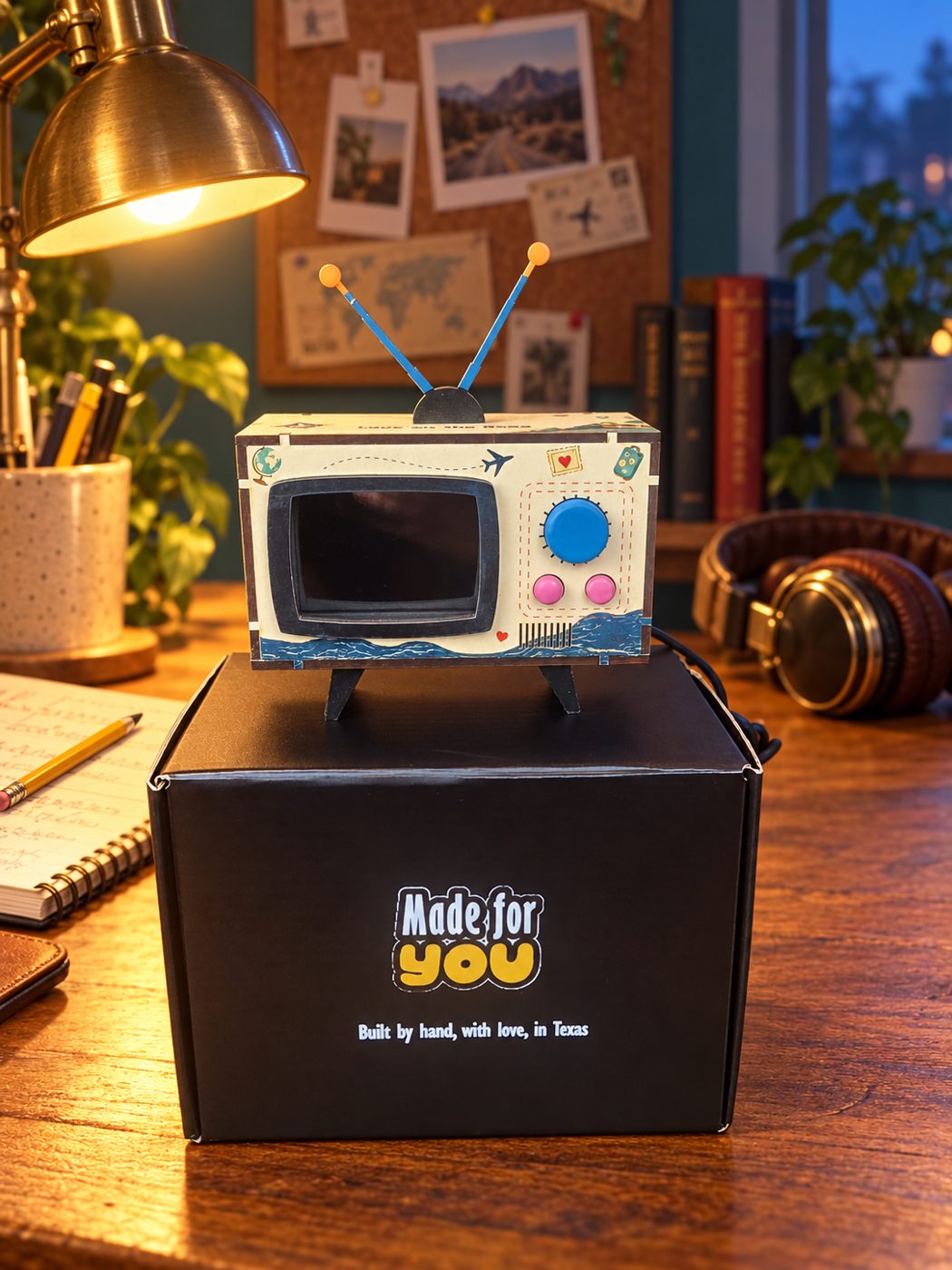
Ricky Flores is the founder of Watch N Wow and an electrical engineer with 15+ years of experience building consumer technology at Apple, Samsung, and Texas Instruments. In Dallas, Texas, he builds the Mini Memory TV by hand: a small retro TV that plays a video, a message and an original song made from your photos and your story. Read more at watchnwow.com.
Sources
- Rentfrow, P. J., & Gosling, S. D. (2003). “The do re mi’s of everyday life: The structure and personality correlates of music preferences.” Journal of Personality and Social Psychology, 84(6), 1236–1256. https://doi.org/10.1037/0022-3514.84.6.1236
- Boer, D., Fischer, R., Strack, M., Bond, M. H., Lo, E., & Lam, J. (2011). “How shared preferences in music create bonds between people: Values as the missing link.” Personality and Social Psychology Bulletin, 37(9), 1159–1171. https://doi.org/10.1177/0146167211407521
- Krumhansl, C. L., & Zupnick, J. A. (2013). “Cascading reminiscence bumps in popular music.” Psychological Science, 24(10), 2057–2068. https://doi.org/10.1177/0956797613486486
- Krumhansl, C. L. (2017). “Listening niches across a century of popular music.” Frontiers in Psychology, 8, 431. https://doi.org/10.3389/fpsyg.2017.00431
- Janata, P. (2009). “The neural architecture of music-evoked autobiographical memories.” Cerebral Cortex, 19(11), 2579–2594. https://doi.org/10.1093/cercor/bhp008