Table of Contents
Anniversary Gifts Beyond Flowers and Jewelry: What Research Says
Anniversary gifts beyond flowers and jewelry: what the studies on novelty, shared memory and sentimental value say to give once the classics are covered.
The roses died in a week, which is what roses do. The necklace is lovely and lives in a drawer with the other lovely necklaces. Now the anniversary is coming around again and you are staring at the same two aisles.
Here is the short answer. The best anniversary gifts beyond flowers and jewelry do one of two jobs the classics can’t: they give the two of you something new to do together, or they hand your shared history back in a form you can hold. Both are backed by decent research. Neither requires spending more.
Key Takeaways
- Novelty is not a cliché. In three lab experiments, couples who did a seven-minute novel, mildly challenging task together reported higher relationship quality afterward than couples who did a mundane one (Aron et al., 2000).
- Recalling your own relationship memories raises warmth toward your partner; recalling fictional relationship stories does not (Alea & Bluck, 2007).
- Givers pick “safe” gifts that match tastes far more often than recipients want; recipients lean toward sentimental gifts (Givi & Galak, 2017).
- Flowers and jewelry still dominate spending: in the National Retail Federation’s latest Valentine’s survey, jewelry was the top category at $7.0 billion and 41% planned to buy flowers.
- The practical move is a hybrid: one new experience plus one keepsake made from a specific memory of yours.
Why anniversary gifts beyond flowers and jewelry are hard to find
The complaint shows up in nearly the same words every year. “We’ve done flowers, we’ve done jewelry, we’ve done the nice dinner.” “She has enough necklaces.” “He says don’t get me anything, and I know he half means it.” The problem is not a lack of products. Search “anniversary gifts” and you get thousands. The problem is that most of them are variations on the same three ideas, and you have already given all three.
The numbers show how strong the default is. In the National Retail Federation and Prosper Insights survey of 7,791 U.S. adults on Valentine’s Day plans, jewelry was the largest spending category at $7.0 billion, 41% planned to buy flowers, and 39% planned an evening out. These are not bad gifts. They are popular because they are low-risk: nobody is offended by roses.
That low risk is also the trap. A gift chosen because it can’t go wrong rarely goes memorably right. After a few anniversaries, the classic gifts stop telling your partner anything about this year, or about you. They mark the date without marking the relationship.
There’s a second, quieter problem. Anniversaries are about time, and most anniversary gifts ignore time entirely. A bracelet bought for year three could have been bought for year thirteen. The research below suggests two ways out, one pointing forward and one pointing back.
What the research actually says
New shared experiences fight the slow drift
The best-known study here comes from Arthur Aron and colleagues, published in the Journal of Personality and Social Psychology in 2000. They started with a newspaper questionnaire and a door-to-door survey, which found that couples who reported doing more “exciting” activities together were more satisfied, and that the link ran through relationship boredom. Then came three lab experiments. Couples did a seven-minute task together: either a novel and arousing one or a more mundane one. The novel-task couples showed bigger increases in relationship quality from before to after, a comparison with a no-activity control showed the effect came from the novel task itself, and ratings of videotaped discussions picked up the same change. The authors tied the result directly to the typical decline in relationship quality after the honeymoon period.
Amy Muise and colleagues extended this nearly two decades later in the same journal (2019). Across three studies using daily diaries, longitudinal tracking and an experiment with established couples, engaging in “self-expanding” activities together, ones that feel new and broaden your sense of yourselves, was linked to higher desire, which in turn was linked to greater relationship satisfaction.
The limits: Aron’s tasks lasted minutes, in a lab, and the effect was measured right after. Muise’s samples were mostly North American couples. Neither study tested gifts. The leap from “a new shared activity helps” to “give a new shared activity” is ours. But it is a short leap.
Your own memories do something fiction doesn’t
The second line of research points backward. Nicole Alea and Susan Bluck, in Applied Cognitive Psychology (2007), had 129 younger and older adults in romantic relationships recall either real events from their relationship or read fictional relationship vignettes, measuring intimacy before and after. Warmth toward the partner rose after recalling real shared events, regardless of age or gender, and women also reported more closeness. The best predictor was how personally significant the memory was, more than how vivid.
This matters for gifts because so many “romantic” gifts are fiction: a generic love quote, a stock image of a couple on a beach. Alea and Bluck’s comparison condition was, in effect, a generic love story. It didn’t move people. Their own story did.
Recipients want sentimental gifts more than givers think
Then there is the giver’s nerve. Julian Givi and Jeff Galak, in the Journal of Consumer Psychology (2017), asked givers and recipients to choose between a gift that matched the recipient’s tastes and a sentimentally valuable one, tied to a shared person, place or time. Across three studies and several occasions and relationship types, givers chose the preference-matching gift much more often than recipients would have preferred. The reason was certainty: givers felt sure the tasteful gift would be liked and unsure about the sentimental one.
Jewelry is the textbook preference-matching gift. It’s the “she likes gold, she wears small earrings” choice. Givi and Galak suggest that the sentimental alternative is the one your partner is more likely to want, and the one you are more likely to talk yourself out of.
And the small things count
Sara Algoe, Shelly Gable and Natalya Maisel’s daily-diary study of cohabiting couples (Personal Relationships, 2010) found that receiving thoughtful benefits from a partner predicted gratitude, and that gratitude predicted more connection and satisfaction the next day, for both the person who received and the person who gave. Their key word is “thoughtful”: the benefit had to show the partner was paying attention, not that they spent money.
Anniversary gift options compared
The table compares the usual gifts with the two alternatives the research supports.
| Gift type | What it does well | Where it fails | Evidence |
|---|---|---|---|
| Flowers | Easy, visible, signals the date was remembered | Gone in a week; says little about this particular year | NRF Valentine’s survey (41% plan to buy) |
| Jewelry | Lasting, wearable, socially safe | A “taste-matching” gift; can feel interchangeable across years | Givi & Galak 2017 |
| Nice dinner out | Time together; easy to plan | Familiar by year five; little novelty | Aron et al. 2000 (familiar activities did not lift quality) |
| A new shared experience (a class, a trip somewhere neither has been, a skill you both lack) | Novelty and mild challenge measurably lift relationship quality | Needs scheduling; can feel like homework if it’s really one person’s hobby | Aron et al. 2000; Muise et al. 2019 |
| A keepsake built from your own history (letter, photo story, recorded memories, a song or video about you two) | Raises warmth through real shared memory; recipients like sentimental gifts more than givers expect | Takes time; generic “custom” versions with no real memory inside fall flat | Alea & Bluck 2007; Givi & Galak 2017 |
The two bottom rows aren’t competitors. One builds new memories, the other honors old ones. Together they cover what the classic gifts skip: time.
What to actually do
Give a first, not a favorite
Pick something neither of you has done. A pottery or cooking class, a hike you have never taken, a city two hours away you keep saying you’ll visit. Aron’s novel tasks were slightly awkward on purpose; mild challenge was part of the effect. A favorite restaurant is comforting, which is fine, but it isn’t new. If your partner hates surprises, announce the experience and let them help choose.
Make sure it’s shared, not delegated
A spa voucher for one is a nice gift. It isn’t a shared experience. The studies above measured couples doing something together. If the experience is your idea, plan the logistics yourself so it lands as a gift rather than a task. Book it, arrange childcare, put it on the calendar.
Pair the experience with a memory from your past
Before or after the outing, hand over something that points backward: a one-page letter about a specific day from your first year, a short video built from photos of a place you used to go, a small box with the ticket stub from your first concert. Alea and Bluck found personal significance mattered most, so choose the memory you both bring up, not the most photogenic one.
Trust the sentimental option
When you catch yourself reaching for the safe choice because you’re unsure the meaningful one will land, remember Givi and Galak: that uncertainty is common, and it pushes givers away from what recipients prefer. If you want insurance, give both: the earrings and the letter. But don’t skip the letter.
Show attention, not budget
Algoe’s couples responded to thoughtfulness. Reference something your partner said months ago. Fix the thing they keep mentioning. A gift that proves you were listening registers more than one that proves you shopped.
What not to do
Don’t recreate your wedding or first date as an exact copy and expect the same feeling; replays invite comparison. And don’t make the “experience” an activity only you love. A ticket to your favorite band’s show is a gift to you with a guest.
How to make it personal
If you have 10 minutes
Write down three moments from this past year that only the two of you would recognize: the night the power went out, the argument about the GPS, the morning on the porch. Pick one. That’s the center of your gift, whatever form it takes.
If you have a weekend
Book one thing neither of you has done, and build a small keepsake around one memory from your relationship: a handful of photos from that time, a short note explaining why that moment still matters to you, maybe a song you associate with it. Our piece on why a gift with a moment attached lasts longer explains why pairing the two works.
If you want it to last years
Give it a physical form and a date. Put the year and the place on it. Make it something that can be replayed or reread without your help, and plan to add to it next anniversary. For more on why looking back makes a gift feel bigger, see how nostalgia shapes a gift.
The question to ask yourself: “Does this gift say anything about our year, or could I have given it to anyone?”
Frequently asked questions
What do you give for an anniversary when you’ve done everything?
Look at what you haven’t done together rather than what you haven’t bought. A first-time shared experience lifted relationship quality in Aron and colleagues’ 2000 experiments, and a keepsake built from your own memories raised warmth in Alea and Bluck’s 2007 study. Combine one of each and the gift stops repeating itself.
Are experiences better anniversary gifts than things?
For connection, experiences have strong support: Chan and Mogilner (2017) found experiential gifts strengthened relationships more than material ones. But a physical keepsake tied to a real shared memory does a different job: it keeps the memory findable. Many couples do best with both.
Is jewelry a bad anniversary gift?
No. It’s lasting and often loved. The research only suggests it shouldn’t be the automatic choice. Givi and Galak (2017) found givers over-pick taste-matching gifts like jewelry and under-pick sentimental ones that recipients actually prefer. Adding a personal note or memory to the jewelry addresses both.
How do I make an anniversary gift sentimental without being cheesy?
Use specifics instead of declarations. “The night we got lost in Fort Worth and ate gas-station tacos on the hood” is sentimental; “you are my everything” is a greeting card. Alea and Bluck found personal significance, not intensity, predicted closeness.
What are good anniversary ideas on a budget?
A new local experience (a free trail, a museum day, a class at a community center) plus a handwritten letter about one specific memory costs little and covers both research-backed jobs. Thoughtfulness, not price, drove gratitude in Algoe, Gable and Maisel’s 2010 daily-diary study of couples.
About the author
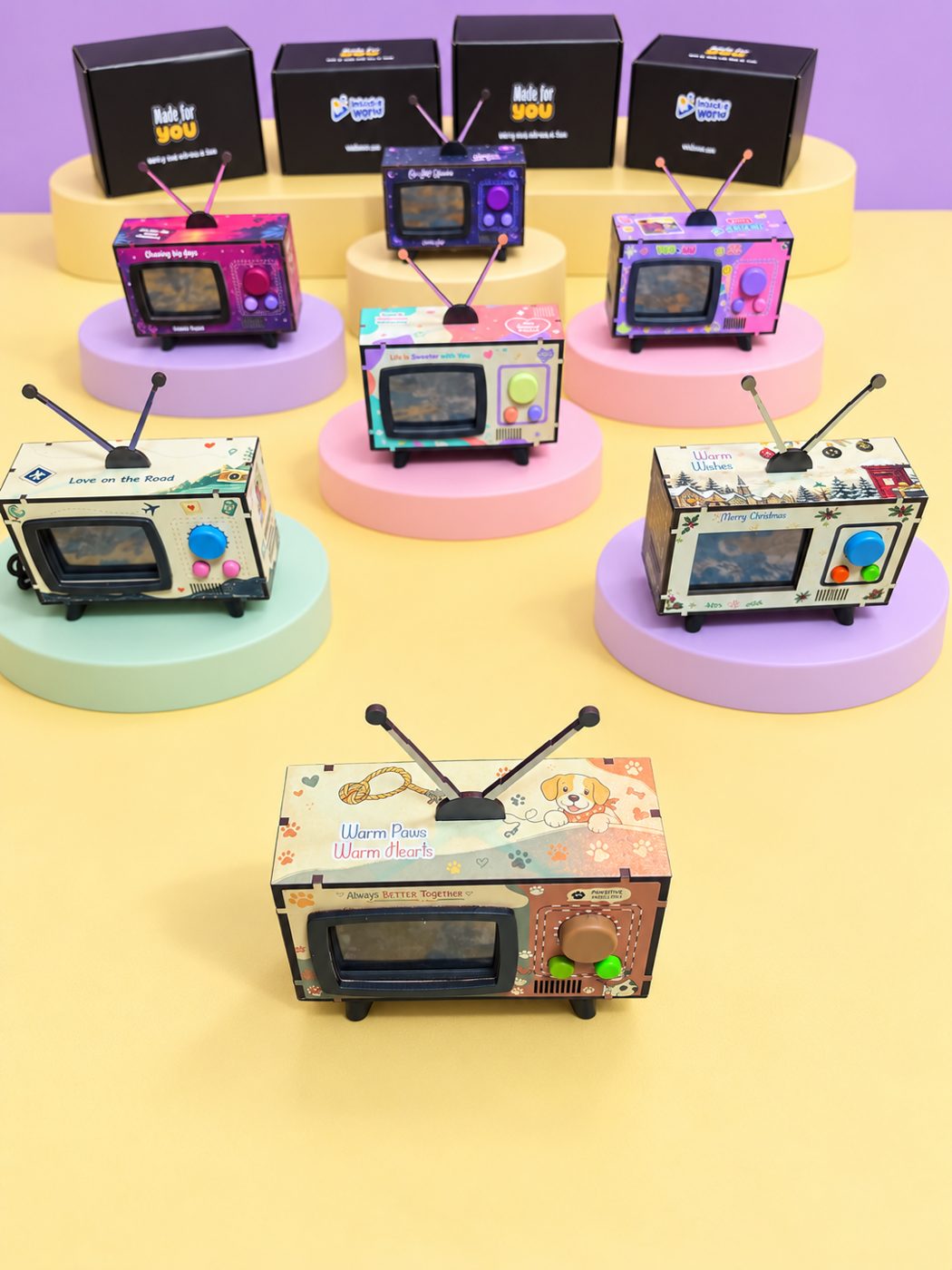
Ricky Flores is the founder of Watch N Wow and an electrical engineer with 15+ years of experience building consumer technology at Apple, Samsung, and Texas Instruments. In Dallas, Texas, he builds the Mini Memory TV by hand: a small retro TV that plays a video, a message and an original song made from your photos and your story. Read more at watchnwow.com.
Sources
- Aron, A., Norman, C. C., Aron, E. N., McKenna, C., & Heyman, R. E. (2000). “Couples’ shared participation in novel and arousing activities and experienced relationship quality.” Journal of Personality and Social Psychology, 78(2), 273–284. https://doi.org/10.1037/0022-3514.78.2.273
- Muise, A., Harasymchuk, C., Day, L. C., Bacev-Giles, C., Gere, J., & Impett, E. A. (2019). “Broadening your horizons: Self-expanding activities promote desire and satisfaction in established romantic relationships.” Journal of Personality and Social Psychology, 116(2), 237–258. https://doi.org/10.1037/pspi0000148
- Alea, N., & Bluck, S. (2007). “I’ll keep you in mind: The intimacy function of autobiographical memory.” Applied Cognitive Psychology, 21(8), 1091–1111. https://doi.org/10.1002/acp.1316
- Givi, J., & Galak, J. (2017). “Sentimental value and gift giving: Givers’ fears of getting it wrong prevents them from getting it right.” Journal of Consumer Psychology, 27(4), 473–479. https://doi.org/10.1016/j.jcps.2017.06.002
- Algoe, S. B., Gable, S. L., & Maisel, N. C. (2010). “It’s the little things: Everyday gratitude as a booster shot for romantic relationships.” Personal Relationships, 17(2), 217–233. https://doi.org/10.1111/j.1475-6811.2010.01273.x
- Chan, C., & Mogilner, C. (2017). “Experiential gifts foster stronger social relationships than material gifts.” Journal of Consumer Research, 43(6), 913–931. https://doi.org/10.1093/jcr/ucw067
- National Retail Federation. (2026). “Valentine’s Day spending expected to reach new records.” Survey conducted with Prosper Insights & Analytics. https://nrf.com/media-center/press-releases/valentine-s-day-spending-expected-to-reach-new-records