Table of Contents
Meaningful 30th Birthday Gifts That Skip the Age Jokes
The best meaningful 30th birthday gifts celebrate what they built, who they love and what comes next. Research on new decades explains why age jokes fall flat.
The party store has an aisle for it. Black balloons, “Dirty Thirty” sashes, a mug that says “I’m not 30, I’m 18 with 12 years of experience.” Someone in the group chat has already suggested a cane as a joke. You laugh, and then you remember that your friend spent the last month quietly wondering whether they are where they “should” be.
Here is the short answer. The most meaningful 30th birthday gifts do the opposite of an age joke: they show the person what they have built, who they love and what they are heading toward. Research on new decades suggests people turning 30 are already taking stock. A gift can either add evidence that the last ten years counted, or add another punchline about decline.
Key Takeaways
- People approaching a new decade (ages 29, 39, 49) search for meaning more than people at other ages, and act on it, in six studies by Adam Alter and Hal Hershfield (2014, PNAS).
- In an analysis of 195 humorous birthday cards, more portrayed aging negatively than positively (Demos & Jache, 1981, The Gerontologist). The genre still fills the card aisle.
- Age stereotypes are absorbed across the life span and can later shape how people function, according to Becca Levy’s stereotype embodiment theory (2009).
- The late teens through the twenties are a period of identity exploration (Arnett, 2000), so 30 often marks the end of a chapter people are still making sense of.
- The practical move is a “decade audit” gift: three achievements, three people, three hopes, made specific to them.
Why “over the hill” gifts land wrong at 30
Ask people about their own 30th and you hear two very different stories. Some loved the roast. Others describe a quiet sting: “Everyone kept joking about me being old, and I was already freaking out about not having a house.” “I got four cards about wrinkles and none that said anything about me.” “My friends meant well, but it felt like the theme of the party was ‘your youth is over.’”
The pattern isn’t that humor is bad. It’s that generic age humor is about a number, not about a person. A card about wrinkles could go to anyone turning 30. And it arrives at a moment when many people are privately running a scorecard: career, relationships, money, where they live, what they thought they would have done by now.
The 30th-birthday question people search for (“meaningful gifts for a 30th birthday,” “what to get someone turning 30 who has everything”) usually comes from a giver who senses this. They want something that marks the milestone without making it about decline. The research below explains why that instinct is sound.
What the research actually says
New decades make people audit their lives
In 2014, Adam Alter and Hal Hershfield published six studies in Proceedings of the National Academy of Sciences under a blunt title: “People search for meaning when they approach a new decade in chronological age.” They looked at people whose ages end in nine (“nine-enders”) and found they were more likely to undertake a search for existential meaning when approaching a new decade, or when imagining entering a new epoch. That search showed up in behavior: exercising more vigorously, seeking extramarital affairs and, at the darkest end, choosing to end their lives. The authors describe it as people auditing the meaningfulness of their lives as each decade approaches, a pattern they report across dozens of countries and cultures.
Two cautions. These are patterns in large datasets and lab studies, not a prediction about your friend. And the effect concerns the approach to the decade (age 29), which is often exactly when you are planning the gift. But the core point holds: a round-number birthday is not neutral. It prompts a question. “Has my life so far meant something?”
Birthday humor has a long habit of mocking age
Vicki Demos and Ann Jache analyzed 195 age-related humorous birthday cards for a 1981 paper in The Gerontologist. Coders agreed that more of the cards portrayed aging negatively than positively, with recurring themes of physical and mental decline, hiding one’s age and the boundaries of “too old.” The study is old and the card aisle has changed, but anyone who has shopped for a 30th lately will recognize the genre. The joke format treats each birthday as a step toward loss.
Age stereotypes start early and stick
Becca Levy’s theory of stereotype embodiment, laid out in Current Directions in Psychological Science (2009), proposes that age stereotypes are internalized across the life span, can operate without awareness, become more powerful when they become self-relevant, and influence health through several pathways. In an earlier longitudinal study in the Journal of Personality and Social Psychology, Levy and colleagues followed 660 people aged 50 and older and found those with more positive self-perceptions of aging, measured up to 23 years earlier, lived 7.5 years longer on average, after controlling for age, gender, socioeconomic status, loneliness and functional health.
To be clear about the limits: nobody has shown that a joke at a 30th birthday party shortens a life. Levy’s work concerns older adults and a lifetime of messages. What it does suggest is that “getting older equals getting worse” is a story people absorb long before it applies to them, and a milestone birthday is one of the places where we tell it most often.
Thirty closes a chapter of exploration
Jeffrey Arnett’s influential paper in American Psychologist (2000) proposed “emerging adulthood,” roughly ages 18 to 25, as a distinct period of identity exploration in love, work and worldview, which exists in cultures that allow young people a prolonged stretch of independent role exploration. Later work stretched the idea into the late twenties. For many people, the years before 30 were spent trying things: jobs, cities, relationships. Thirty is often when they start telling the story of that decade to themselves.
That is useful for a gift-giver. It means the person may welcome help seeing the decade as a story with progress in it, not a list of things they didn’t get to.
What the giver can and can’t control
One more finding worth keeping in mind. Yan Zhang and Nicholas Epley showed in the Journal of Experimental Psychology: General (2012) that recipients don’t automatically think about how much thought went into a gift; they mostly notice it when something triggers them to. Givers overestimate how much their effort will register. A gift that makes the thought visible (their own achievements named, their people present) doesn’t rely on the recipient doing that work.
Age-joke gifts vs decade-audit gifts
The table compares common 30th-birthday gift themes on what they tell the person about the last decade.
| Gift theme | What it says about the decade | Where it works | Where it fails |
|---|---|---|---|
| ”Over the hill” gag gifts (canes, black balloons, wrinkle cards) | Getting older means losing something | A friend who loves roasts and is relaxed about the milestone | Lands on the private scorecard; says nothing about them |
| Generic luxury item | You are an adult now, here is an adult thing | Someone who has been wanting that specific item | Could be for anyone; no story |
| Experience (trip, dinner, concert) | Let’s start the next decade well | Fun, social, good for anticipation | Says little about the last ten years |
| Decade audit: achievements, people, hopes | The last decade counted, here is the evidence | Almost anyone; scales from a card to a full project | Takes time to gather; must be specific to work |
| Letters or videos from people across the decade | You have been loved in every chapter | People who keep sentimental things | Hard to collect without a plan and a deadline |
The last two rows answer the question Alter and Hershfield’s research says people are asking. You can still make the experience or the luxury item the “main” gift and attach a decade audit to it.
What to actually do
Build a “decade audit” with three columns
Make three short lists about the person: three things they built or survived in their twenties, three people who mattered, and three things you hope for them. Then turn it into a gift: a card, a small book, a framed list, a short video. This directly answers the meaning-audit that Alter and Hershfield describe. The failure mode is generic praise. “You’re so successful” is a card. “You moved to Houston with two suitcases and now you run the team you were hired into” is evidence.
Collect voices from different chapters
Ask one person from each era of their twenties (a college roommate, a first boss, a current friend, a sibling) for two sentences: one memory and one thing they admire. Arnett’s work suggests the twenties are a sequence of identities. Hearing from each chapter shows the person how those identities connect. Keep the request short and give a deadline.
Keep the humor, make it about them
If your friendship runs on teasing, tease about them, not about age. The time they got lost driving to their own going-away party is a joke only your group can make. A cane could be for anyone. Specific humor is affectionate; generic age humor, as the card analysis suggests, mostly points at decline.
Give the next decade a first page
Add one forward-looking piece: a plan for something they said they want to do in their thirties, a first lesson, a first trip, a blank journal with your note on page one. This reflects the “hopes” column and turns the birthday from an ending into a start. For ideas on keeping a tribute from feeling generic, see what “personalized” should really mean.
Mark the date on the object
Thirty is a milestone people revisit. Put the date and a line about the moment on whatever you give. Our piece on why the thought behind a gift often goes unnoticed explains why making the effort visible matters.
What not to do
Don’t build the whole party around the number. One “30” balloon is fine; a theme of decline is not, especially for someone who has told you they’re anxious about it. And don’t compare: a tribute that lists what other people had done by 30 turns a celebration into a performance review.
How to make it personal
If you have 10 minutes
Write the three columns: built, people, hopes. One line each. If you can’t fill the first column, text a sibling or old friend: “What’s something they did in their twenties that you think they don’t give themselves credit for?”
If you have a weekend
Message four people from different chapters of their twenties for two sentences each. Find one photo from each chapter. Put them in order with the sentences under each photo. Add your own three hopes at the end.
If you want it to last years
Give the decade audit a physical form they can reread at 40: a printed booklet, a framed page, a recording that plays without an account or a password. Date it. A record of who they were at 30, written by people who love them, gets more valuable with every year, a point we explore in how nostalgia makes a gift feel bigger.
The question to ask yourself: “If they read this gift at 3 a.m. while worrying about where their life is going, would it help?”
Frequently asked questions
What is a meaningful gift for a 30th birthday?
A gift that answers the question many people ask at a new decade: has my life meant something so far? Alter and Hershfield (2014) found people approaching a new decade search for meaning. A “decade audit” (three things they built, three people who mattered, three hopes) or letters from friends across their twenties does that directly, and can be attached to any main gift.
Are “over the hill” gifts offensive at 30?
Not always, but they are risky. Some people love a roast. Others are privately anxious about the milestone, and generic age jokes (more negative than positive in Demos & Jache’s 1981 card analysis) say nothing about them as a person. If you joke, make it a specific story about them rather than a joke about the number.
What do you get someone turning 30 who has everything?
Evidence and people rather than objects. A collection of short messages from people across their twenties, a photo from each chapter with a line about it, or a plan for something they want to do in their thirties. These can’t be bought by the recipient and are specific to them, which is what “has everything” usually means they are missing.
Why do people get anxious about turning 30?
Round-number ages seem to prompt a life review. In six studies, Alter and Hershfield (2014) found people whose ages end in nine search for meaning more than others. Thirty also often closes a decade of trying out jobs, places and relationships (Arnett, 2000), so it can feel like a deadline even though it isn’t one.
About the author
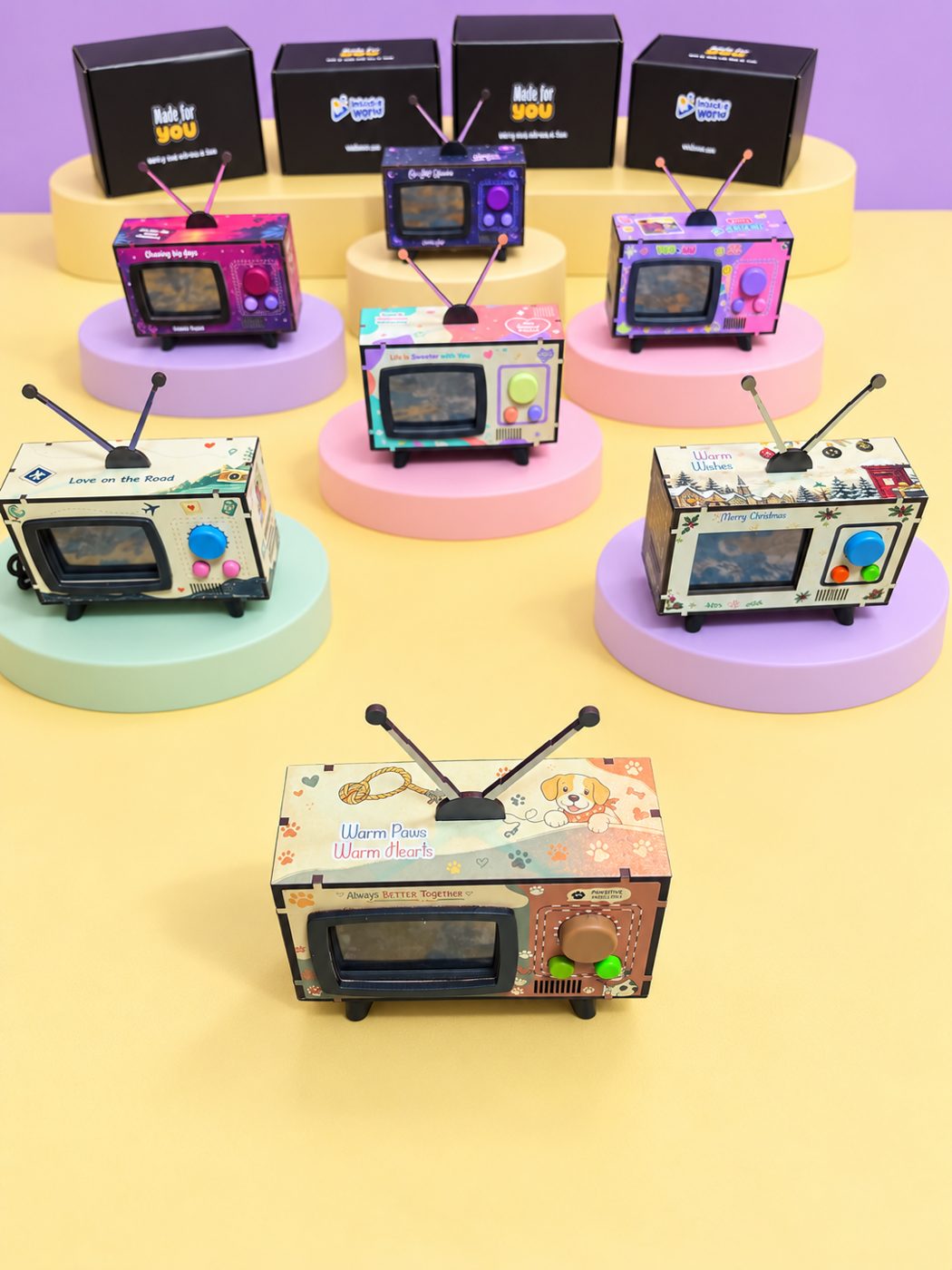
Ricky Flores is the founder of Watch N Wow and an electrical engineer with 15+ years of experience building consumer technology at Apple, Samsung, and Texas Instruments. In Dallas, Texas, he builds the Mini Memory TV by hand: a small retro TV that plays a video, a message and an original song made from your photos and your story. Read more at watchnwow.com.
Sources
- Alter, A. L., & Hershfield, H. E. (2014). “People search for meaning when they approach a new decade in chronological age.” Proceedings of the National Academy of Sciences, 111(48), 17066–17070. https://doi.org/10.1073/pnas.1415086111
- Demos, V., & Jache, A. (1981). “When you care enough: An analysis of attitudes toward aging in humorous birthday cards.” The Gerontologist, 21(2), 209–215. https://doi.org/10.1093/geront/21.2.209
- Levy, B. (2009). “Stereotype embodiment: A psychosocial approach to aging.” Current Directions in Psychological Science, 18(6), 332–336. https://doi.org/10.1111/j.1467-8721.2009.01662.x
- Levy, B. R., Slade, M. D., Kunkel, S. R., & Kasl, S. V. (2002). “Longevity increased by positive self-perceptions of aging.” Journal of Personality and Social Psychology, 83(2), 261–270. https://doi.org/10.1037/0022-3514.83.2.261
- Arnett, J. J. (2000). “Emerging adulthood: A theory of development from the late teens through the twenties.” American Psychologist, 55(5), 469–480. https://doi.org/10.1037/0003-066X.55.5.469
- Zhang, Y., & Epley, N. (2012). “Exaggerated, mispredicted, and misplaced: When ‘it’s the thought that counts’ in gift exchanges.” Journal of Experimental Psychology: General, 141(4), 667–681. https://doi.org/10.1037/a0029223