Table of Contents
Personalized Closing Gifts That Celebrate the Buyer, Not You
Personalized real estate closing gifts work when the buyer's name and milestone are the biggest thing on them. What research says, plus policy checks.
The keys change hands, everyone smiles for the photo, and the agent hands over a gift bag. Inside: a cutting board engraved with the agent’s logo, phone number and “Thank you for your business!” The buyers will use it. Every time they slice a lime, they’ll see an ad.
Personalized real estate closing gifts work best when the buyer is the biggest name on them. A closing gift is a thank-you and a celebration of someone else’s milestone. Research on brand prominence and sentimental value explains why the buyer-centered version gets kept, displayed and remembered, and why the agent-centered version often doesn’t.
Key Takeaways
- Ask whose name is biggest on the gift. If it’s the agent’s, it’s marketing, not a closing gift.
- People who don’t need to signal status tend to prefer subtle branding; loud logos make items less likely to be displayed (Han, Nunes & Drèze, 2010; Berger & Ward, 2010).
- Gifts tied to a shared moment carry sentimental value that recipients want more often than givers choose (Givi & Galak, 2017).
- Today’s buyers are older than they used to be: NAR’s 2025 profile put the median first-time buyer at 40 and the median repeat buyer at 62. Don’t assume a “starter” aesthetic.
- Check brokerage policy and referral rules before tying any gift to future business.
Why closing gifts drift toward the agent
Closing gifts sit in an awkward spot. They’re sincere thanks, and they’re also part of a business that runs on referrals. NAR reports that 91% of buyers would use their agent again or recommend them, which is exactly why agents want to be remembered.
That pressure shows up in the gift. Many popular closing-gift products are designed with space for the agent’s name, photo and contact details. NAR’s own roundup of personalized closing gift ideas (2023) mentions address stamps that can carry the agent’s name, logo and contact information so clients keep those details, next to ideas centered on the buyers, like a custom portrait of the home or a wine label with the family’s name and move-in year.
Both kinds of gift are on the market. The question is which one the buyer would choose to put on a shelf. An item covered in someone else’s contact details is easy to use and easy to forget, and just as easy to drop in a donation bag. Nobody is offended. They just don’t keep it.
What the research says about whose name belongs on the gift
Loud branding narrows who wants to display an item. Han, Nunes and Drèze (2010), in the Journal of Marketing, introduced “brand prominence,” the conspicuousness of a logo on a product. Wealthy consumers low in need for status preferred quiet goods with subtle marks; loud logos appealed mainly to people trying to signal status. Berger and Ward (2010), in the Journal of Consumer Research, found that high-end products were actually less likely to carry clear logos and that insiders prefer subtle markers. Neither study is about closing gifts. Both point the same direction: a prominent logo turns an object into a sign, and many people don’t want someone else’s sign in their home.
Sentimental value is undersupplied. Givi and Galak (2017), in the Journal of Consumer Psychology, found that givers choose preference-matching gifts more often than recipients would like and choose sentimentally valuable gifts (tied to shared events and relationships) less often than recipients would prefer. Givers felt less certain the sentimental option would land. A home purchase is one of the most memorable shared events an agent and client will have.
A clear occasion helps an elaborate gift read as sincere. Marchand, Holler and Dünschede (2024) found that elaborate brand gifts can raise suspicion of a persuasion attempt, and that a justifying occasion reduced that effect. Closing day is the occasion. Keeping the focus on it, rather than on the next referral, keeps the gift on the right side of that line.
Thoughtfulness shows up when the gift is specific. Zhang and Epley (2012), in the Journal of Experimental Psychology: General, found that recipients often don’t credit a giver’s thoughtfulness unless something prompts them to think about it. A gift that names the buyers, the house and the date does the prompting.
The buyers themselves have changed. NAR’s 2025 Profile of Home Buyers and Sellers found first-time buyers fell to a record-low 21% of purchases, with a median age of 40, and repeat buyers had a median age of 62. A closing gift designed for a twenty-something’s first apartment may miss a couple in their sixties who are downsizing.
Agent-centered vs buyer-centered closing gifts
The table shows the same gift ideas done two ways.
| Gift idea | Agent-centered version | Buyer-centered version | Why it matters |
|---|---|---|---|
| Engraved kitchen item | Agent’s logo and phone number | Family name and move-in year | Brand prominence (Han et al., 2010) |
| Home portrait | Agent’s logo in the corner | Just the house, maybe the street name if they want it | Display value |
| Address stamp | Agent’s contact details included | Only the buyers’ details | Daily-use item = daily ad |
| Welcome basket | Brokerage-branded everything | Local businesses near the new home | Ties to their new place |
| Card | Pre-printed “Thanks for your business” | Handwritten, names a moment from the search | Specificity (Zhang & Epley, 2012) |
| Photo keepsake | Agent in the closing photo, front and center | The buyers and their keys, agent optional | Whose milestone it is |
The buyer-centered column isn’t more expensive. It’s the same budget pointed at a different person.
What to actually do
Put the buyers’ name at the center
Whatever you choose, the biggest text should be their name, their house or their move-in year. Your name belongs on the card. Ask yourself whether they’d display it if you weren’t their agent; for a deeper look at the low, medium and heavy options, see how much branding belongs on a client gift.
Use what they told you during the search
You spent weeks hearing what they wanted: the kitchen they fell for, the backyard for the dog, the walk to the coffee shop. That’s the material. A gift that references the reason they chose this house beats anything generic.
Make the moment part of the gift
The keys photo, the date, the first night. Givi and Galak’s results suggest buyers value that link more than you’d expect. Our article on why gifts with a moment attached last longer explains the memory side of this.
Don’t assume who the buyers are
Not every buyer is a young couple. Some are single, some are multigenerational households, some are retirees. Base the gift on what you learned about these specific people, not on a “new homeowner” template.
Be careful with the address
A personalized address item is useful inside the home. A photo of the house with the street number, posted publicly, is a different matter. Ask before you share anything showing the house online. Our guide to a first-home memory gift covers the permission and privacy side.
Check brokerage policy and referral rules
A thank-you gift to your own client is common practice, but brokerages often have policies, and gifts tied to referrals can raise legal questions. Under RESPA Section 8 (12 CFR 1024.14), giving a “thing of value” for the referral of settlement service business is prohibited, and the regulation defines thing of value broadly. Keep the closing gift unconditional and ask your broker about anything connected to future referrals.
What not to do
Don’t attach an ask. A card that says “The best compliment is a referral!” turns the thank-you into a transaction at the exact moment it should feel like a celebration.
How to make it personal
If you have 10 minutes
Reread your notes or texts from the search and write down the one thing these buyers kept coming back to about this house. That’s the theme of the gift.
If you have a weekend
Ask the buyers if they’d like a photo of themselves with the keys or in front of the house, and turn it into something printed with their names and the move-in year, no logo.
If you want it to last years
Choose something tied to the house that will still make sense in ten years: a portrait of the home, a framed first-night photo, a keepsake with their names. Then mark the anniversary of closing with a short note, not a sales call.
The question to ask yourself: “If my name disappeared from this gift, would it still be a gift?”
Frequently asked questions
What is a good personalized closing gift for buyers?
Something with the buyers’ names, their home or their move-in year at the center, connected to what they loved about the house. A custom portrait of the home, a family-name keepsake or a framed keys photo works. Keep your branding to the card so the gift is about their milestone.
Should realtors put their logo on closing gifts?
Keep it small. Research on brand prominence suggests prominent logos make items less appealing to display for many people (Han et al., 2010). A logo on the card, the tag or the packaging is enough for buyers to remember who it’s from without turning the gift into an ad.
How much do realtors spend on closing gifts?
There’s no reliable standard figure. Budget by relationship and check your brokerage’s policy. For tax purposes, the IRS limits business-gift deductions to $25 per recipient per year, with spouses treated as one taxpayer; ask your accountant how that applies to you. A specific, buyer-centered gift doesn’t need to be expensive.
Is a closing gift required?
No. It’s a common practice, not an obligation, and buyers don’t expect one in every transaction. If you give one, make it unconditional and about them. A handwritten note naming a moment from the search can be as meaningful as an object.
About the author
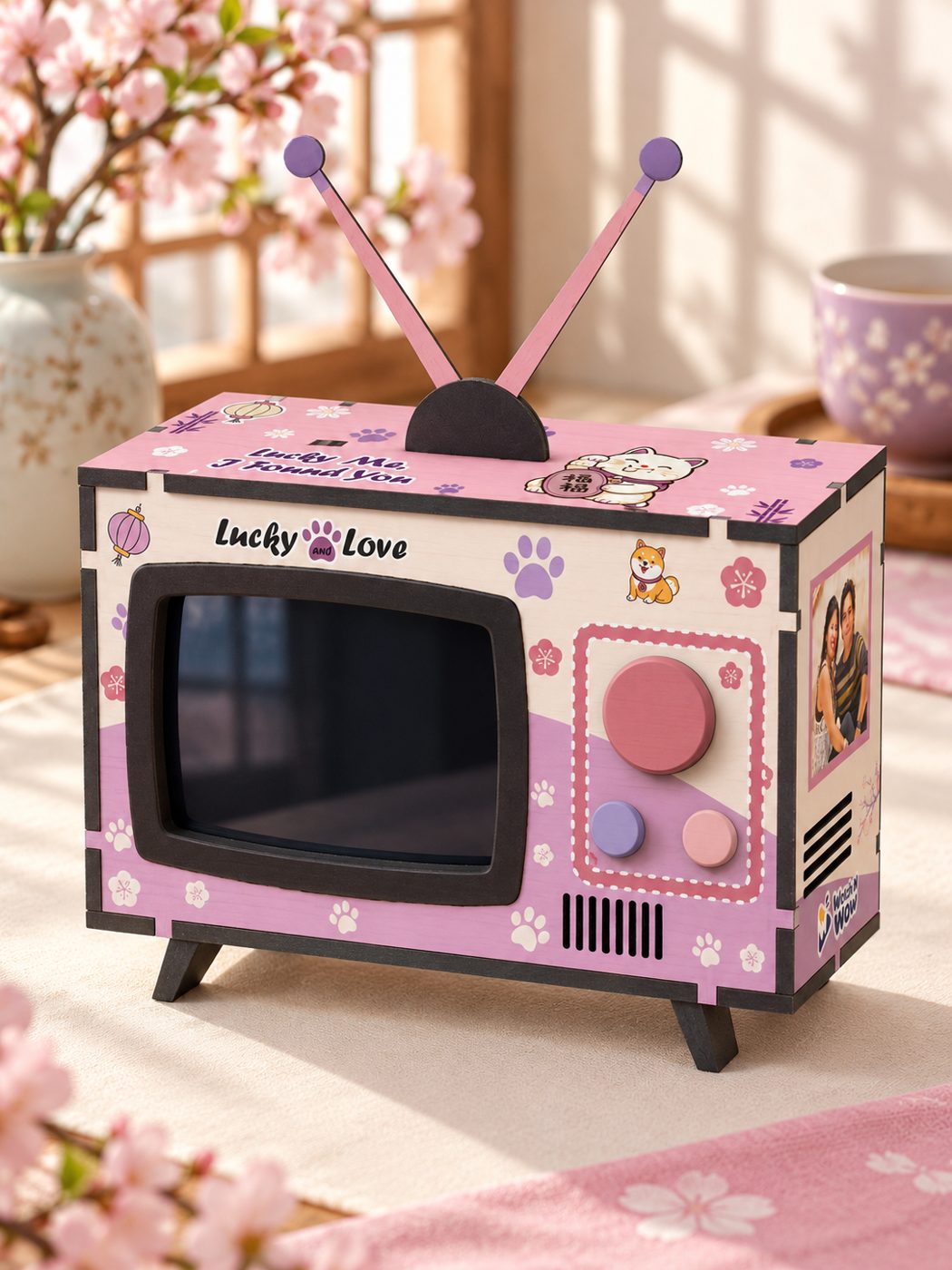
Ricky Flores is the founder of Watch N Wow and an electrical engineer with 15+ years of experience building consumer technology at Apple, Samsung, and Texas Instruments. In Dallas, Texas, he builds the Mini Memory TV by hand: a small retro TV that plays a video, a message and an original song made from your photos and your story. Read more at watchnwow.com.
Sources
- Han, Y. J., Nunes, J. C., & Drèze, X. (2010). “Signaling status with luxury goods: The role of brand prominence.” Journal of Marketing, 74(4), 15–30. https://doi.org/10.1509/jmkg.74.4.015
- Berger, J., & Ward, M. (2010). “Subtle signals of inconspicuous consumption.” Journal of Consumer Research, 37(4), 555–569. https://doi.org/10.1086/655445
- Givi, J., & Galak, J. (2017). “Sentimental value and gift giving: Givers’ fears of getting it wrong prevents them from getting it right.” Journal of Consumer Psychology, 27(4), 473–479. https://doi.org/10.1016/j.jcps.2017.06.002
- Marchand, A., Holler, A., & Dünschede, T. (2024). “Consumer perceptions of influencer gifting.” Psychology & Marketing, 41(10), 2342–2354. https://doi.org/10.1002/mar.22058
- Zhang, Y., & Epley, N. (2012). “Exaggerated, mispredicted, and misplaced: When ‘it’s the thought that counts’ in gift exchanges.” Journal of Experimental Psychology: General, 141(4), 667–681. https://doi.org/10.1037/a0029223
- National Association of REALTORS® (2025). “First-Time Home Buyer Share Falls to Historic Low of 21%, Median Age Rises to 40.” https://www.nar.realtor/newsroom/first-time-home-buyer-share-falls-to-historic-low-of-21-median-age-rises-to-40
- Dittmann Tracey, M. (2023). “10 Clever Ideas for Personalized Closing Gifts.” REALTOR® News, National Association of REALTORS®. https://www.nar.realtor/news/real-estate-news/sales-marketing/10-clever-ideas-for-personalized-closing-gifts
- Consumer Financial Protection Bureau. Regulation X, 12 CFR 1024.14, Prohibition against kickbacks and unearned fees. https://www.consumerfinance.gov/rules-policy/regulations/1024/14/
- Internal Revenue Service. Publication 463, Travel, Gift, and Car Expenses (Chapter 3, Gifts). https://www.irs.gov/publications/p463