Table of Contents
What to Include in a Personalized Song So It Sounds Like Them
What to include in a personalized song: concrete habits, places and moments beat praise. What memory research says about details that make it feel like theirs.
You have a blank form open. It asks for a name, an occasion and “a few things about them.” You type “kind, funny, the best mom ever,” look at it, and feel the problem before you can name it. Every mom in the country could be described that way.
What to include in a personalized song comes down to one rule: give the song details that could only belong to this person. A habit (she hums while she cooks), a place (the porch on Beckley Avenue), a phrase they always say, and one moment that changed something. A name in the chorus is only the start. The rest of this article explains why specific details carry so much weight, and how to collect the right ones.
Key Takeaways
- Concrete details (habits, places, repeated phrases, one specific moment) do more work in a song than adjectives like “kind” or “amazing”.
- Memory research consistently finds that information linked to the self is remembered better; a detail the listener recognizes as theirs gets that advantage.
- Hearing your own name triggers distinct brain activity, but a name alone does not make a song personal; the details around it do.
- Givers tend to avoid sentimental specifics because they feel riskier, yet recipients often prefer sentimental gifts.
- Repeated lines and early lines are the ones listeners remember, so put the most personal detail where it will repeat.
Why “kind, funny and amazing” makes a song sound like anyone
The most common complaint about personalized songs is that they sound like a template with a name pasted in. Usually that is not the songwriter’s fault, or the software’s. It is the brief. When the input is a list of compliments, the output is a list of compliments set to music, and compliments are interchangeable.
Read through gift forums and you’ll find the same frustration from the giver’s side: “I don’t know what to write,” “I’m not a writer,” “I just put that he’s a great dad.” People reach for praise because it feels safe. Praise can’t be wrong. A detail can be: maybe she doesn’t remember the porch, maybe the nickname is embarrassing now.
But praise has a cost. A song is short, usually a few verses and a chorus repeated three or four times. Every line spent on “you’re always there for me” is a line not spent on the Tuesday night you drove four hours because her car broke down outside Amarillo. The second line tells the listener what “always there” meant. The first only asks them to take your word for it.
The useful shift is from describing the person to pointing at evidence. Not “she’s generous” but “she still sends twenty dollars in every birthday card, even to the grandkids who are thirty.” Specific details are what make a listener think: that’s me, and nobody else.
What the research actually says
No study has tested personalized gift songs directly. What exists is a solid body of memory and gift research that explains why some details land and others slide past. The findings below come from lab studies, mostly with university students, so treat them as mechanisms rather than guarantees.
Information tied to the self is remembered better
In a classic 1977 experiment in the Journal of Personality and Social Psychology, Rogers, Kuiper and Kirker asked people to judge adjectives in different ways: how the word looked, how it sounded, what it meant, or whether it described them. Words judged in relation to the self were recalled best. The authors concluded that the self acts as a powerful organizing structure for incoming information.
Two decades later, Symons and Johnson pooled the research in a 1997 meta-analysis in Psychological Bulletin and confirmed the self-reference effect in memory. They noted it was smaller when compared against thinking about another person, and they attributed it to the self being a well-developed, frequently used structure that helps people elaborate and organize new material.
For a song, the practical reading is simple. A line that the listener immediately connects to their own life (“the blue truck with the broken radio”) is processed through the richest filing system they have. A generic line is filed with every other generic line.
Your own name gets special treatment, but it is a doorway
Carmody and Lewis (2006, Brain Research) used fMRI to compare responses to hearing one’s own first name versus other names. Several left-hemisphere regions responded more strongly to the person’s own name. The name gets attention. (For the wider science of why music reaches memory, see why a song with your name in it hits different.)
That is why names in choruses work as hooks. But attention is not the same as meaning. Once the name has the listener’s ear, the next line has to give them something only they would recognize. A name surrounded by generic praise is a door that opens onto an empty room.
Givers avoid sentimental details because they feel risky
Givi and Galak (2017, Journal of Consumer Psychology) found across three studies that givers often choose gifts that match a recipient’s stated preferences over sentimentally valuable ones, even when recipients would prefer the sentimental option. The reason: givers feel confident that a preference-matched gift will be liked, and uncertain about a sentimental one.
Writing a song brief triggers the same fear. “She hums Selena songs while she makes tamales” feels exposed. “She loves music and cooking” feels safe. The research suggests the safe version is the one more likely to disappoint.
Thought only counts when the receiver can see it
Zhang and Epley (2012, Journal of Experimental Psychology: General) found that a giver’s thoughtfulness shapes appreciation mainly when something prompts the receiver to think about the giver’s mindset. Givers tend to misjudge when their effort will register. In a song, specificity is that prompt. A detail only someone paying attention could know makes the effort visible without anyone having to explain it.
Repetition and position decide what sticks
Hyman and Rubin (1990, Memory & Cognition) asked students to recall Beatles songs from cues. The best predictors of whether a line was remembered were how often it repeated and how early it appeared. Participants recalled about 21% of lines overall, but the repeated ones dominated.
For a personalized song, this is a placement rule. The single most personal detail belongs in the chorus or the opening lines, not buried in verse two.
Which details do the most work in a song
Here is a comparison of the detail types people usually put in a song brief, scored by how much they distinguish the person and where the research above suggests they belong.
| Detail type | Example | Distinguishes the person? | Best place in the song | Research link |
|---|---|---|---|---|
| Name | ”Marisol” | Gets attention, little meaning alone | Chorus | Carmody & Lewis, 2006 |
| Praise adjective | ”kind, strong, amazing” | Rarely | Use sparingly, or cut | (no specific benefit found) |
| Habit or ritual | ”hums while making tamales” | Strongly | Verse, as a scene | Rogers et al., 1977 |
| Place | ”the porch on Beckley Avenue” | Strongly | Verse or bridge | Symons & Johnson, 1997 |
| Repeated phrase | ”Ay, no, otra vez” | Very strongly | Chorus hook | Hyman & Rubin, 1990 |
| One turning-point moment | ”the night the car died outside Amarillo” | Strongly | Bridge | Givi & Galak, 2017 |
| Shared future wish | ”next summer, the beach in Galveston” | Moderately | Final chorus | Common songwriting practice |
The pattern is clear: the details that distinguish someone are concrete and checkable. Adjectives sit at the bottom because they describe a category of person, not this person. If your brief is mostly adjectives, convert each one into the evidence behind it.
What to actually do
Turn every adjective into a scene
Take each compliment and ask, “How do I know?” “Generous” becomes “pays for everyone’s tacos and pretends he forgot his wallet next time so you can pay.” That converted line carries self-relevant detail the listener will recognize instantly, which is the self-reference effect doing its job.
Collect three kinds of detail: a habit, a place, a phrase
These three are the easiest to find and the hardest to fake. A habit shows who they are on an ordinary day. A place grounds the song in real geography. A phrase, especially one in their own words, is the strongest candidate for a hook because listeners remember repeated lines.
Pick one moment, not ten
A song can carry one story well. Choose the moment that changed something: the first apartment, the diagnosis they got through, the day the baby came home. Leave the rest for the card or the video. Trying to fit a whole biography turns lyrics into a list. If you want a fill-in worksheet for this, use our custom song brief template for non-writers.
Put the most personal detail where it repeats
Because repeated and early lines are remembered best, tell whoever writes the song (a person or a tool) which detail is most important, and ask for it in the chorus or first lines.
Check details with someone who knows them
Before you send the brief, run the details past a sibling or friend. Are the facts right? Is the nickname still welcome? This takes five minutes and avoids the most painful kind of mistake: a wrong detail sung out loud.
What not to do
Don’t include private details the person wouldn’t want played at a party (health, money, old relationships) unless the song is for a private listen and you’re sure. And don’t stack inside references so densely that the rest of the family is lost; one or two per song is plenty.
How to make it personal
If you have 10 minutes
Write down three things: one thing they do every day, one place that belongs to them, and one sentence they always say. Use their exact words for the sentence. That’s already a better brief than most.
If you have a weekend
Ask two people who know them well, “What’s one thing she does that nobody else does?” Record their answers as voice notes so you keep the phrasing. Pick the one moment that changed something and write it as three plain sentences: where, what happened, why it mattered.
If you want it to last years
Keep the brief. Print it, date it in the corner, and store it with the song file. Years from now, the list of habits and phrases you collected will be its own record of who this person was at this point in their life.
The question to ask yourself: “If I read this line to a stranger, would they know it’s about her, or could it be about anyone?”
Frequently asked questions
What should I write about someone for a custom song?
Write evidence, not compliments: a daily habit, a place connected to them, a phrase they always say, and one moment that mattered. Memory research on the self-reference effect suggests listeners process details tied to their own lives more deeply, so concrete specifics make the song feel like theirs.
How many details should a personalized song include?
Fewer than you think. Three to five strong details usually fill a song, with one standout detail repeated in the chorus. Songs are short, and Hyman and Rubin’s research found repeated and early lines are remembered best, so a long list dilutes the lines that matter.
Is it enough to put their name in the song?
A name catches attention; Carmody and Lewis (2006) found one’s own name triggers distinct brain activity. But a name surrounded by generic praise still sounds generic. The surrounding details are what make the listener feel the song could only be about them.
What if my person is private and wouldn’t like personal details in a song?
Use details that are specific but not exposing: a favorite chair, a morning ritual, a place you went together. Specific doesn’t have to mean secret. Ask yourself whether they would be comfortable hearing the song with family in the room.
Should I include inside jokes in a personalized song?
One, if it can be understood with a little context. A joke only two people understand can leave everyone else confused, so give it a setup line. Our guide to describing an inside joke for a song covers how.
About the author
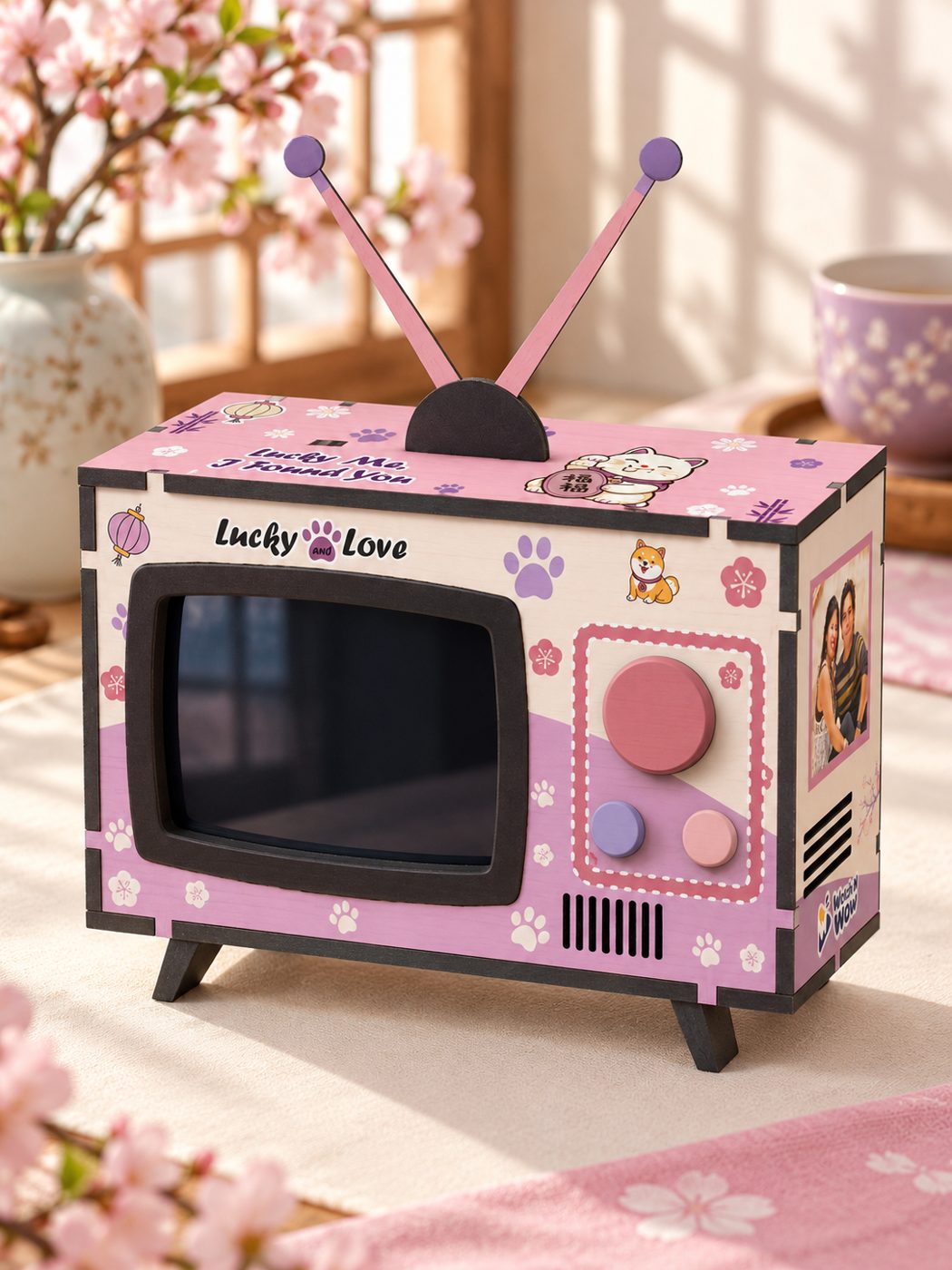
Ricky Flores is the founder of Watch N Wow and an electrical engineer with 15+ years of experience building consumer technology at Apple, Samsung, and Texas Instruments. In Dallas, Texas, he builds the Mini Memory TV by hand: a small retro TV that plays a video, a message and an original song made from your photos and your story. Read more at watchnwow.com.
Sources
- Rogers, T. B., Kuiper, N. A., & Kirker, W. S. (1977). “Self-reference and the encoding of personal information.” Journal of Personality and Social Psychology, 35(9), 677–688. https://doi.org/10.1037/0022-3514.35.9.677
- Symons, C. S., & Johnson, B. T. (1997). “The self-reference effect in memory: A meta-analysis.” Psychological Bulletin, 121(3), 371–394. https://doi.org/10.1037/0033-2909.121.3.371
- Carmody, D. P., & Lewis, M. (2006). “Brain activation when hearing one’s own and others’ names.” Brain Research, 1116(1), 153–158. https://doi.org/10.1016/j.brainres.2006.07.121
- Givi, J., & Galak, J. (2017). “Sentimental value and gift giving: Givers’ fears of getting it wrong prevents them from getting it right.” Journal of Consumer Psychology, 27(4), 473–479. https://doi.org/10.1016/j.jcps.2017.06.002
- Zhang, Y., & Epley, N. (2012). “Exaggerated, mispredicted, and misplaced: When ‘it’s the thought that counts’ in gift exchanges.” Journal of Experimental Psychology: General, 141(4), 667–681. https://doi.org/10.1037/a0029223
- Hyman, I. E., Jr., & Rubin, D. C. (1990). “Memorabeatlia: A naturalistic study of long-term memory.” Memory & Cognition, 18(2), 205–214. https://doi.org/10.3758/BF03197096