Table of Contents
Sentimental Gifts Without Clutter: Four Options Compared
Sentimental gifts without clutter: how a letter, an experience, a digital keepsake and one small display piece compare on space, meaning and how long they last.
Your sister just finished a weekend of decluttering. Four bags went to the donation center, the hall closet has visible floor for the first time in years, and she sent the family group chat a photo of her empty shelves with three celebration emojis. Her birthday is in two weeks. You want to give her something that means something. You also want to stay in the family.
Sentimental gifts without clutter are possible because a memory doesn’t need a big object to live in. A letter, a shared experience, a digital keepsake with a real home, or one small piece chosen for one specific spot can carry as much meaning as a box of things, and the research on clutter and on how people let go of sentimental possessions explains why.
Key Takeaways
- In a Morning Consult survey for Michaels, 54% of US adults said their household had “more stuff than it needs.” Many recipients are actively trying to own less.
- How people describe their homes tracks their stress: wives whose home tours used more clutter words had flatter daily cortisol slopes and more depressed mood over the day (Saxbe & Repetti, 2010).
- Taking a photo of a sentimental possession made people more willing to donate it, because the photo preserved the memory and the sense of self tied to it (Winterich, Reczek & Irwin, 2017).
- Digital keepsakes have a weakness: people value digital goods less than physical versions, largely because they feel less ownership over them (Atasoy & Morewedge, 2018). Give a digital gift a physical anchor.
- The four clutter-free options (letter, shared experience, digital keepsake, one small display piece) each suit a different person. The table below shows which.
When personal starts to mean “one more thing to store”
“I love her, but where am I supposed to put a framed collage?” That’s the honest version of a question gift threads keep circling. Others: “My parents are downsizing, what do I get them?” “My partner is a minimalist and I’m sentimental.” “Every personalized gift I get is a mug with my name on it, and I have eleven mugs.”
The tension is real, and it isn’t a moral failing on either side. Sentimental people want the gift to mean something; the people receiving gifts increasingly want fewer objects. In Morning Consult’s holiday survey for Michaels, 54% of adults said their household already had more stuff than it needs, and 65% said they wanted a less commercial season.
The usual shortcut to “personal” makes this worse. Put a name on a thing, and you’ve made the thing harder to give away. A personalized cutting board can’t be regifted, donated without guilt, or tucked into a drawer without the recipient feeling a little bad about it. You’ve created something they can’t throw away and may not want to keep.
The way out isn’t to stop being sentimental. It’s to separate the memory from the object. A memory can live in a page of handwriting, in an afternoon, in a file with a real place to play, or in one small object chosen for a spot that already exists in their home. Each of those carries meaning without asking for a new shelf.
What the research says about clutter and keepsakes
Clutter shows up in how people talk about home, and in their stress. Darby Saxbe and Rena Repetti analyzed self-guided home tours from 60 dual-income spouses, published in Personality and Social Psychology Bulletin. They counted words about clutter and unfinished projects (“stressful home”) and words about rest and nature (“restorative home”). Over the following three weekdays, wives with higher stressful-home scores had flatter cortisol slopes across the day, a pattern associated with poorer health, and more depressed mood as the day went on; wives with more restorative descriptions showed the opposite. The results held after controlling for marital satisfaction and neuroticism. The limits matter: this was a small, correlational study, the clear effects were in women, and it measured how people described their homes, not how much stuff they owned. Still, it suggests that for some recipients, a home that feels full is a burden, not a backdrop.
A memory can outlive the object. Karen Winterich, Rebecca Reczek and Julie Irwin, in the Journal of Marketing (2017), asked why people hold on to sentimental possessions they no longer use. Their answer: letting go of the object feels like losing a piece of identity. In a field study at a donation drive, encouraging people to photograph sentimental items before donating them increased donations, and five lab experiments showed why. Preserving the memory, for example with a photo, reduced the sense of identity loss. For a gift giver, this is the key finding. What people want to keep is the memory and what it says about them. The object is often just the container.
Digital memories are valued less, unless they feel owned. Ozgun Atasoy and Carey Morewedge ran five experiments, reported in the Journal of Consumer Research (2018), comparing physical and digital versions of the same goods, including souvenir photographs, books and films. People paid more for, and were more willing to buy, the physical versions. The reason was psychological ownership: physical things more easily become “mine.” When the researchers increased feelings of ownership and control over the digital version, the gap narrowed. That’s a useful warning and a useful fix. A link in a text message is easy to forget; a digital keepsake with a clear place to live and something to hold or press is closer to owned. Our piece on why a gift you can hold lands differently goes deeper into that study.
Experiences don’t take shelf space, and they strengthen the relationship. Cindy Chan and Cassie Mogilner’s Journal of Consumer Research studies of real gift exchanges found experiential gifts improved relationship strength more than material gifts, driven by the emotion felt during the experience itself. For someone who wants to own less, an experience is the obvious candidate, with one caveat: once it’s over, nothing reminds them of it unless something small stays behind. Our article on gifts with a moment attached covers that before, during and after pattern.
Letters are lighter than they look, and land better than expected. Amit Kumar and Nicholas Epley’s 2018 experiments found that people writing gratitude letters underestimated how positive recipients would feel and overestimated the awkwardness. A letter is a single sheet of paper. It’s the lightest keepsake there is.
Four clutter-free sentimental gifts, compared
Here is how the four options compare on what matters for someone who wants to own less.
| Option | Space it takes | What carries the meaning | Where it fails | Best for |
|---|---|---|---|---|
| A handwritten letter | One sheet, fits in a drawer or a book | Specific memories in your words and handwriting | Vague letters (“you’re the best”) feel generic | Anyone, especially people who reread things |
| A shared experience | None, unless you add a small reminder | The emotion during the time together (Chan & Mogilner) | Fades without a trace; can be hard to schedule | People who value time over things |
| A digital keepsake (video, song, photo story) | None on shelves; needs a device or a home | Faces, voices, music, moments in motion | Valued less if it’s only a link (Atasoy & Morewedge); can get lost | People who already watch and share videos, with a plan for where it lives |
| One small display piece | A single spot you’ve picked in advance | One image or object tied to one moment | Becomes clutter if there’s no spot for it | People with one shelf, desk or nightstand that matters to them |
Read down the “where it fails” column and a pattern appears. Each option fails when it has no home: the letter with nothing specific in it, the experience with nothing left behind, the video with no place to play, the object with no spot. Clutter isn’t about how sentimental a gift is. It’s about whether it has somewhere to belong.
What to actually do
Find the spot before you choose the gift
Picture the recipient’s home. Is there a nightstand, a desk, a kitchen windowsill, a bookshelf with one gap, a phone they look at all day? Choose the gift to fit that spot. If you can’t name a spot, choose a letter or an experience.
Write the letter, and make it specific
One page. One or two moments, each with a place and a time. What they did, what it meant, what you still think about. Kumar and Epley’s writers worried about awkwardness that mostly didn’t happen. Tuck it into a book they love, so it lives where they’ll find it again.
Give an experience with one small thing left behind
A dinner, a concert, a morning at the market, a drive to the place they grew up. Then leave one small trace: a printed photo from the day, the ticket stub in a card, a recipe card for the dish you ate. That’s the experience plus a reminder, without a box.
Give a digital keepsake a physical anchor
If you make a video, a photo story or a song, don’t just send the link. Atasoy and Morewedge found ownership closes the value gap, so give it something to hold: a printed QR card in a frame, a USB drive in a small envelope, a device that plays only that, or a scheduled moment to watch it together. Tell them where it lives and how to play it again.
If you choose an object, make it the only object
One small display piece, chosen for one spot, tied to one moment. A single framed photo for the desk, not a collage for a wall they don’t have. Winterich’s work suggests the memory is what matters; one strong container beats five weak ones.
What not to do
Don’t put their name on something just to make it personal; names make objects harder to let go of. Don’t assume a minimalist wants nothing; many want fewer, better things. And don’t give a sentimental gift that requires storage, assembly or a new piece of furniture.
How to make it personal
If you have 10 minutes
Write down three moments with this person, each with a place. Pick one and write two sentences about it. That’s the core of a letter, a caption for a photo, or the starting point for an experience.
If you have a weekend
Write the full letter by hand. Or plan a specific half-day together and book it. Or gather 10 to 15 photos of the two of you into a short slideshow with one song, and decide exactly where and how they’ll watch it.
If you want it to last years
A clutter-free keepsake lasts when it has a home, their name or face in it, one moment attached and something to reread or replay. A letter kept in a favorite book does all four. So does one framed photo on the nightstand, or a short video with a clear place to play it.
The question to ask yourself: “Do I know exactly where this will live in their home, and would they choose to keep it there?”
Frequently asked questions
What is a sentimental gift that doesn’t take up space?
A handwritten letter, a shared experience, or a digital keepsake like a short video or photo story. A letter is the lightest: one page that fits in a drawer or a book. Experiences take no space and strengthened relationships more than material gifts in Chan and Mogilner’s (2017) studies; add one printed photo afterward so something remains.
What do you get a minimalist who is also sentimental?
One small thing tied to one moment, chosen for a spot they already have, or nothing physical at all. A letter, a planned day together, or a single framed photo for a desk usually works. Avoid collections, sets and anything with their name on it that they’d feel guilty giving away.
Are digital gifts less meaningful than physical ones?
They can be. Atasoy and Morewedge (2018) found people valued digital versions of photos, books and films less than physical ones, mostly because they felt less ownership. The fix is to make the digital gift feel owned: give it a physical anchor, a clear place to play, and a moment to watch it together.
How do I declutter without losing the memories?
Photograph sentimental items before you let them go. Winterich, Reczek and Irwin (2017) found that preserving the memory with a photo reduced the feeling of losing part of yourself and made people more willing to donate. The same idea works in reverse for gifts: give the memory, not more objects.
Is a photo gift clutter?
It depends on where it goes. One photo printed well for a specific spot is a keepsake. A box of prints with no plan becomes clutter. If you have many photos, choose a few, or turn them into a short video that lives in one place. See our guide to meaningful gifts on a budget for low-cost ways to do this.
About the author
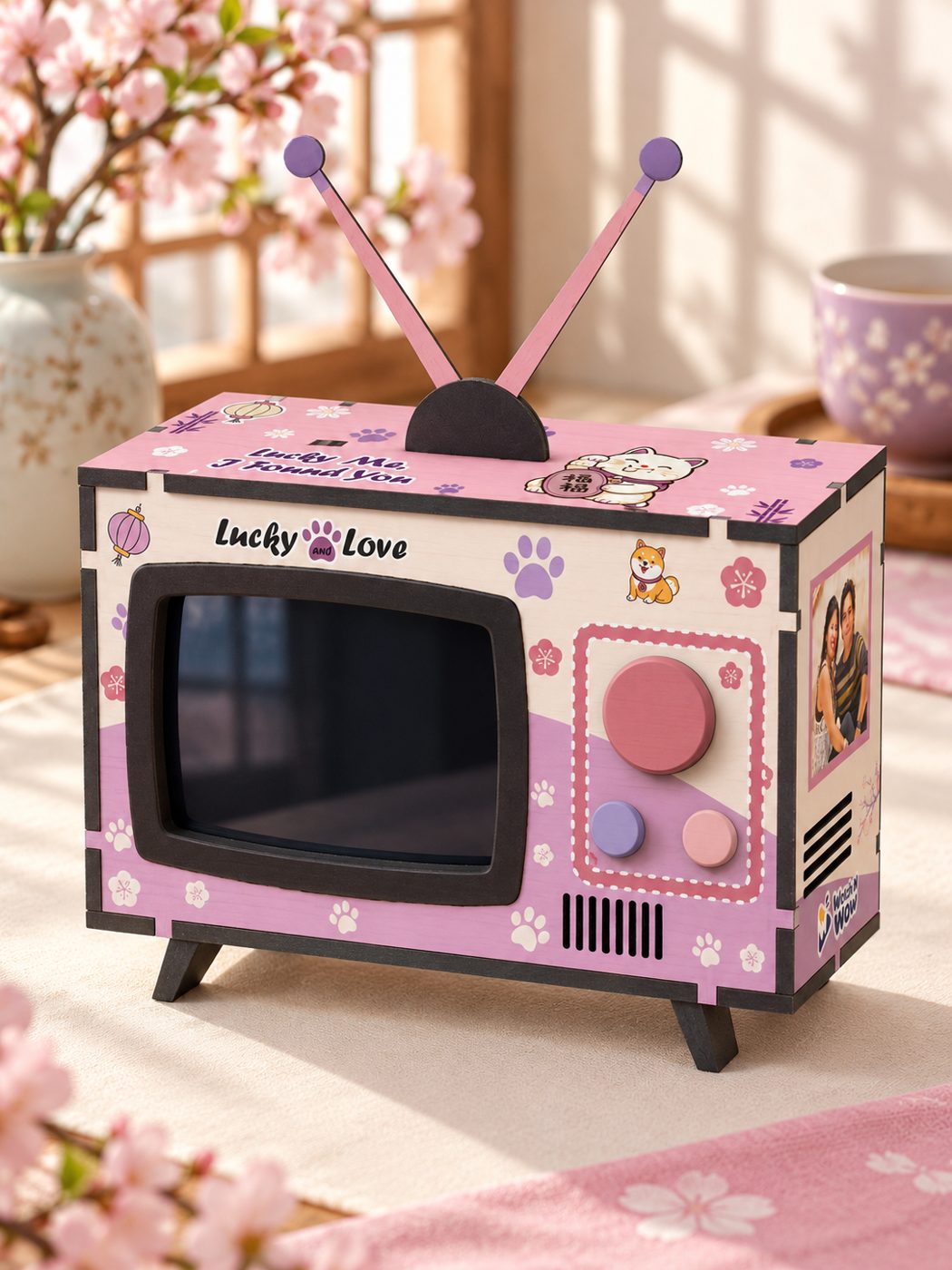
Ricky Flores is the founder of Watch N Wow and an electrical engineer with 15+ years of experience building consumer technology at Apple, Samsung, and Texas Instruments. In Dallas, Texas, he builds the Mini Memory TV by hand: a small retro TV that plays a video, a message and an original song made from your photos and your story. Read more at watchnwow.com.
Sources
- Saxbe, D. E., & Repetti, R. (2010). “No place like home: Home tours correlate with daily patterns of mood and cortisol.” Personality and Social Psychology Bulletin, 36(1), 71–81. https://doi.org/10.1177/0146167209352864
- Winterich, K. P., Reczek, R. W., & Irwin, J. R. (2017). “Keeping the memory but not the possession: Memory preservation mitigates identity loss from product disposition.” Journal of Marketing, 81(5), 104–120. https://doi.org/10.1509/jm.16.0311
- Atasoy, O., & Morewedge, C. K. (2018). “Digital goods are valued less than physical goods.” Journal of Consumer Research, 44(6), 1343–1357. https://doi.org/10.1093/jcr/ucx102
- Chan, C., & Mogilner, C. (2017). “Experiential gifts foster stronger social relationships than material gifts.” Journal of Consumer Research, 43(6), 913–931. https://doi.org/10.1093/jcr/ucw067
- Kumar, A., & Epley, N. (2018). “Undervaluing gratitude: Expressers misunderstand the consequences of showing appreciation.” Psychological Science, 29(9), 1423–1435. https://doi.org/10.1177/0956797618772506
- Michaels / Morning Consult (2026). “State of the Holiday Season” report. https://www.michaelspressroom.com/news/detail/5110/michaels-state-of-the-holiday-season-report-consumers